


Wall Street finished Friday with a welcome rally, but a rebound isn't the same as a repaired market. The Nasdaq Composite gained roughly 1.2% on the day while the S&P 500 and Dow also advanced. Across the week however, the S&P and Dow lost ground while technology led. That distinction matters, as while a softer jobs report has eased immediate tightening fears, we are nowhere near to resolving the pressures facing the wider market.
Domestically, September payrolls increased by just 29,000, with unemployment at 4.2% and combined downward revisions of 60,000 to July and August. Those are reasons for monetary policymakers to proceed carefully, but they also raise questions about future demand. A market that welcomes weaker hiring as rate relief must eventually confront what that hiring says about revenues. Low weekly unemployment claims and sluggish job creation can coexist; firms can avoid dismissals while becoming reluctant to expand.
Inflation offers a similarly divided picture. August core PCE rose 0.2% month on month and 3.0% year on year, while real consumer spending increased 0.6% during the month. That combination supports the possibility of continued spending alongside slower underlying inflation, but it does not settle the consequences of more recent energy disruption, nor guarantee that long-term borrowing costs will follow near-term policy expectations lower. The consumer and the bond market are reacting to different parts of the same economy.
Energy policy has now provided a concrete counterweight to the supply shock. Friday's G7 statement commits to a coordinated 100-million-barrel release over four months, with substantial diesel supply frontloaded into the first 20 days. It also reaffirms opposition to energy export restrictions between G7 countries. This is a commitment to implementation, not proof that the fuel has already reached users or that Hormuz disruption has ended, and suggests panic rather than a solution. Delivery and refinery capacity remain the test.
Our macro dashboard gives us another reason to be selective. Its S&P 500 breadth score is 28.1, classified Weak, as of 2 October; sentiment is 52.7, classified Neutral. Only 24.7% of constituents are above their 50-day moving averages. These are weak scores but no washout has yet occurred, and Friday's advance therefore sits inside a market with fragile foundations, and if the rally does continue we would want to see strength spread beyond the companies already doing most of the work.
There's a reasonable bullish counterargument: strong earnings can support equities even as yields rise, and cash leaving the bond markets may find a new home in equities. Internationally there is much trepidation in Europe over the prospect of war with Russia, with the Hormuz crisis still very much a factor as we move into the winter months, and that scared money will likely look for the safe haven in the US markets.
During the next week we will see if relief can become resilience. Monday brings services PMI, Tuesday international trade, Wednesday the September Fed minutes and energy inventories, and Friday preliminary Michigan sentiment. PepsiCo's Thursday results provide an important consumer read-through. There is no scheduled FOMC decision this week.
US indices: a rebound needs more participants
(Reported COT, 22–29 September). In E-mini S&P 500 futures, Leveraged Funds added 5,320 longs and 2,235 shorts. Their net position improved by 3,085 contracts to −372,489, from −375,574. This is modestly less bearish exposure, with additional long accumulation exceeding new shorting. It remains a substantial net short position, at −19.65% of open interest and a 23.4 four-year signed net-position percentile, and suggests there is fuel for a rally.
Exposure has improved a little, but it's still some distance from outright bullish positioning, and the neighbouring contracts qualify that improvement. Nasdaq-100 Leveraged Funds reduced both sides, with larger short reductions, and remained net short at −24,723 contracts despite a 69.9 percentile. Russell 2000 funds increased net shorts, reaching −114,554 contracts.
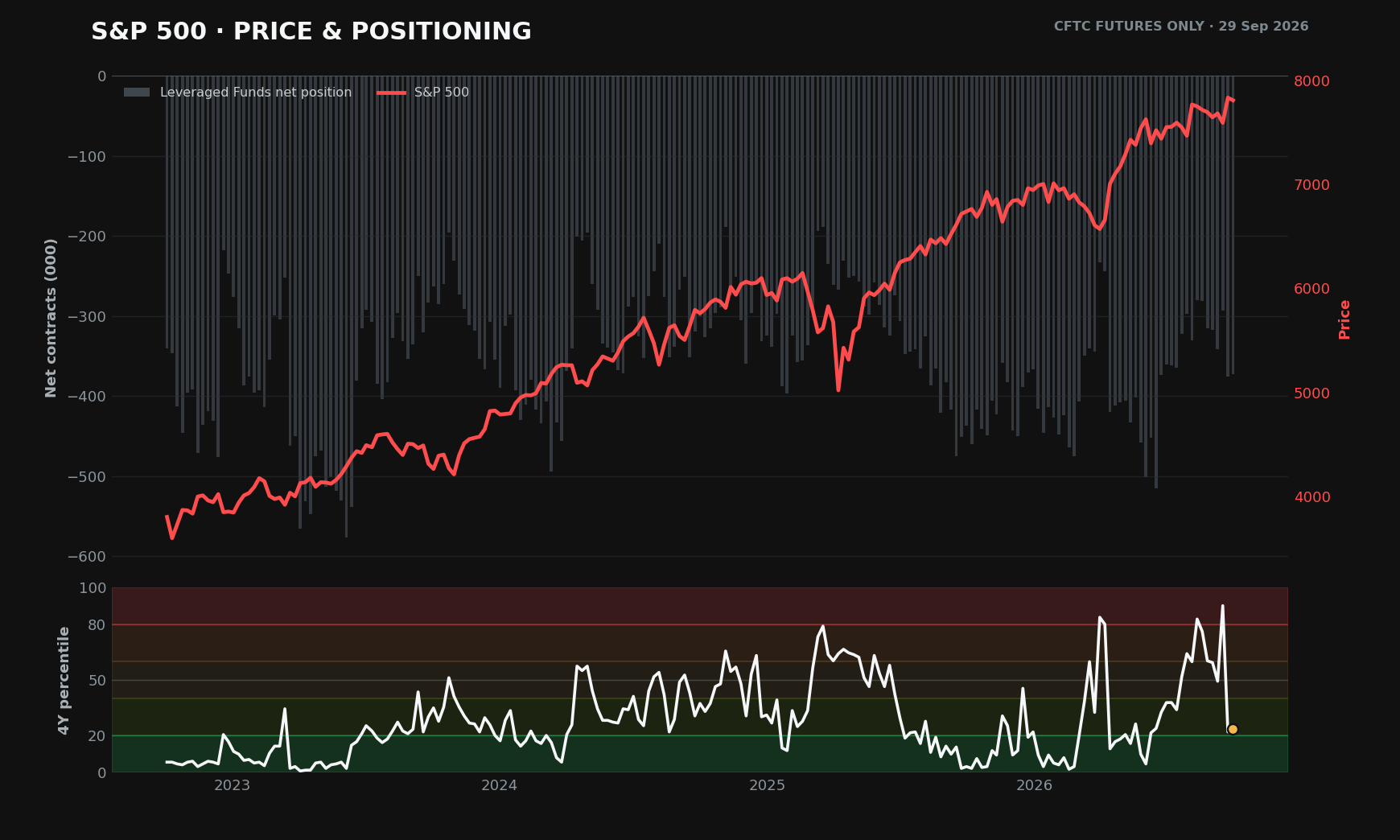
From Wednesday 30 September to Friday 2 October, technology held up, Thursday's action held support and Friday gave us the advance. That pattern is consistent with selective buying and possibly some short covering, but it can't establish which trader category bought or whether new longs survived the close.
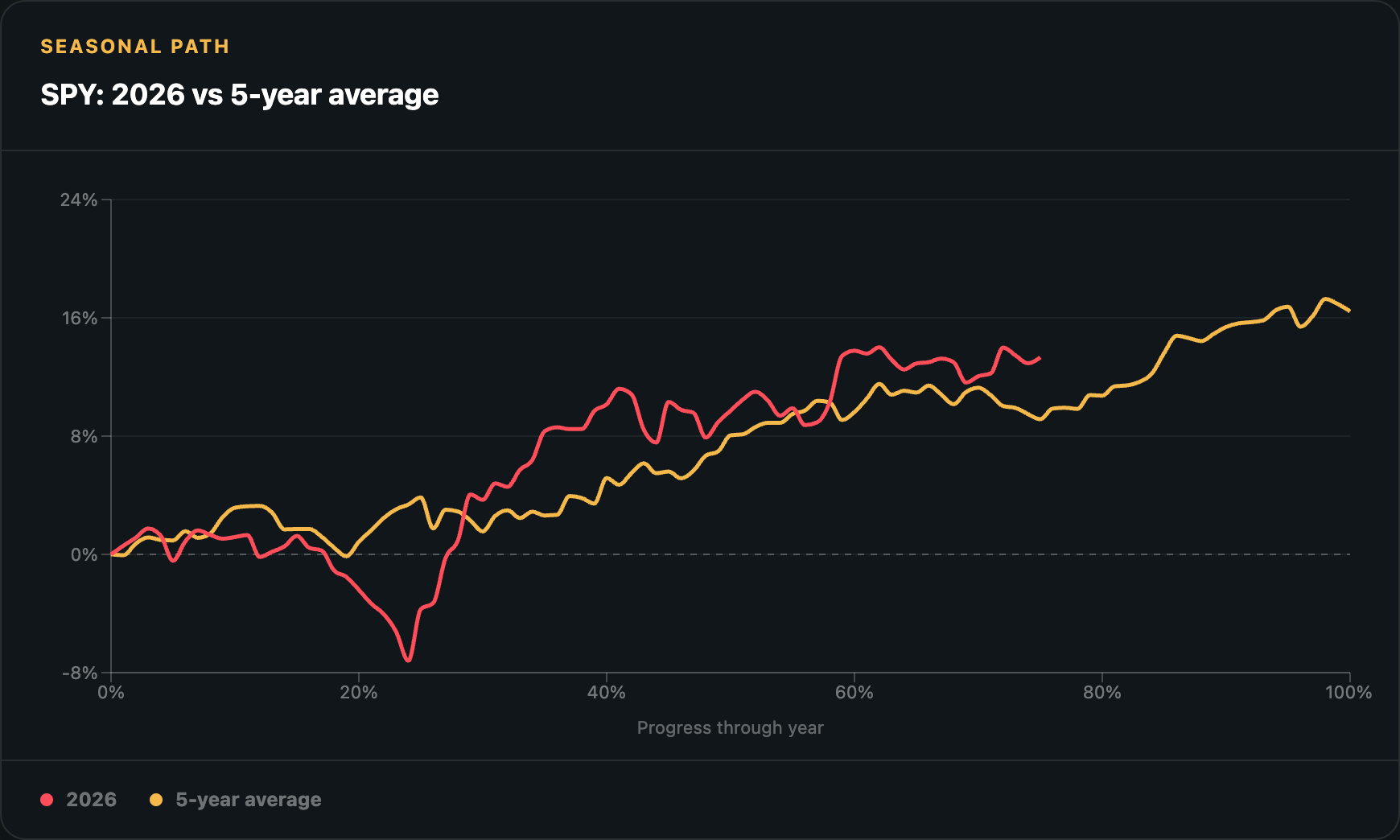
Five-year seasonality provides little immediate help. The SPY average weekly return is −0.08%, and while we are in the zone for a low to form and a rally to begin, the historical seasonal path can easily improve later without requiring a gain in the next week specifically.
For the week ahead, my view is cautiously constructive for a continuation of the rebound, conditional on stable long-term yields and broader participation which I think we will see. Strong services activity without renewed price pressure would help, but overall given the current market sentiment and positioning, the pain trade seems to be higher.
Gold: seasonal support still needs a price response
(Reported COT, 22–29 September). COMEX gold Managed Money reduced longs by 3,988 contracts and added 3,083 shorts. Net exposure declined 7,071 contracts to +120,318, from +127,389. That is long liquidation combined with fresh shorting, rather than merely profit-taking inferred from price. The position remains net long, at 29.6% of open interest, and above its historical midpoint with a 64.6 four-year percentile. Conviction has softened, although we haven't seen an extreme positioning washout.
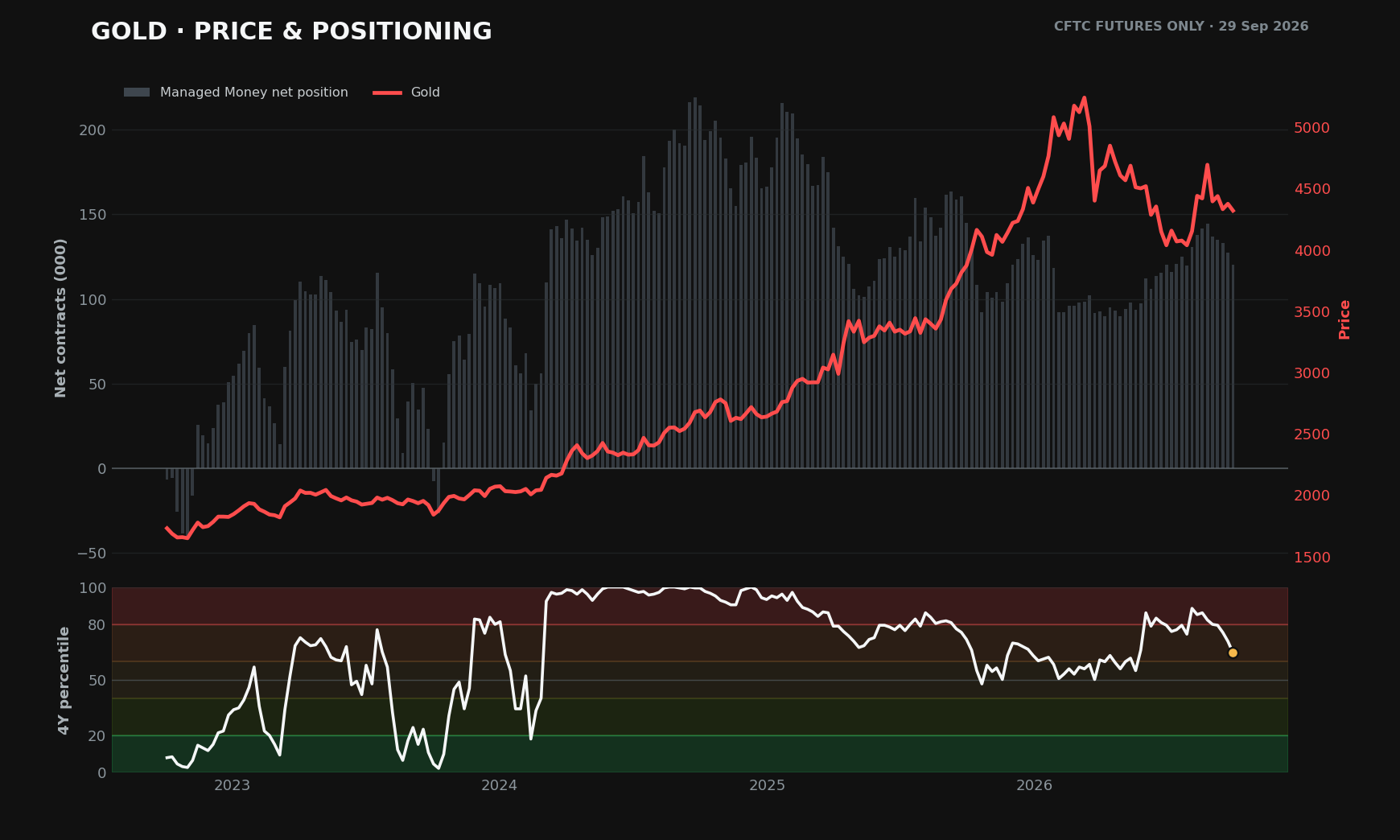
The Friday decline despite a softer dollar suggests currency relief alone isn't enough at this point. Continued liquidation is one possible explanation, but we don't have post-Tuesday position counts to establish it. Friday's move also shouldn't be taken as proof of a continuous selling pattern across all three sessions.
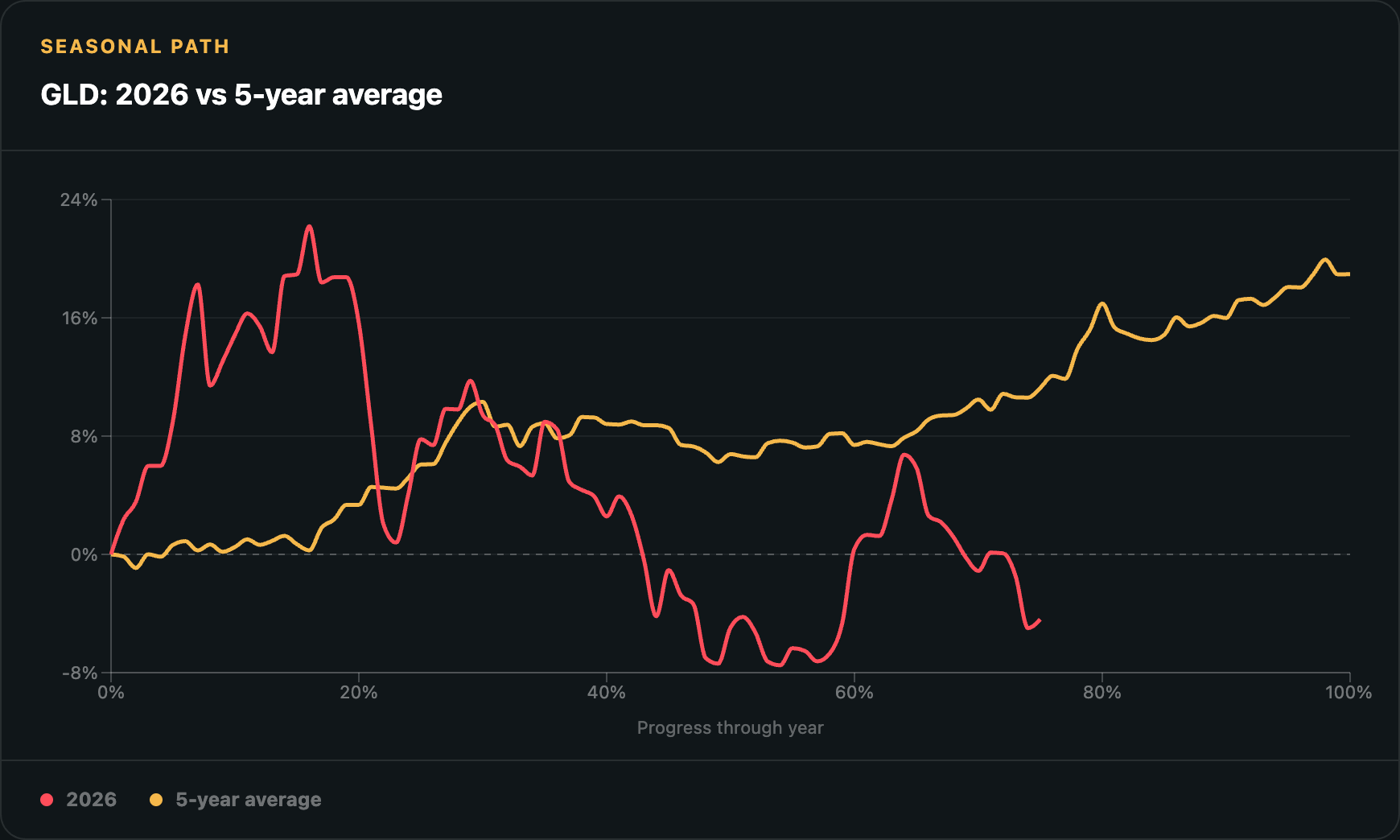
Gold has the strongest positive Week 41 seasonality of these four proxies: GLD averaged +1.27% over 2021–2025. That supports watching for stabilisation, rather than assuming the seasonal pattern will overpower the present rate environment, but it does give the bulls something to cling to.
The relevant sentiment backdrop is divided between equity market relief and persistent household inflation concern. Michigan's September final survey shows elevated inflation expectations; its October preliminary release on Friday will test whether energy developments are changing that assessment. Weak equity breadth is cross-asset context, not a measurement of participation in gold. Safe-haven demand can help gold during uncertainty, but sustained real-yield pressure can offset it.
For the week ahead, my view is neutral with a conditional recovery bias if yields and the dollar ease and gold begins holding gains after favourable news. A failure to recover when both currency and rate conditions improve would weaken the recovery case, but I don't think we will see that necessarily. For now though, I'd focus on watching for a low to form rather than trying to catch it outright.
Oil: a policy cushion is not a supply cure
(Reported COT, 22–29 September). NYMEX WTI Managed Money cut longs by 14,162 contracts and added 8,074 shorts. Net exposure fell 22,236 contracts to +79,592, from +101,828. The remaining net long represents 4.24% of open interest, at a 25.4 four-year percentile. Conviction has weakened and exposure sits below its historical midpoint.
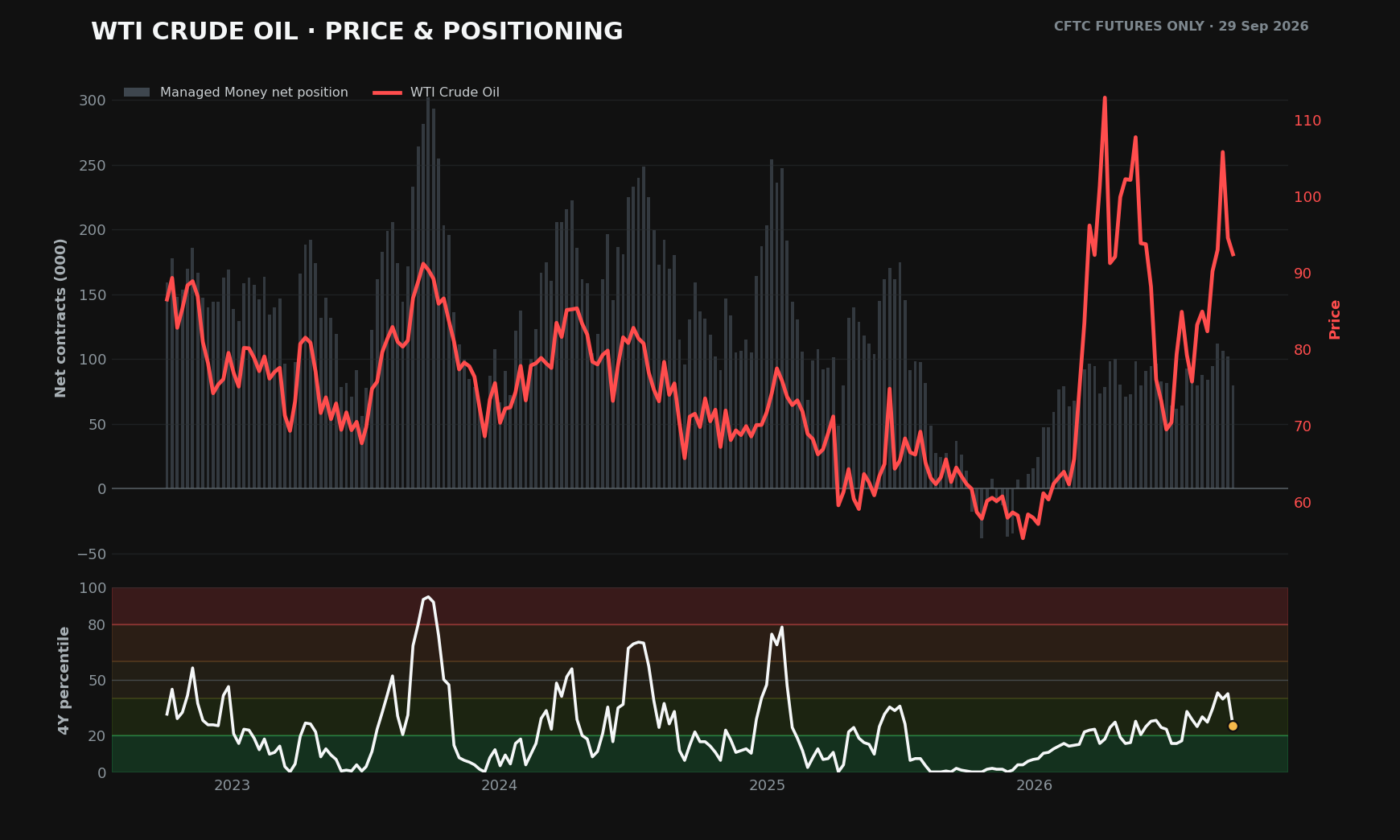
Supply worries and the reserve release news pulled oil in different directions after Tuesday. The price evidence doesn't give us a consistent measure of Friday's move, so there's little value in building the outlook around a precise daily change. What matters more is whether the promised supply starts easing physical shortages. The COT figures can't yet tell us how managed money responded to the later policy news.
The G7 commitment gives us a reason to question a purely bullish oil outlook, but does not quash it. It includes refinery coordination and a pledge against intra-G7 export restrictions, alongside reserve releases. Its wording connects implementation to existing commitments; treating the entire announced volume as wholly additional supply would require more detail. The market still needs deliveries, product allocation and evidence of improved physical transit.
USO's five-year Week 41 average is +0.25%, a small seasonal tailwind. The modest average offers little protection against geopolitical headlines. Wednesday's EIA report, scheduled after 15:30 BST, matters for crude and refined-product stocks; a crude build can coexist with fuel scarcity.
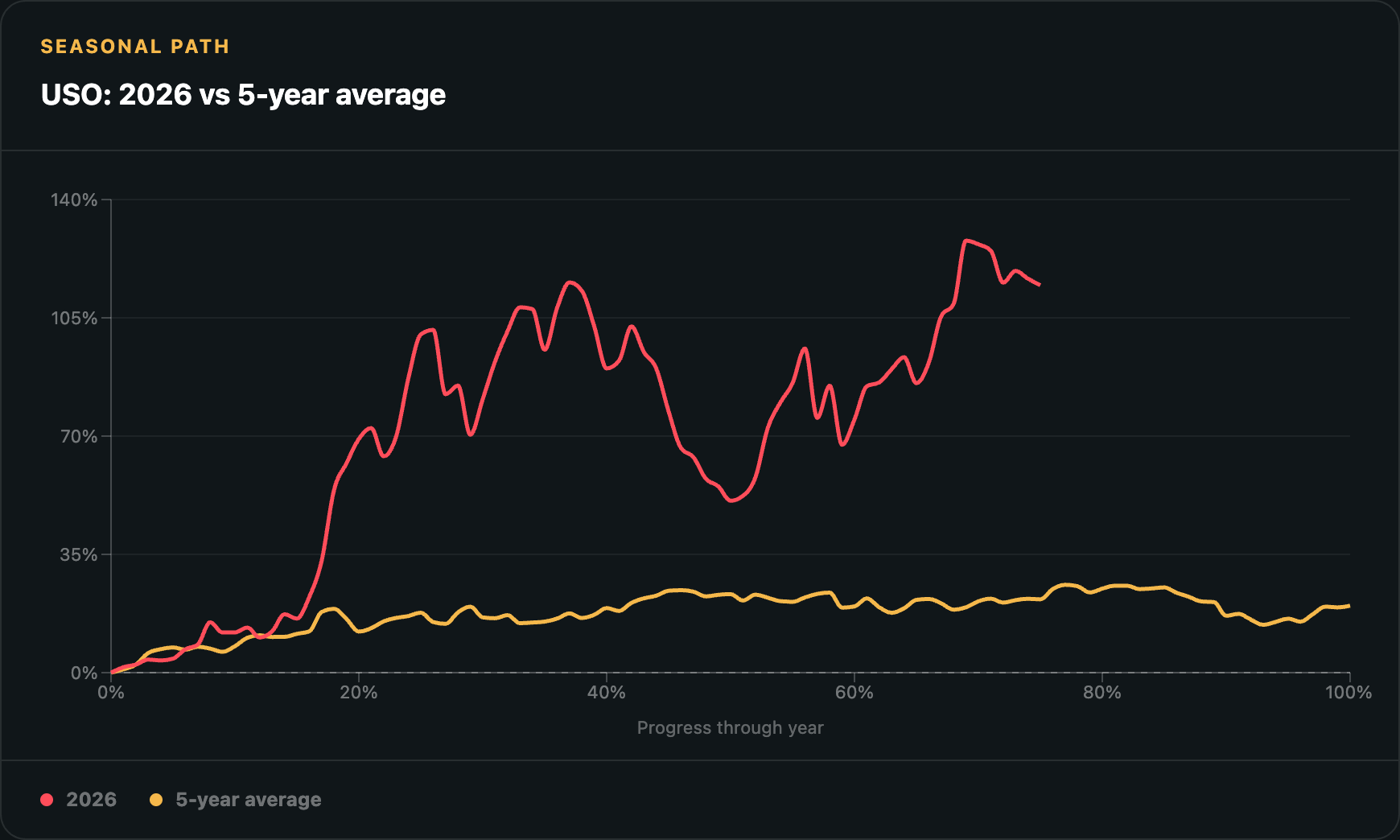
For the week ahead, my view is that we will be rangebound with a downside bias if reserve implementation and improving flows reduce the scarcity premium. The market needs more clarity on the reserve release detail and many will wait for that before updating positions. I would not be outright short here. Renewed attacks, export restrictions or delayed diesel deliveries would favour a sharp rebound, so one eye on the news is required. The small positive seasonal average and reduced speculative longs are reasons to avoid excessive confidence in the downside case.
US bonds: policy relief meets crowded duration
(Reported COT, 22–29 September). In ten-year Treasury note futures, Asset Managers added 187,929 longs and covered 57,218 shorts. Net exposure rose 245,147 contracts to +2,776,531, from +2,531,384. It represents 48.91% of open interest, at a 97.6 four-year percentile. That leaves duration exposure unusually high relative to this category's own history. This is Asset Manager positioning, not the Leveraged Fund category used for equities, and it cannot be read as the whole market's net view.
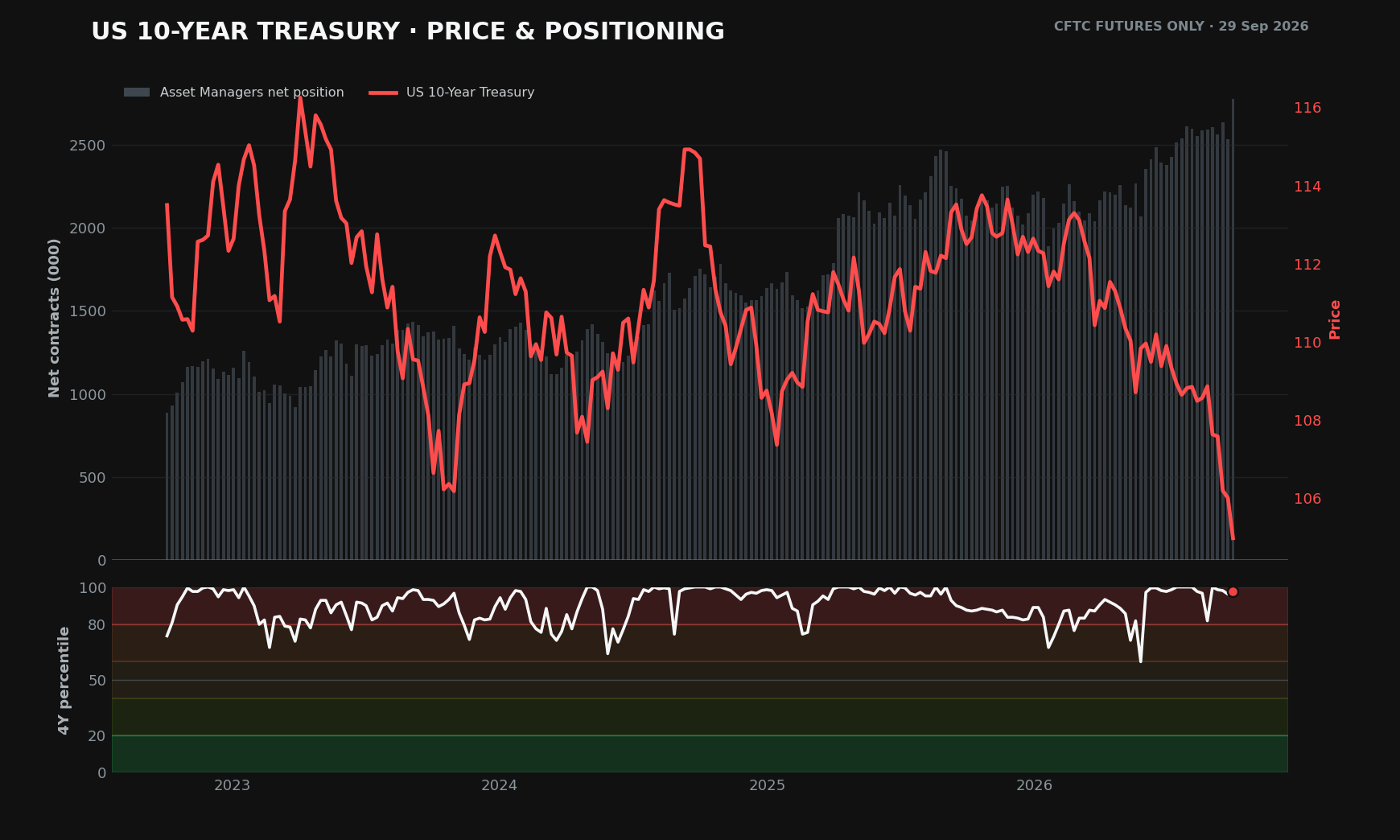
Long yield pressure persisted after Wednesday's softer inflation figure, Thursday brought a reversal, and Friday's early payroll-driven yield decline subsequently faded. That pattern is consistent with buyers finding value while remaining wary of inflation and the extra return demanded for holding longer-dated bonds. It doesn't prove fresh asset-manager buying or establish why yields reversed.
IEF's five-year Week 41 average return is only +0.07%. Seasonality is essentially flat at this horizon and does not independently support a strong bond-price call, but we are coming into the time of year where we have seen yields fall / bonds rally. However, the crowded Asset Manager net long argues for caution about how much buying remains available if inflation expectations rise again.
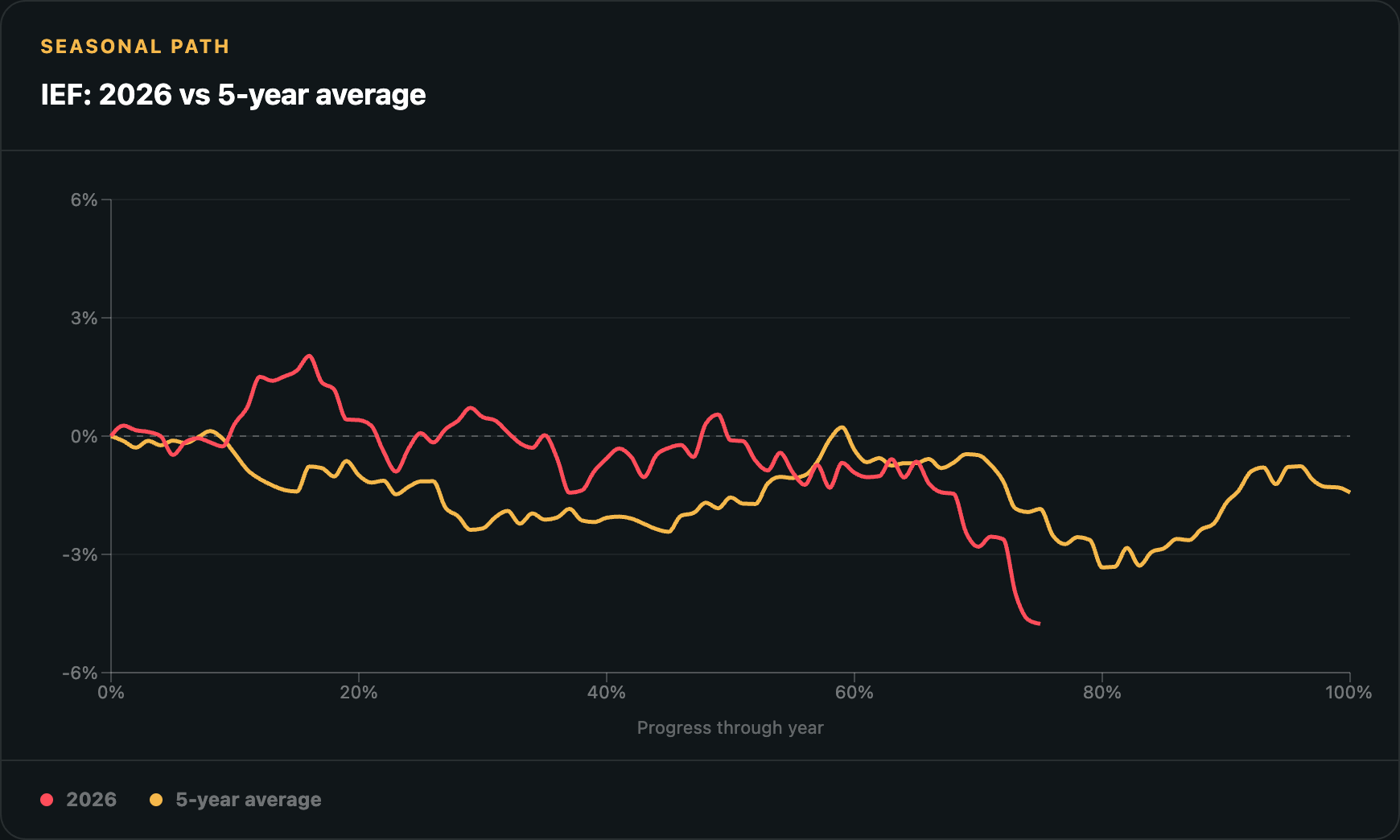
For the coming week, I’m neutral to modestly positive on bond prices. The recent selling looks a little overdone to me, and softer services data or easing inflation expectations could give yields room to settle. Wednesday’s Fed minutes may shed more light on September’s policy decision, although they won’t capture policymakers’ reaction to the latest jobs report. Thursday’s weekly jobless claims will provide a more recent check on the labour market, while Friday’s Michigan survey will show whether consumers’ inflation concerns are easing. If those concerns remain elevated, any recovery in bond prices could struggle to gather pace.
Comments
Log in or sign up to join the conversation.