


The first week of September settled nothing. The US labour market report showed employment holding up while the pace of hiring slows, which left the Fed's next step exactly where it was. The dollar stayed strong and stock indices finished the week without a clear idea. This week hands the market two answers instead: the ECB decides on Thursday, and the US CPI forecast arrives on Friday as the last major number before the Fed meets in September.
Chinese data fills the first half of the week. Trade figures on Tuesday and inflation on Wednesday give a read on the world's second economy and on global demand, which matters most to the Australian dollar and to industrial metals. UK GDP lands on Friday in the same session as US inflation, so the pound faces two moving parts at once.
In Brief
China Trade Balance and Australia NAB Business Confidence (Tuesday, September 8): a read on Asian demand and on the mood of Australian business.
China CPI (Wednesday, September 9): the state of Chinese domestic demand, with no consensus figure published in the calendar we work from.
ECB Rate Decision (Thursday, September 10): a 25 basis point rise to a 2.50% deposit rate is close to fully priced, so the press conference carries the week for the euro.
US CPI (Friday, September 11): the US CPI forecast is 3.4% headline and 2.5% core, both unchanged, and it is the last inflation report before the September Fed meeting.
UK GDP (Friday, September 11): 0.1% month on month after a 0.1% contraction, released in the same session as US inflation.
Where the Market Stands Going Into the Week
Two central banks sit on either side of Friday. The ECB moves first and is expected to raise the deposit rate from 2.25% to 2.50%, with the key rate going from 2.40% to 2.65%. That decision is close to fully priced, so the number itself is settled and the euro will trade on what Christine Lagarde says about the path from here. The Fed meets later in September and has not seen August inflation yet, which is what makes Friday the more consequential of the two dates for the dollar.
The US CPI forecast is unchanged on both lines: 3.4% headline and 2.5% core, matching July. A consensus that expects nothing to move raises the stakes, because the entire reaction comes from the size of the miss. There is no cushion of an expected change to absorb a surprise in either direction.
Positioning going in is uneven. AUD/USD and GBP/USD both sit near recent highs after strong August runs, with their oscillators leaving overbought territory, so both need fresh confirmation to go further. EUR/USD has already broken out of its ascending channel to the downside and trades near 1.1610, which means the euro enters its own central bank meeting on the back foot. The US 500 is consolidating inside a rising channel after the summer advance.
Key Events of the Week
Date | Event | Instruments | Importance |
|---|---|---|---|
Tue, Sep 8 | China Trade Balance + Australia NAB Business Confidence | AUD/USD, Iron Ore, Copper | ●● Medium |
Wed, Sep 9 | China CPI | AUD/USD, Copper | ● Low |
Thu, Sep 10 | ECB Rate Decision | EUR/USD, European bonds, DAX | ●●● High |
Fri, Sep 11 | US CPI | US 500, USD Index, US Treasuries | ●●● High |
Fri, Sep 11 | UK GDP, m/m | GBP/USD, FTSE 100, UK gilts | ●● Medium |
8 Sep
China & Australia · Trade and Business Sentiment · Tuesday
China Trade Balance and Australia NAB Business Confidence
China Trade Balance, Forecast
120.0 billion USD
Previous
112.5 billion USD
NAB Business Confidence, Forecast
-8
Previous
-6
Why It Matters
China is Australia's main trading partner, so Chinese foreign trade data has a visible effect on the Australian dollar. Exports and imports give a read on world trade and on demand for raw materials, above all iron ore and industrial metals. The NAB index covers the other side of the same question, the mood of Australian business itself, and the consensus of -8 after -6 points to sentiment weakening. Chinese inflation follows on Wednesday as a read on domestic demand.
Market Reaction
A trade surplus above 120.0 billion USD alongside a NAB print better than the forecast would support AUD/USD and lift iron ore and copper with it. Chinese figures that point to cooling would return pressure to the Australian dollar quickly, whatever the domestic sentiment number does.
Market Sentiment
The view on the Australian dollar stays moderately positive, held up by strong commodity prices. On the chart, AUD/USD holds near the highs of recent weeks after a strong upward move. Price stays above the middle Bollinger band and MACD keeps a positive impulse, though the stochastic has started to leave overbought territory, which warns of a possible local correction. Holding above 0.7215 confirms the advance continues toward 0.7285. A return below 0.7178 would be the first sign of buyers losing strength.
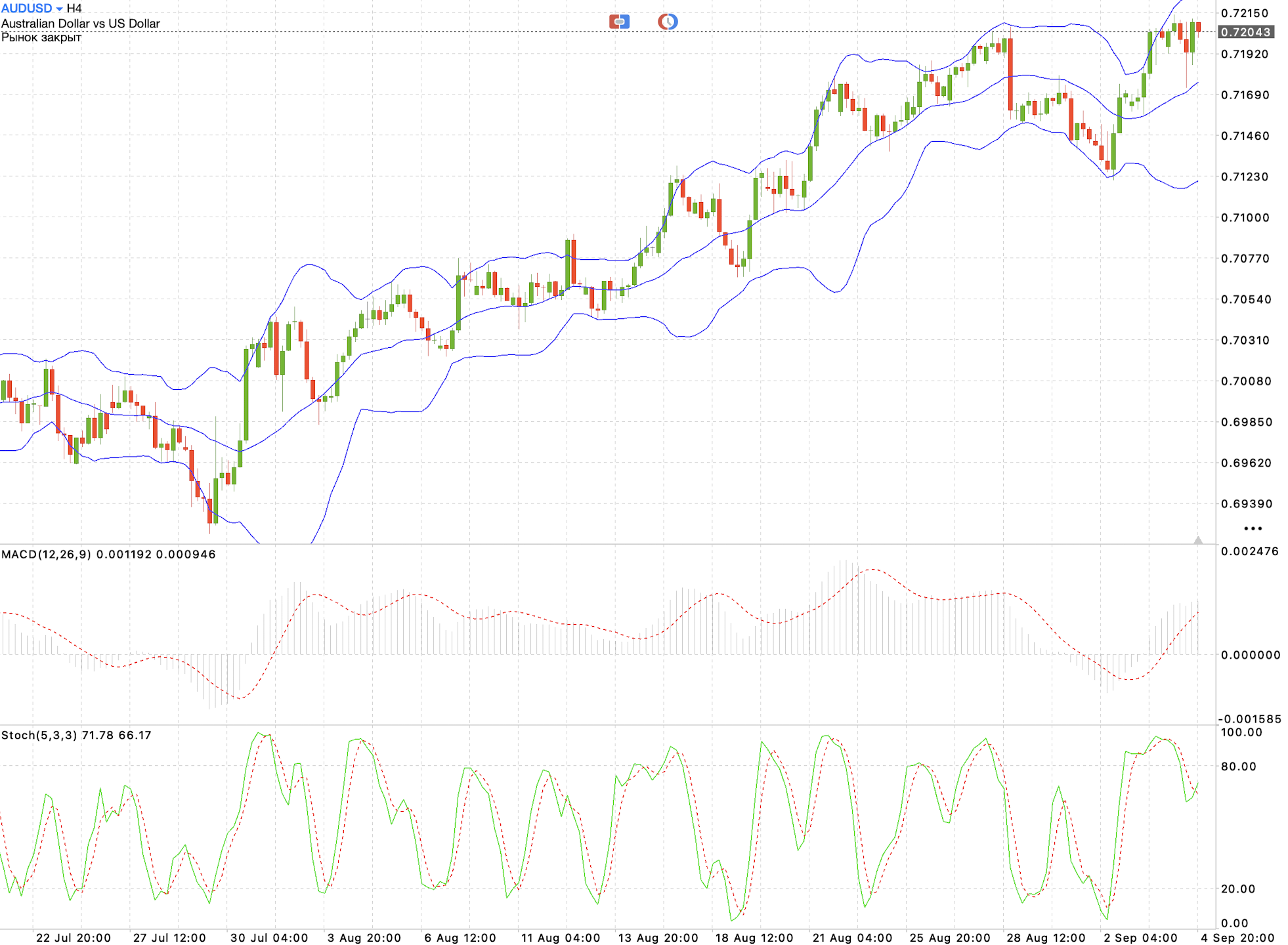
AUD/USD H4 chart ahead of the China trade balance and NAB business confidence releases. Source: RoboForex. Past performance is not indicative of future results.
Key Levels and Trade Parameters — AUD/USD
Parameter | Value |
|---|---|
Resistance | 0.7215 / 0.7285 |
Support | 0.7178 |
Entry, Buy Stop | 0.7215 |
0.7178 | |
0.7285 | |
Risk to reward | 1:1.9 |
10 Sep
Eurozone · Central Bank · Thursday
ECB Rate Decision
Deposit Rate, Forecast
2.50%
Previous
2.25%
ECB Key Rate, Forecast
2.65%
Previous
2.40%
Why It Matters
Thursday is the week's main event for European financial markets. A 25 basis point rise on both the deposit rate and the key rate is close to fully priced, which moves the whole question onto the comments from Christine Lagarde and the updated staff assessments of the Eurozone economy. A signal that the tightening cycle still has room to run would give the euro extra support. More cautious wording on the steps after this one would instead bring profit-taking after the recent strengthening of the European currency.
Market Reaction
Firm guidance from the press conference would lift EUR/USD and push European government bond yields higher, with the DAX under pressure from the prospect of tighter policy. Cautious wording would send the euro toward 1.1510 and support European stocks. The decision itself is close to priced, so the reaction belongs to the press conference.
Market Sentiment
The market is treating the decision far more calmly than the press conference that follows it. The signals on the path of rates from here are what drives the euro up to the Fed meeting later in the month. On the chart, EUR/USD trades around 1.1610 after leaving an ascending channel and stays below the recent local highs. Price holds near the middle Bollinger band, MACD keeps a negative impulse, and the stochastic continues to fall out of the neutral zone, which points to weakening short-term demand. Soft ECB rhetoric would add pressure and take the pair to support at 1.1510. A return above 1.1655 would be the first sign of the upward impulse recovering.
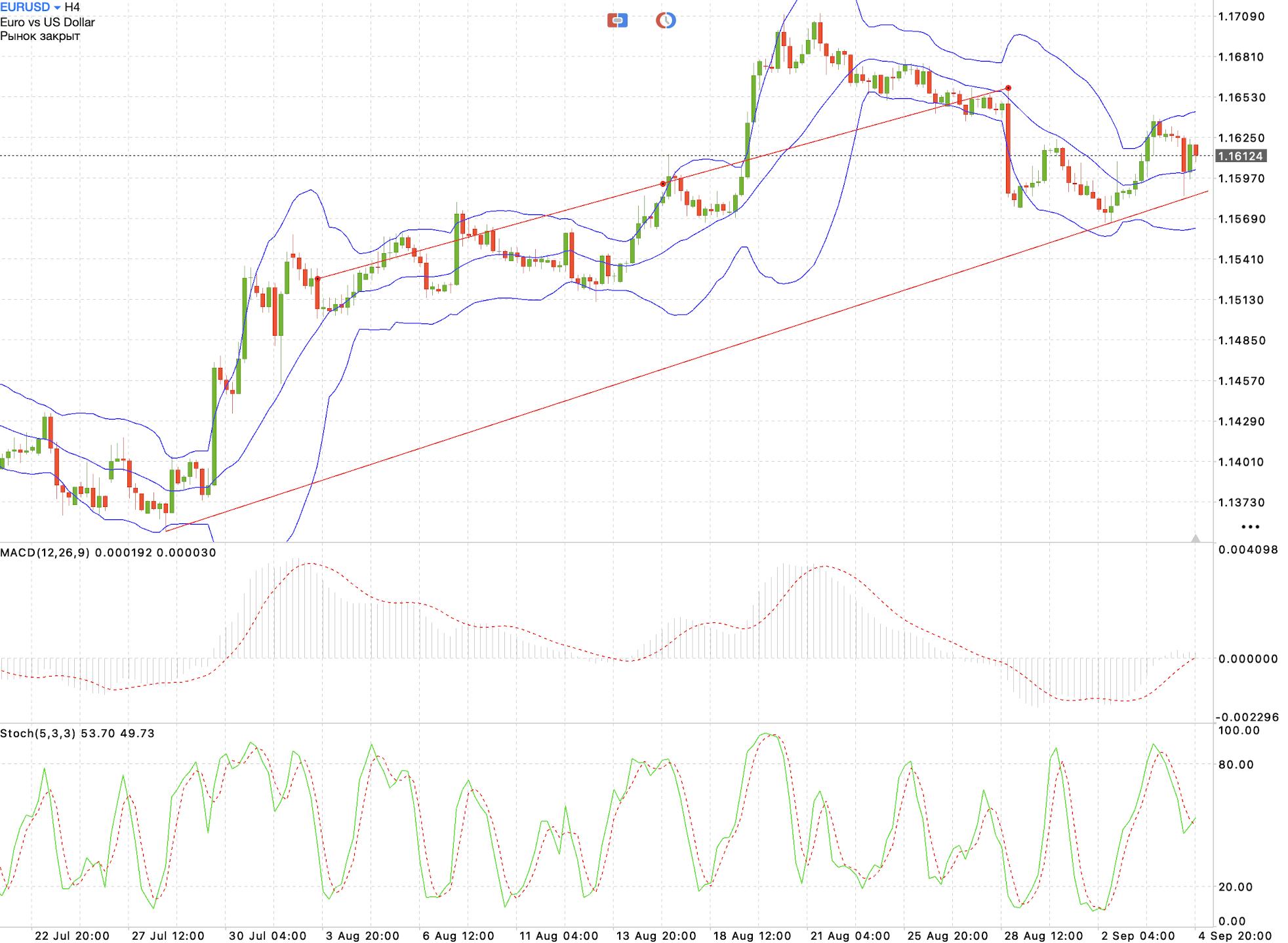
EUR/USD H4 chart ahead of the ECB rate decision. Source: RoboForex. Past performance is not indicative of future results.
Key Levels and Trade Parameters — EUR/USD
Parameter | Value |
|---|---|
Resistance | 1.1655 |
Support | 1.1590 / 1.1510 |
Entry, Sell Stop | 1.1590 |
Stop loss | 1.1655 |
Take profit | 1.1510 |
Risk to reward | 1:1.2 |
11 Sep
USA · Inflation · Friday
US CPI
Headline CPI, Forecast (y/y)
3.4%
Previous
3.4%
Core CPI, Forecast (y/y)
2.5%
Previous
2.5%
Why It Matters
This is the last major inflation report before the September Fed meeting, which is what gives it the power to settle expectations for the path of US rates. The US CPI forecast is unchanged on both lines, 3.4% headline and 2.5% core, and that is the detail worth holding onto: with no change expected, the entire market reaction comes from the size of the deviation. Inflation above expectations raises the probability of the Fed keeping policy tight. Weaker figures support the case for near-term easing and strengthen demand for risk assets.
Market Reaction
A hot print would lift the dollar and US Treasury yields and widen the pressure on US stocks. A soft print would send the US 500 back toward its highs and take the dollar lower. Volatility on the US market at the moment of release is traditionally among the highest of the month, and UK GDP lands in the same session.
Market Sentiment
After a mixed employment report, investors are waiting on inflation as the main reference point for what the Fed does next. On the chart, the US 500 is consolidating after a strong summer rise and stays inside an ascending channel. Price holds above the middle Bollinger band and MACD is gradually recovering a positive impulse, though the stochastic is turning down out of overbought territory, which warns of a possible short-term correction. Softer inflation would return the index to fresh highs, with 7755 the level that confirms it and 7850 the target. Faster price growth would widen the pressure on US stocks and put 7685 back in play.
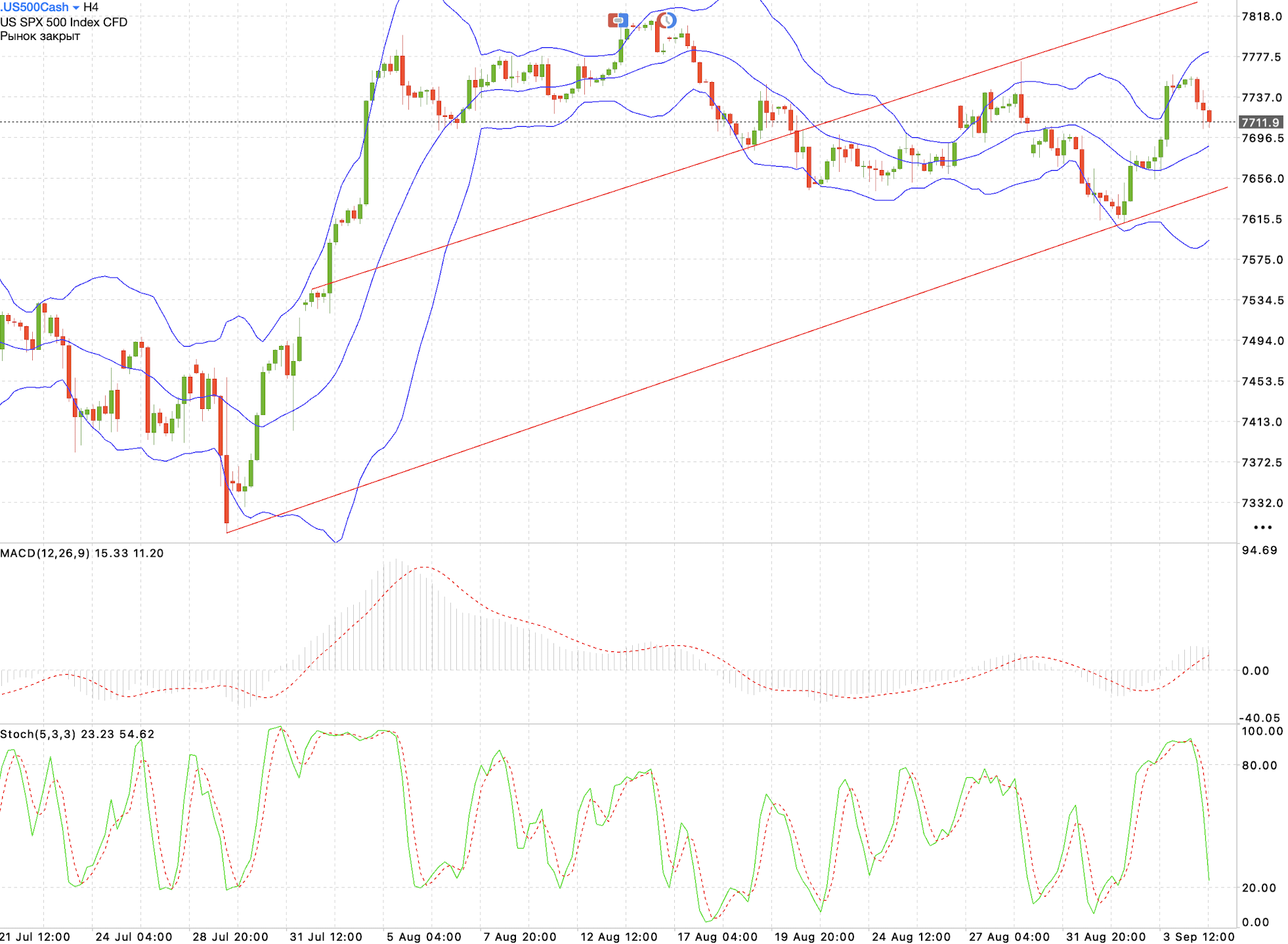
US 500 H4 chart ahead of the US CPI release. Source: RoboForex. Past performance is not indicative of future results.
Key Levels and Trade Parameters — US 500
Parameter | Value |
|---|---|
Resistance | 7755 / 7850 |
Support | 7685 |
Entry, Buy Stop | 7755 |
Stop loss | 7685 |
Take profit | 7850 |
Risk to reward | 1:1.4 |
11 Sep
United Kingdom · Growth · Friday
UK GDP
GDP, Forecast (m/m)
+0.1%
Previous
-0.1%
Why It Matters
After the economy unexpectedly contracted in the previous month, Friday shows whether the United Kingdom returned to growth. The report is an important indicator of where the economy stands before the next Bank of England meeting and of how durable domestic demand is with interest rates still high. It arrives in the same session as US inflation, so volatility on the currency market could rise noticeably. A stronger British result would support the pound even against a strong dollar.
Market Reaction
GDP above the 0.1% consensus would lower expectations of near-term Bank of England easing, support GBP/USD and lift UK government bond yields. A second contraction would raise the pressure on the pound, and the FTSE 100 would take the news better than the currency does.
Market Sentiment
Consensus on the pound stays cautiously positive. The base case is a return to moderate growth after the weak previous month, though the market still doubts how durable that recovery is. On the chart, GBP/USD trades around 1.3610 and continues to move inside a steady ascending channel after a strong August. Price holds above the middle Bollinger band, MACD keeps a positive impulse while its speed gradually falls, and the stochastic has left overbought territory for the neutral area. Holding above 1.3640 confirms the pair is ready to continue toward 1.3730. A fall under 1.3575 would be the first sign of the uptrend weakening and would widen the probability of a deeper correction.
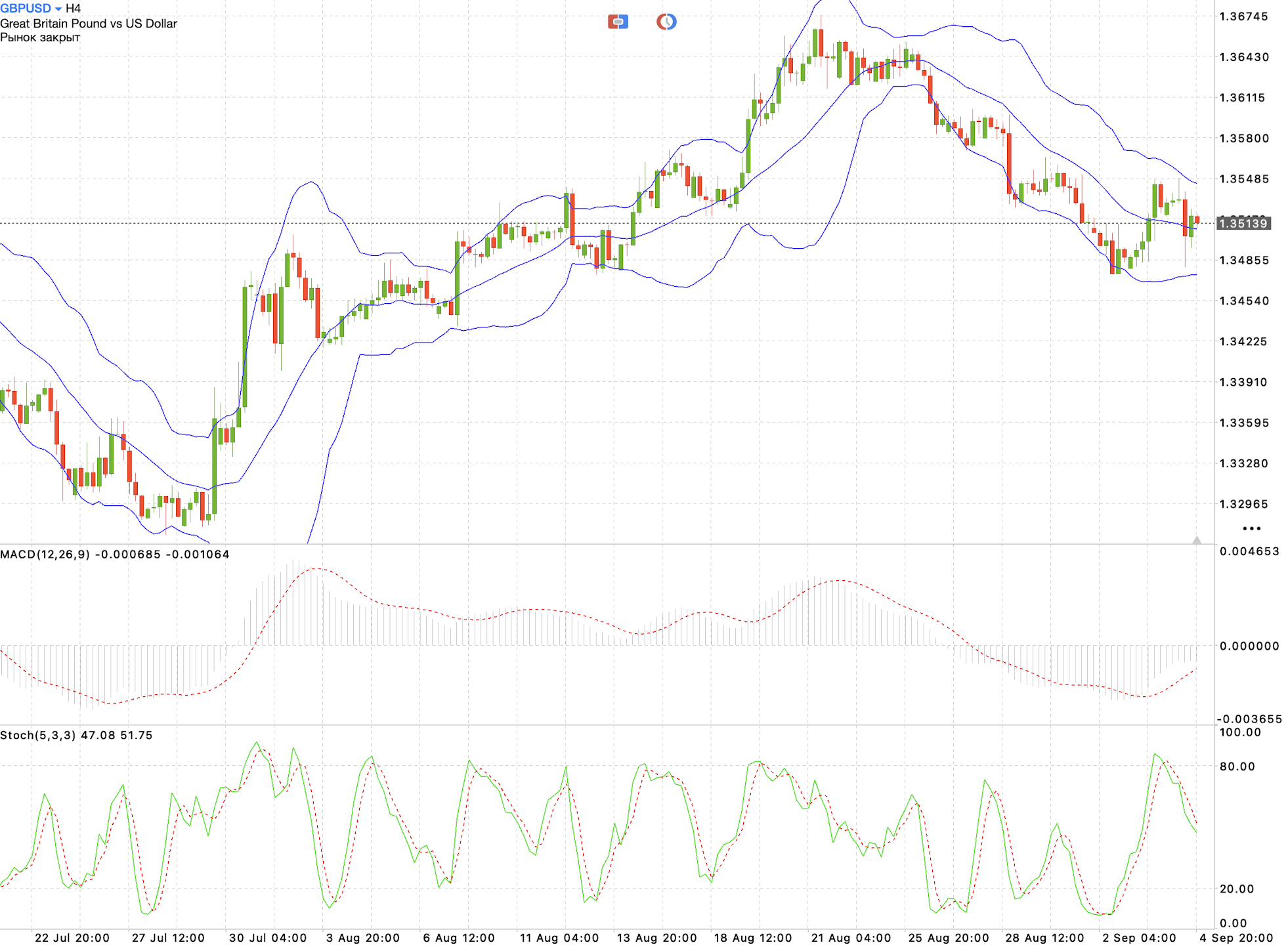
GBP/USD H4 chart ahead of the UK GDP release. Source: RoboForex. Past performance is not indicative of future results.
Key Levels and Trade Parameters — GBP/USD
Parameter | Value |
|---|---|
Resistance | 1.3640 / 1.3730 |
Support | 1.3575 |
Entry, Buy Stop | 1.3640 |
Stop loss | 1.3575 |
Take profit | 1.3730 |
Risk to reward | 1:1.4 |
Conclusion
Europe moves first and America answers. The ECB is expected to lift the deposit rate to 2.50% on Thursday, and because that is close to fully priced, the euro trades on the press conference: firm guidance keeps EUR/USD above 1.1655, cautious wording opens the path to 1.1510. Friday then delivers the US CPI forecast of 3.4% headline and 2.5% core, both unchanged, which means the level is already agreed and the reaction depends entirely on the miss.
A soft inflation print sends the US 500 through 7755 toward 7850 and takes the dollar lower. A hot one puts 7685 back in play and strengthens the case for the Fed holding policy tight into its September meeting. The two smaller stories set their own levels: Chinese trade data above 120.0 billion USD keeps AUD/USD pointed at 0.7285, and UK GDP above 0.1% gives GBP/USD the confirmation it needs at 1.3640.


Comments
Log in or sign up to join the conversation.