

Investors received a steady flow of really rotten news on many fronts last week. China's economy shrank by -6.8%. JPMorgan (JPM) CEO Jamie Dimon said we need to expect a "severe recession" as well as "meaningfully bad" credit card defaults. The IMF changed its 2020 global growth forecast to -3.0% from +3.3%. Goldman Sachs (GS) said the economic downturn will be four times worse than 2008. Super.
The hard data was also downright discouraging. We learned that Retail Sales fell a record -8.7% in March. Industrial Production plunged by -5.4% last month, which was the worst decline since 1946. Housing starts plummeted -22.3% in March. The Philly Fed Business Activity Index cratered 43.9 points in April to a reading of -56.6, a record low. The Conference Board's Leading Economic Index dropped by a record-breaking -6.7%. And the initial claims for unemployment insurance numbers were once again mind-numbing, coming in at 5.25 million.
Speaking of unemployment, the number of continuing claims, which lag initial claims by one week, hit a record high of 11.98 million, and are likely to rise again in next week's report. According to First Trust, the share of workers covered by unemployment insurance in the last three weeks has increased to 8.2% from record low of 1.2%. To put that in perspective, First Trust's Chief Economist Brian Wesbury tells us that the highest level in the past 50 years was 7.0% (seen in 1975). Oh, and these numbers are going to get worse.
So, how did the markets respond to all of the miserable data? Not surprisingly, the yield on the U.S. ten-Year Treasury Note fell from 0.729% to 0.654%, which, while still above the 0.5% seen on March 9, is in the vicinity of all-time lows. I think the key here is that, while bond yields didn't crash on the week's bad news, they did move back toward the recent lows. So, the message from the bond market would appear to be that, while the bad news was to be expected, it was still bad news.
On the other hand, the stock market had a completely different take. The S&P 500 rose 3.04% on the week, which finished off an impressive surge of 15.5%, in just two weeks. And since the low seen on March 23, the blue-chip index now sports a gain of 28.48%.
I know what you are thinking, the news is awful, so naturally stocks surge. Got it. Wait, what?
Two Themes
One of the best books I read about the stock market at a young age was Stock Market Logic, by Norman Fosback. The key takeaway was to understand that the stock market has its own brand of logic, which is oftentimes both perverse and the exact opposite of what one might expect.
As I've said a time or twenty over the years, the key to understanding Ms. Market's game is to recognize the market is a discounting mechanism of future expectations. And while it may seem like a bit of a stretch, the stock market is currently looking ahead; well ahead - to better days.
This is one of the two key themes in the market right now. The first is, this too shall pass, and that we can count on science to allow us to return to some form of normal at some point in the future. The second is an oldie but a goody, the Fed has once again mounted their white horses.
The Fed Changed The Rules Of The Game
As the COVID-19 crisis began, one of the primary fears was that the Fed couldn't fix the virus problem. Slashing interest rates to zero and buying bonds just wasn't going to do the trick. The thinking was that while the Fed and fiscal stimulus could make things less bad, they couldn't have a significant impact on the problem.
But that was then. That was before the dynamic duo of Steven Mnuchin and Jay Powell (who apparently are best buds) got together and decided to change the game. And while these guys can't fix the virus, they do appear to have (a) taken the worst case scenario off the table (i.e. another credit crisis) and (b) are putting some sort of a floor under the economy.
To be sure, we are looking at a nasty recession. But the thing to remember is that this recession is self-induced. Things were just fine, thank you, before the virus hit. And since the Fed/Government had a playbook of their own to follow and decided to move fast and hard against this crisis, the damage is likely to be lessened significantly.
The key here is the Fed changed the rules of the game. You see, by law the Fed isn't allowed to buy stuff like corporate bond ETFs, municipal bonds, etc. And they are definitely not allowed to talk about buying the S&P 500 ETF (SPY).
But via the new partnership between the Fed, Treasury, and a little firm called BlackRock (BLK), almost anything is possible now. And this is a game changer for the markets. Using a sports analogy, the Fed didn't just move the goal posts here. No, they made the goal posts the entire width of the field!
How It Works
So, here's what is happening. Fed and Treasury get together to create something called an SPV (Special Purpose Vehicle). The Treasury then sells a bunch of bonds, which the Fed buys. The proceeds of the bond sales are then placed into the SPV. Note that the SPV can then "lever up" the money it has in its account and spend something like ten times the amount of money available - on basically anything it wants. There are none of those annoying restrictions the Fed has to deal with placed on the SPV.
Bam! Just like that, the Fed effectively can buy corporate bonds, junk bonds, muni bonds, ETFs of all shapes and sizes, and even stocks in order to support markets and send a warning to those nasty short sellers.
The other thing to know here is that the Fed doesn't act like a prudent money manager and move into positions slowly. No, when the Fed decides to buy, they do so with a big splash. They don't care what price they get. No, instead they want to send a message to the market that "enough is enough" and further short-selling may cause significant pain. Remember, the buyer of last resort has an almost limitless checkbook. And Jay Powell has said the Fed will "do anything it takes" to support the economy during this crisis.
Next, understand that if traders have learned anything since the 2008 crisis, it is to "shake hands with the government" when they are buying stuff. In other words, traders know that one of the oldest rules in the game is "don't fight the Fed." And since the Fed usually gets what it wants in the end, if the Fed is talking about buying, traders want to be in a front-running position.
From my seat, this is at least part of the reason why stocks are ignoring all the bad news and moving on up. The other is the "looking ahead" thing.
Theme #2: Looking Ahead
The second theme that appears to be giving the market a lift is that there was actually some good news on the virus front last week. As such, the idea is that we should just "write off" 2020 (we already know it will be ugly) and "look ahead" to the "grand re-opening" of the economy.
Sprinkled in between all the grotesque economic news, was some good news regarding COVID-19. We heard that the "curve" appears to be peaking in NYC. We heard that GlaxoSmithKline (GSK) is teaming up with Sanofi (SNY) on a vaccine, and could produce hundreds of millions of doses by the end of 2021. We heard that Johnson & Johnson (JNJ) could produce 900 million vaccine doses by April 2021 (assuming the vaccine works in the trial slated to begin in the fall, of course!). And we heard that Gilead's (GILD) drug, Remdesivir is showing promising results in something called a "compassionate trial" with 120 patients in Chicago.
The key to the Remdesivir news is that if the results continue to be good in expanded trials (something that Gilead itself has warned against becoming overly optimistic about), then something akin to a "cure" might be available until a vaccine can make its way to the masses.
In other words, if we can find a "drug therapy" that keeps people out of the hospital, and/or off of ventilators, then we actually could start talking about the economy going back to some semblance of "normal."
The War Playbook
I've written that perhaps the best analogy to follow for this market is the "war playbook." Prior to war breaking out, the market tends to freak out about what could happen to the economy. However, once the war begins, it is the news of "how the war is going" that drives the markets.
This concept helps support the idea that stocks can ignore all the bad economic news and look ahead. If there is promising news on the war front (Remdesivir and others as well as the development of a vaccine in record time), then stocks may be able to continue to advance for a while as the market "discounts" future expectations.
But if the news from the virus front starts to turn bad, well, we all know what will happen next.
Pulling Good News Forward
In closing, it is important to remember that stocks can only "discount" a concept, such as winning the war on COVID-19 sometime in the next three-six months, for so long. I.E. Stocks can only go so far without actual good news on the virus and the economy.
Remember, unless a "cure" is found in the next few weeks, economic damage will continue to be done - damage that is unlikely to be reversed quickly. In addition, consumer behavior is rapidly changing. And the longer consumers are removed from their "old normal," the more likely it is that the new behavior such as spending less, doing less, saving money, paying down debt, etc. will become "the new normal."
And if "the new normal" takes root with consumers, then economic growth could be hard to find. Which, in turn, means earnings growth might be difficult to achieve. As such, an environment with "slow" or "no" growth is a distinct possibility - which isn't exactly a great backdrop for rising stock prices.
The bottom line is that while stocks are indeed looking ahead to better days here, the ultimate upside is limited in the near-term. And I, for one, think that a battle between expectations versus reality will likely result.
Weekly Market Model Review
Each week we do a disciplined, deep dive into our key market indicators and models. The overall goal of this exercise is to (a) remove emotion from the investment process, (b) stay "in tune" with the primary market cycles, and (c) remain cognizant of the risk/reward environment.
The Major Market Models
We start with six of our favorite long-term market models. These models are designed to help determine the "state" of the overall market.
There is one change to report on the Primary Cycle board this week. My "Desert Island Model" flip-flopped again, this time moving from neutral to negative. Overall, the board is currently rated as moderately negative. This tells me that while the bulls have enjoyed a whale of a rally, some caution remains warranted.
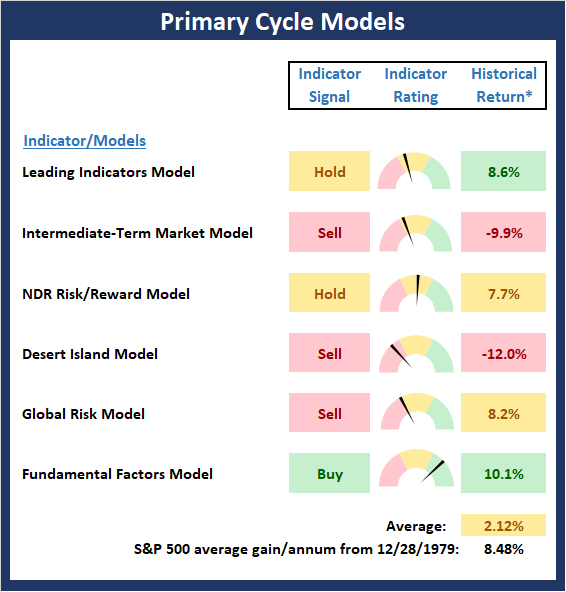
Source: Ned Davis Research (NDR) as of the date of publication. Historical returns are hypothetical average annual performances calculated by NDR. Past performances do not guarantee future results or profitability - NOT INDIVIDUAL INVESTMENT ADVICE.
The State of the Fundamental Backdrop
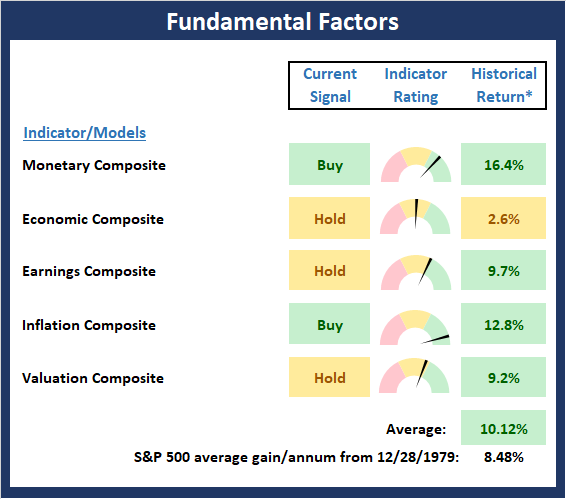
Next, we review the market's fundamental factors in the areas of interest rates, the economy, inflation, and valuations.
I recently pointed out the improvement in valuations, which, from my point of view, helped justify the idea that a preliminary (and perhaps final) low had been established. The bad news is that the ferocious bounce seen over the last three weeks has pushed valuations back into the neutral zone. My thinking is this represents a fundamental problem with the bull theme that stocks can simply fast forward to when the economy recovers.
Source: Ned Davis Research (NDR) as of the date of publication.
The State of the Trend
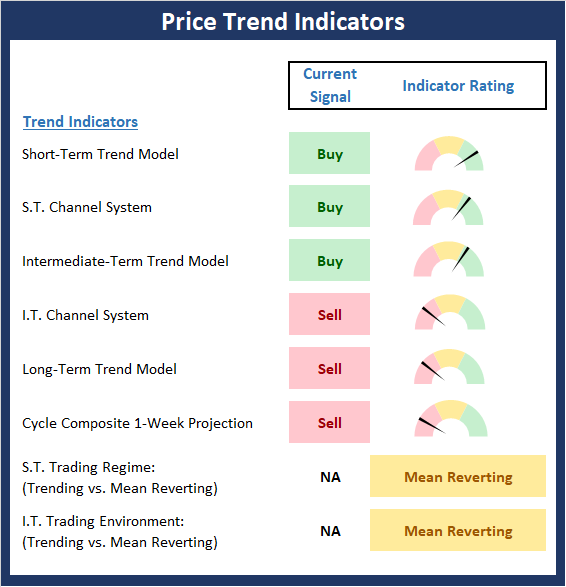
After looking at the big-picture models and the fundamental backdrop, I like to look at the state of the trend. This board of indicators is designed to tell us about the overall technical health of the current trend.
Not surprisingly, the trend board remains in pretty good shape. However, it is important to keep in mind that there has been significant technical damage done to the tape, as evidenced by the I.T. Channel and Long-Term Trend model readings. My take is that the rally will likely encounter some resistance in the coming days.
Source: Ned Davis Research (NDR) as of the date of publication.
The State of Internal Momentum
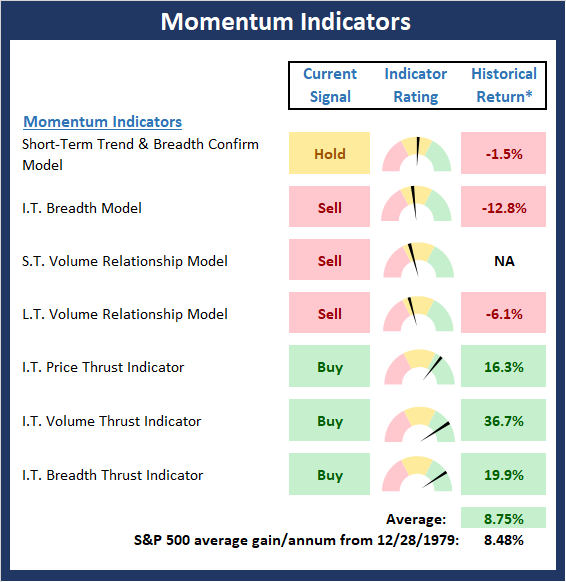
Next, we analyze the "oomph" behind the current trend via our group of market momentum indicators/models.
The Momentum Board saw some improvement this week, as our thrust indicators all now sport a bright shade of green, and our trend/breadth confirm model has been upgraded to neutral. But since this board weights the intermediate, and long-term more than the short-term, the overall rating of the board is neutral.
Source: Ned Davis Research (NDR) as of the date of publication.
Early Warning Signals
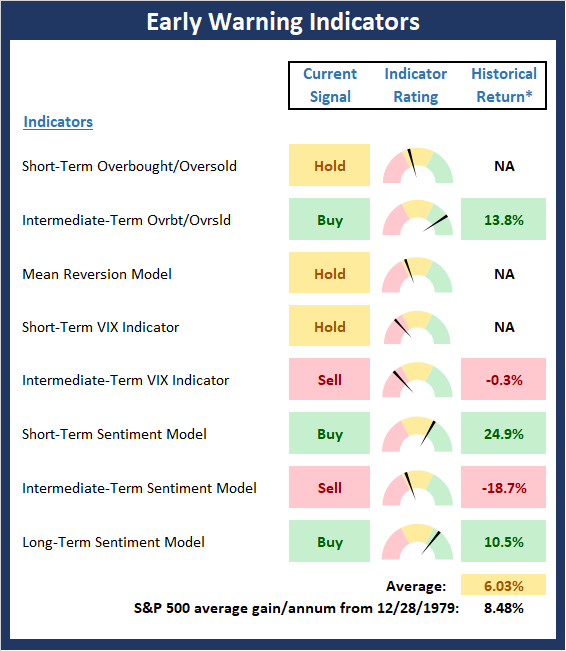
Once we have identified the current environment, the state of the trend, and the degree of momentum behind the move, we then review the potential for a counter-trend move to begin. This batch of indicators is designed to suggest when the table is set for the trend to "go the other way."
The Early Warning board is a bit of a mess at this point. From a short-term perspective, stocks are now overbought. But from an intermediate-term point of view, they remain oversold. In addition, the VIX indicators are suggesting that the table is beginning to be set up for a countertrend move. Historically, the best countertrend moves occur when "the stars are aligned" in terms of overbought/sold, volatility, and sentiment indicators. And this is simply not the case here.
Source: Ned Davis Research (NDR) as of the date of publication.


Comments
Log in or sign up to join the conversation.