

The Producer Price Index (PPI) year-over-year inflation increased from +2.8 % to +4,2 %

Analyst Opinion of Producer Prices
Year-over-year inflation pressures significantly grew againvthis month.
Here is what the BLS said in part:
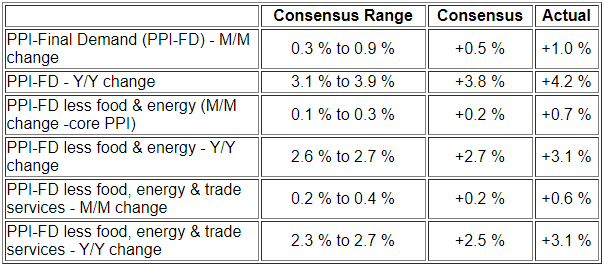
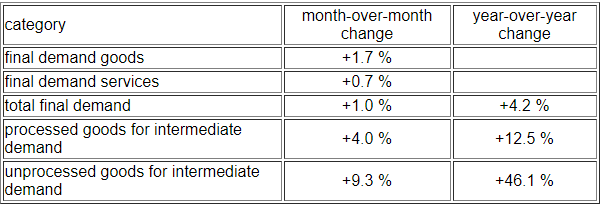
The Producer Price Index for final demand increased 1.0 percent in March, seasonally adjusted, the U.S. Bureau of Labor Statistics reported today. Final demand prices rose 0.5 percent in February and 1.3 percent in January. (See table A.) On an unadjusted basis, the final demand index moved up 4.2 percent for the 12 months ended in March, the largest advance since rising 4.5 percent for the 12 months ended September 2011. In March, almost 60 percent of the increase in the index for final demand can be traced to a 1.7-percent advance in prices for final demand goods. The index for final demand services moved up 0.7 percent. Prices for final demand less foods, energy, and trade services rose 0.6 percent in March following an increase of 0.2 percent in February. For the 12 months ended in March, the index for final demand less foods, energy, and trade services moved up 3.1 percent, the largest advance since climbing 3.1 percent for the 12 months ended September 2018.
The PPI represents inflation pressure (or lack thereof) that migrates into consumer price.
The market had been expecting (from Econoday):
(Click on image to enlarge)
The producer price inflation breakdown:
(Click on image to enlarge)

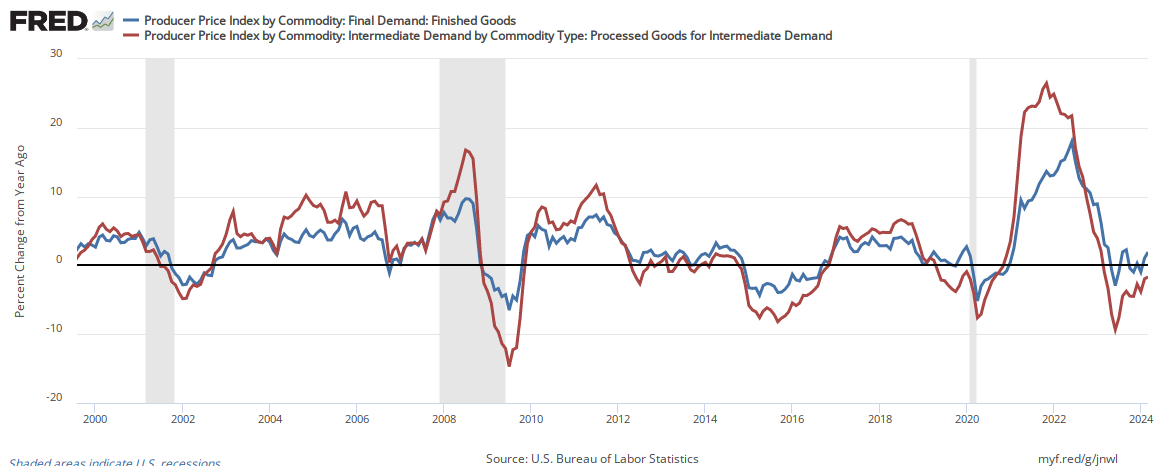
In the following graph, one can see the relationship between the year-over-year change in the intermediate goods index and finished goods index. When the crude goods growth falls under finish goods - it usually drags finished goods lower.
Percent Change Year-over-Year - Comparing PPI Finished Goods (blue line) to PPI Intermediate Goods (red line)
(Click on image to enlarge)
Econintersect has shown how pricing change moves from the PPI to the Consumer Price Index (CPI).
Comparing Year-over-Year Change Between the PPI Finished Goods Index (blue line) and the CPI-U (red line)
(Click on image to enlarge)

The price moderation of the PPI began in September 2011 when the year-over-year inflation was 7.0%.
Caveats on the Use of Producer Price Index
Econintersect has performed several tests on this series and finds it fairly representative of price changes (inflation). However, the headline rate is an average - and for an individual good or commodity, this series provides many sub-indices for a specific application.
A very good primer on the Producer Price Index nuances can be found here.
Because of the nuances in determining the month-over-month index values, the year-over-year or annual change in the PPI index is preferred for comparisons.
There is a moderate correlation between crude goods and finished goods. Higher crude material prices push the finished goods prices up.


Comments
Log in or sign up to join the conversation.