

Malic Acid has emerged as a critical specialty chemical across multiple industries, including food and beverages, pharmaceuticals, cosmetics, and industrial manufacturing. Known for its sour taste and acidity-regulating properties, Malic Acid is widely used as a flavor enhancer, pH regulator, and preservative in processed foods, carbonated beverages, confectionery products, and nutritional supplements.
According to ChemAnalyst Malic Acid Price: - https://www.chemanalyst.com/Pricing-data/malic-acid-1281
In 2026, the global Malic Acid market has experienced notable price fluctuations driven by changing raw material costs, supply chain disruptions, regional demand shifts, and evolving trade dynamics. Manufacturers, procurement professionals, and market participants are closely tracking Malic Acid price movements to optimize sourcing strategies and inventory planning.
Recent market developments reveal mixed pricing trends across major economies. While North America and Europe witnessed price gains due to tightening supply conditions and stronger procurement activity, Asia-Pacific showed downward movement, reflecting softer export demand and subdued industrial buying.
What is Malic Acid?
Malic Acid is an organic dicarboxylic acid naturally found in fruits such as apples, grapes, cherries, and berries. It plays an essential role in cellular energy production and contributes to the tart flavor of many fruits.
Industrially, Malic Acid is produced via chemical synthesis or bio-based fermentation methods. It is available in two primary forms:
L-Malic Acid – naturally occurring form used in biological systems
DL-Malic Acid – synthetic mixture commonly used in industrial and food applications
The compound is highly valued for:
Strong acidification properties
Improved flavor retention
Better solubility compared to citric acid
Synergistic effects in beverage formulations
Shelf-life enhancement in processed foods
Its broad functionality makes Malic Acid indispensable across several downstream sectors.
Global Malic Acid Market Size and Industry Overview
The global Malic Acid market continues to expand as consumption increases in food processing, nutraceuticals, and personal care industries. Rising consumer preference for flavored beverages, functional foods, and wellness products has strengthened demand worldwide.
Key growth sectors include:
Food & Beverage Industry
The food and beverage sector remains the largest consumer of Malic Acid. It is heavily used in:
Soft drinks
Energy beverages
Candy and confectionery
Bakery products
Ready-to-drink beverages
Growing urbanization and rising consumption of processed food continue to support demand.
Pharmaceuticals and Nutraceuticals
Malic Acid is increasingly used in:
Effervescent tablets
Oral medicines
Mineral supplements
Muscle recovery formulations
The health and wellness sector has created new demand opportunities.
Personal Care and Cosmetics
Skincare and cosmetic manufacturers utilize Malic Acid for:
Exfoliation
pH balancing
Anti-aging formulations
Skin renewal products
The global beauty industry continues to support specialty acid demand.
Major Factors Influencing Malic Acid Prices in 2026
Malic Acid pricing depends on multiple upstream and downstream factors.
Raw Material Costs
One of the most important pricing factors is the cost of raw materials used in synthesis. Fluctuations in:
Maleic anhydride
Fumaric acid
Petrochemical intermediates
directly influence production economics.
Higher feedstock costs typically lead to elevated Malic Acid prices.
Supply Chain and Logistics
Freight rates, port congestion, and shipping delays significantly affect landed costs.
Important logistical factors include:
Ocean freight charges
Container availability
Export bottlenecks
Warehousing costs
Regions dependent on imports are especially sensitive to logistics disruptions.
Industrial Demand Cycles
Demand from downstream industries often determines short-term price direction. Strong procurement from beverage manufacturers, food processors, and supplement producers usually creates upward price pressure.
Energy Costs
Chemical manufacturing is energy-intensive. Rising electricity and fuel prices increase production costs, affecting final market pricing.
Currency and Trade Conditions
Exchange rate volatility and regional trade policies impact import/export competitiveness and pricing parity.
Read the LinkedIn Article : - https://www.linkedin.com/pulse/malic-acid-market-intelligence-2026-price-analysis-demand-singh-ltilc/
Regional Malic Acid Price Analysis – Q1 2026
APAC Market Analysis: Japan
In Asia-Pacific, Japan recorded a decline in Malic Acid prices during the quarter.
Price Trend in Japan
Quarter-over-quarter change: -6.72%
Average price: USD 1523/MT
Pricing basis: FOB Yokohama
The decline in Japanese Malic Acid prices was primarily attributed to subdued export inquiries and cautious purchasing behavior among international buyers.
Export-oriented suppliers faced lower order volumes, which reduced pricing power. Weak procurement from neighboring Asian economies further pressured market sentiment.
Additional factors contributing to price softness included:
Comfortable inventory levels
Reduced spot buying
Slow industrial demand recovery
Weak overseas inquiries
Despite the quarterly decline, Japan remained among the higher-priced markets due to premium manufacturing quality and strong supply reliability.
APAC Outlook
The Asia-Pacific market may recover if:
Regional food demand improves
Export orders rebound
Manufacturing activity accelerates
However, oversupply risks remain a concern.
Europe Market Analysis: Netherlands
Europe experienced notable price growth, with the Netherlands showing strong quarterly gains.
Price Trend in the Netherlands
Quarter-over-quarter change: +8.94%
Average price: USD 1458.67/MT
Pricing basis: Rotterdam CFR
The increase in Malic Acid prices in the Netherlands was primarily driven by pricing parity, stronger procurement activity, and improved regional demand.
European buyers increased purchases to secure inventories amid expectations of tighter supply conditions.
Key factors supporting price increases included:
Higher import replacement costs
Increased freight expenses
Inventory restocking
Stable industrial consumption
Rotterdam remained a strategic pricing hub for European chemical trade, influencing regional market benchmarks.
Europe Outlook
European prices may remain elevated if:
Supply remains tight
Energy prices stay firm
Industrial activity improves
Procurement strategies will remain focused on supply security.
North America Market Analysis: United States
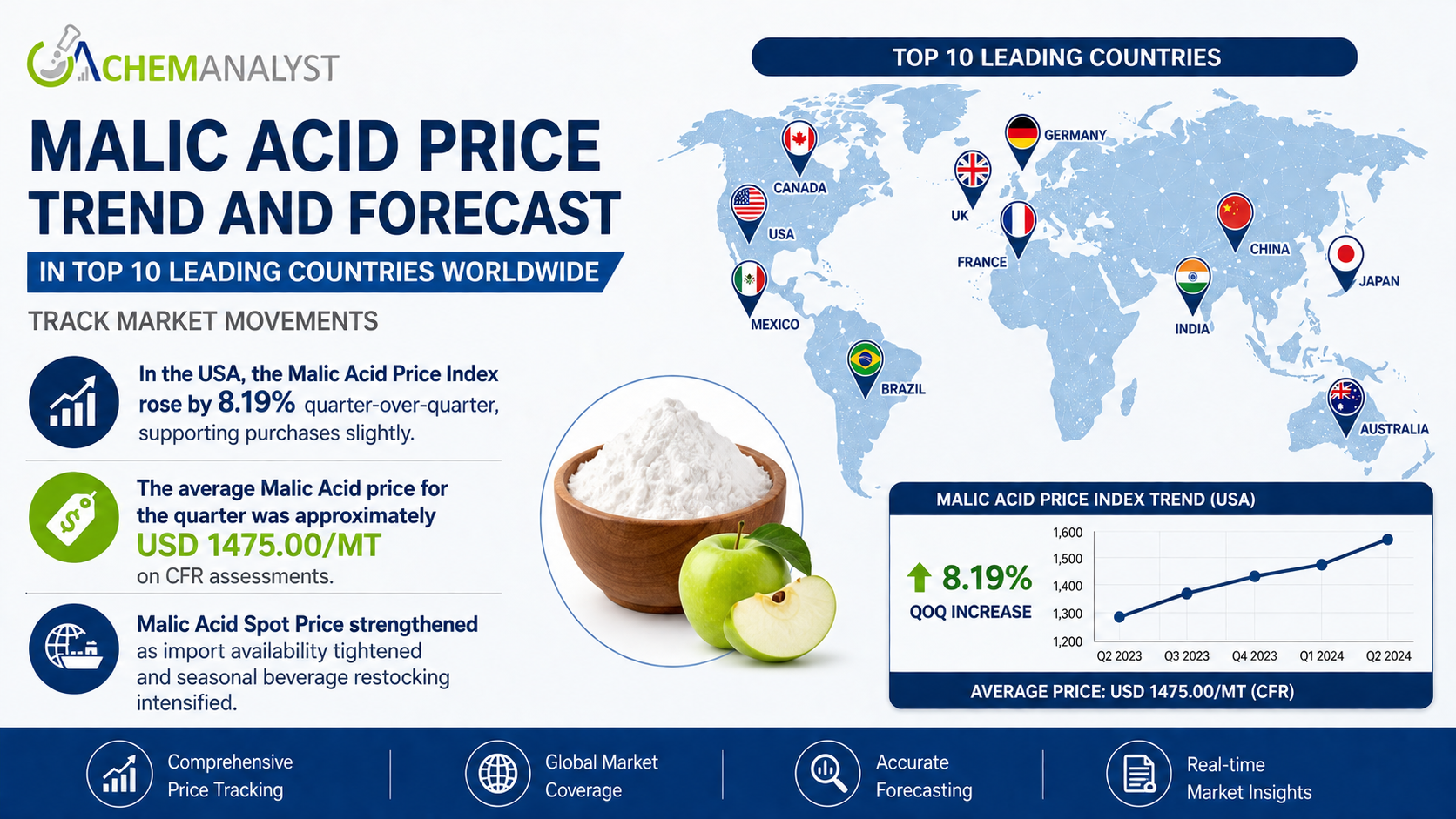
The United States recorded a steady upward price trend in Q1 2026.
Price Trend in the USA
Quarter-over-quarter change: +8.19%
Average price: USD 1475.00/MT
Pricing basis: CFR
Malic Acid prices in the United States rose due to stronger procurement activity and improving downstream demand.
Purchasing interest from food processors and beverage manufacturers strengthened market fundamentals.
Key growth drivers included:
Increased procurement activity
Stable manufacturing demand
Improved restocking cycles
Moderately tighter supply
Market sentiment improved as buyers returned to secure medium-term contracts.
North America Outlook
The U.S. Malic Acid market could remain stable to bullish if:
Beverage demand strengthens
Consumer spending remains resilient
Supply remains balanced
Short-term volatility will likely depend on import availability.
Malic Acid Demand by Application
Food Acidulants
Food acidulation remains the largest application segment. Malic Acid provides a cleaner sour taste compared to citric acid.
Major applications include:
Gummies
Sour candies
Carbonated beverages
Sports drinks
Functional Nutrition
Health-conscious consumers are increasing demand for performance supplements containing Malic Acid.
Use cases include:
Electrolyte drinks
Recovery products
Energy supplements
Industrial Applications
Industrial sectors use Malic Acid in:
Chemical synthesis
Metal cleaning
Specialty formulations
Though smaller in volume, these applications contribute stable demand.
Global Supply Chain Trends for Malic Acid
Global supply chains have become more resilient compared with previous years, yet vulnerabilities remain.
Major supply concerns include:
Raw material shortages
Shipping disruptions
Port delays
Geopolitical uncertainties
Manufacturers are increasingly diversifying suppliers to reduce sourcing risks.
Procurement teams are adopting:
Long-term contracts
Strategic stockpiling
Regional sourcing diversification
These strategies improve supply security amid volatility.
Malic Acid Price Forecast 2026
The Malic Acid market is expected to remain moderately volatile throughout 2026.
Bullish Factors
Price upside may come from:
Rising feedstock costs
Supply shortages
Strong beverage demand
Export recovery
Bearish Factors
Price downside risks include:
Oversupply
Weak consumer demand
Slower manufacturing activity
Reduced export orders
Most analysts expect regional divergence rather than a uniform global trend.
Expected market direction:
APAC: Stable to slightly bearish
Europe: Moderately bullish
North America: Stable to bullish
Future Outlook for the Global Malic Acid Industry
The long-term outlook for Malic Acid remains positive due to expanding applications in food technology, wellness products, and specialty chemicals.
Several megatrends are expected to shape the industry:
Clean Label Food Innovation
Consumers increasingly prefer ingredients perceived as safe and naturally derived.
Functional Beverage Expansion
Energy drinks, sports beverages, and nutraceutical drinks continue growing globally.
Bio-Based Chemical Production
Sustainable production technologies may reshape Malic Acid manufacturing economics.
Producers investing in efficient production technologies and resilient supply chains will gain competitive advantage.
Conclusion
The global Malic Acid market in 2026 reflects a complex pricing environment shaped by regional demand, supply constraints, raw material costs, and trade dynamics.
Japan experienced price declines due to weak export inquiries, while the Netherlands and the United States saw strong price increases supported by improved procurement and tighter market conditions.
As industries continue expanding applications for Malic Acid in food, beverages, pharmaceuticals, and personal care, long-term demand fundamentals remain strong. Businesses monitoring price trends, market signals, and procurement risks will be best positioned to navigate future volatility and capitalize on growth opportunities in the evolving Malic Acid market.
Contact -
Address:
420 Lexington Avenue, Suite 300
New York, NY 10170
United States
Phone: +1 332 258 6602
Website: www.chemanalyst.com
LinkedIn: https://www.linkedin.com/company/chemanalyst/
X (Twitter): https://x.com/chemanalysts
Facebook: https://www.facebook.com/ChemAnalysts/
Comments
Log in or sign up to join the conversation.