

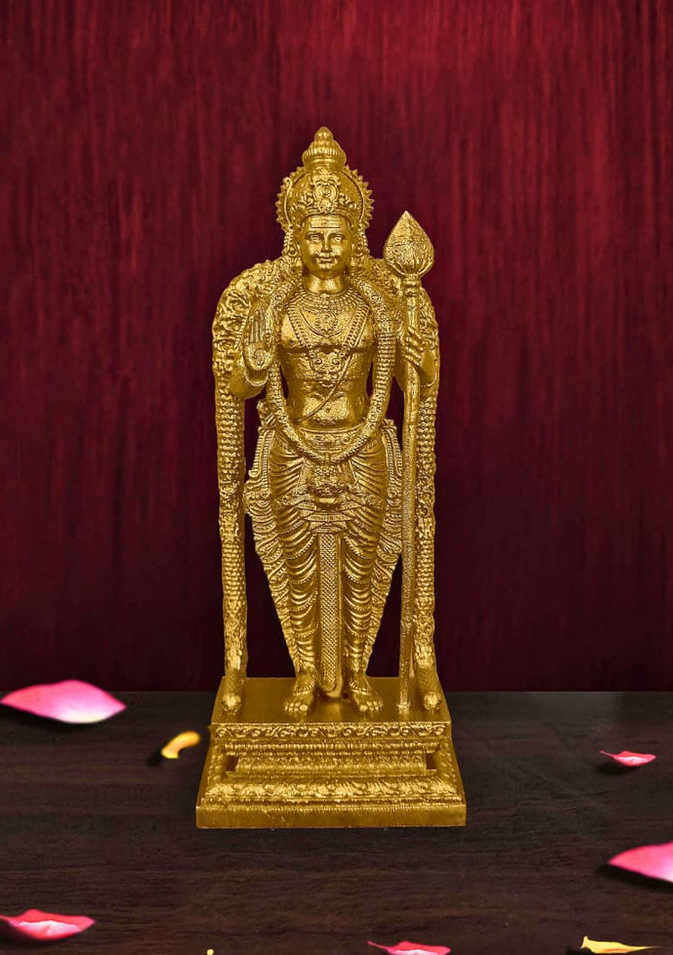
Pathumalai Murugan is how devotees across Malaysia and the wider Tamil diaspora know Lord Murugan as he's worshipped at Batu Caves - the towering limestone hill in Selangor that has grown into one of the most visited Hindu pilgrimage sites outside India. Many who make the trip end up bringing a Brass Murugan idol home with them too, carved in his familiar Vel-bearing, peacock-mounted form, so that same devotion doesn't have to stay behind at the hill.
The word “Pathumalai” literally means “Tenth Hill” in Tamil. Behind this simple name lies a fascinating story of migration, faith, and cultural heritage—a story of a community that carried its sacred traditions and spiritual landscape across the ocean. Today, Pathumalai Murugan stands as a meaningful connection between ancient South Indian traditions and the Tamil community in Southeast Asia, a heritage that Idol Brass is proud to help share
Who Is Pathumalai Murugan?
Murugan and the Arupadaiveedu Tradition
In Tamil Shaivite worship, Lord Murugan - also known as Skanda, Kartikeya, Subramanya and Shanmukha - is traditionally associated with six sacred abodes in Tamil Nadu known as the Arupadaiveedu, each marking a place where he is believed to have manifested or resided: Tiruttani, Swamimalai, Palani, Pazhamuthircholai, Thiruchendur and Tiruparankundram. As Tamil communities settled abroad during the nineteenth and twentieth centuries, this same devotional geography began to extend beyond India's shores.
The "Tenth Hill" Beyond India
In Malaysia, this extension took shape through a chain of hill shrines dedicated to Murugan: Kallumalai in Ipoh, Tanneermalai in Penang, Sannasimalai in Malacca, and finally Pathumalai - the "tenth" sacred hill - at Batu Caves near Kuala Lumpur. Together, these shrines allowed the Tamil diaspora to recreate a familiar sacred landscape in a new home, with Pathumalai Murugan standing as its most prominent and best-known figure today.
The Iconography and Symbolism of Pathumalai Murugan
At Batu Caves, Murugan is depicted in his traditional form - youthful, six-faced in his Shanmukha aspect, holding the Vel (his divine spear, a gift from his mother Parvati for vanquishing evil), and closely associated with the peacock, his vahana. The Vel represents the piercing of ignorance and ego, while the peacock symbolizes the taming of pride and vanity beneath spiritual wisdom.
What makes Pathumalai Murugan especially striking is scale: a 42.7-metre gold-painted statue of Murugan stands at the base of the caves, unveiled in 2006 and recognized as the tallest statue of the deity in the world. Visible from a considerable distance, it announces the presence of the shrine long before a visitor reaches its base, turning the entire hillside into a single, unmistakable act of devotion.
The Story of How Pathumalai Murugan Came to Be
A Cave Shaped Like a Vel
The story of Batu Caves as a Murugan shrine begins not with a myth from ancient scripture but with a nineteenth-century discovery. According to popular account, the entrance of the main cave was said to resemble the shape of Murugan's Vel, and this resemblance was taken as a sign that the site was destined for his worship - a natural landmark reinterpreted through devotional eyes.
K. Thamboosamy Pillai and the Founding of the Shrine
The shrine at Batu Caves was formally established in 1891 by K. Thamboosamy Pillai, a prominent Tamil community leader in colonial Malaya. Inspired by the cave's vel-like opening, he installed a murti of Lord Murugan inside and consecrated the site, laying the foundation for what would grow into the most significant Murugan pilgrimage destination outside India.
Growing Into a Pilgrimage Landmark
Over the following century, the shrine expanded steadily - a staircase of 272 steps was built up to the main cave entrance, additional shrines were established within the cave complex (including the Ramayana Cave and the Dark Cave), and the towering gold statue was added in 2006, cementing Batu Caves' place on the global map of Hindu pilgrimage sites.
Batu Caves: The Home of Pathumalai Murugan
Batu Caves sits roughly thirteen kilometres north of Kuala Lumpur, formed from limestone hills estimated to be over 400 million years old. The main cave, known as Temple Cave, houses several shrines beneath its vaulted natural ceiling, reached only after climbing the steep flight of steps guarded at its base by the towering Murugan statue. The site functions simultaneously as a working temple, a pilgrimage destination and one of Malaysia's most recognized landmarks - a rare instance where geology, colonial-era community history and living devotion have combined into a single sacred place.
Spiritual Significance of Pathumalai Murugan
Devotion to Pathumalai Murugan carries several layers of meaning for worshippers:
Continuity of tradition - the shrine represents the Tamil diaspora's success in carrying the Arupadaiveedu tradition beyond India without losing its sacred structure.
Triumph over obstacles - as with Murugan's other forms, the Vel represents piercing through ignorance, ego and hardship.
Community and identity - Batu Caves has become a unifying pilgrimage site for the entire Tamil Hindu community in Malaysia, especially during Thaipusam.
Devotional endurance - the physical climb up 272 steps is itself treated as an act of penance and dedication, mirroring the spiritual effort of approaching the divine.
Why Is Pathumalai Murugan Different from the Six Traditional Abodes
Unlike the six Arupadaiveedu shrines in Tamil Nadu, each rooted in a specific Puranic episode from Murugan's mythology, Pathumalai Murugan's significance comes from a different kind of story - one of diaspora, community-building and the human decision to declare a distant hillside sacred. It is not one of the original six abodes but their extension, the "tenth hill" added by devotees far from home. This makes Pathumalai Murugan a symbol not just of Murugan's power, but of a community's determination to keep its faith alive across borders - a living continuation of tradition rather than a repetition of it.
Batu Caves is also, each January or February, the focal point of one of the largest Thaipusam gatherings in the world, where devotees carry kavadi - ornate structures borne on the shoulders, sometimes pierced through the skin as an act of penance and gratitude - up the 272 steps to the main shrine, drawing over a million pilgrims and visitors during the festival.
Conclusion
Pathumalai Murugan tells a story that is as much about people as it is about the divine - a nineteenth-century community that looked at a limestone hill and recognized in it the shape of their god's own weapon, and built from that recognition one of the most visited Hindu pilgrimage sites in the world. From the Arupadaiveedu tradition's extension into Malaysia, to the towering golden statue that now marks Batu Caves from afar, to the annual river of Thaipusam devotees climbing its 272 steps, Pathumalai Murugan stands as a reminder that sacred geography can travel as far as faith carries it.
Comments
Log in or sign up to join the conversation.