
Healthcare decisions are rarely just about choosing the newest procedure.
When people research treatment options for piles, they often compare laser treatment with traditional surgery based on headlines, advertised recovery times or the assumption that newer technology must be better.
That approach can be misleading.
A better healthcare decision considers the patient's diagnosis, severity of the condition, expected benefits, recovery requirements, risks and the possibility of needing further treatment.
Why Treatment Choice Isn't One-Size-Fits-All
Piles, also called hemorrhoids, can range from mild internal hemorrhoids to advanced prolapse and combined internal and external disease.
Someone with mild symptoms may improve with conservative measures such as increasing fibre, drinking adequate fluids, avoiding excessive straining and managing constipation.
Another patient may require an office-based procedure, minimally invasive treatment or surgery.
So comparing treatment costs or technologies without understanding the underlying condition can produce the wrong conclusion.
Laser Treatment vs Conventional Surgery
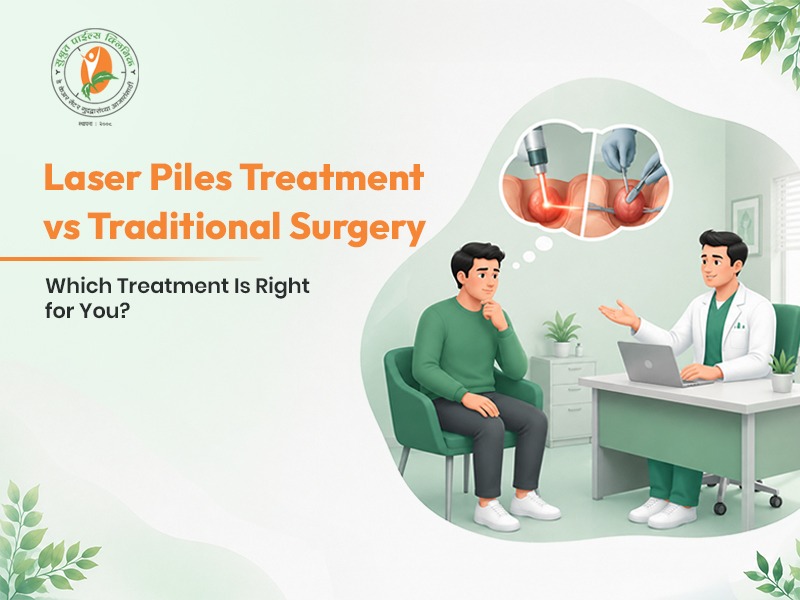
Laser piles treatment can refer to different minimally invasive techniques that use laser energy to treat hemorrhoidal tissue.
Some selected patients may benefit from less tissue disruption and an easier early recovery.
However, “laser” doesn't automatically mean painless, risk-free or superior to every surgical alternative.
Traditional excisional hemorrhoidectomy remains an important treatment for selected patients, particularly those with advanced hemorrhoids, significant prolapse, large external hemorrhoids or symptomatic combined internal and external disease.
The trade-off can be a more demanding recovery and greater postoperative discomfort.
For patients comparing the two approaches, this detailed guide to laser piles treatment and traditional surgery explains the major differences and the factors that can influence treatment selection.
Why the Diagnosis Matters More Than the Technology
Internal hemorrhoids are commonly classified from Grade I to Grade IV.
Grade I hemorrhoids remain inside the anal canal.
Grade II may prolapse during bowel movements but return on their own.
Grade III prolapse and may require manual reduction.
Grade IV remain prolapsed and cannot be pushed back.
The grade provides useful information, but treatment decisions can also depend on external hemorrhoids, symptom severity, previous treatment, recurrence and overall health.
This is why a blanket recommendation such as “laser is better” doesn't make much sense.
Think Beyond the Initial Treatment
Patients often focus on the upfront treatment and overlook recovery and long-term considerations.
Before agreeing to a procedure, it is worth asking:
What exact procedure is being recommended?
Why is it appropriate for this particular condition?
What will recovery involve?
How much postoperative discomfort is expected?
When can normal activities resume?
What are the potential complications?
How likely are symptoms to recur?
Could another treatment be required later?
These questions can provide a more realistic picture than comparing treatment names alone.
Cost Isn't the Only Measure of Value
A cheaper procedure isn't necessarily the better choice, just as a more expensive procedure isn't automatically superior.
The practical value of a treatment depends on whether it is appropriate for the condition and whether the expected benefits justify the recovery, risks and possibility of additional treatment.
For that reason, patients should be cautious about choosing a procedure solely because it is marketed as newer, faster or more advanced.
A More Sensible Way to Compare Treatments
The better approach is:
Diagnosis → severity → treatment options → expected benefits → risks → recovery → recurrence → informed decision.
That sequence is more useful than starting with a particular technology and trying to justify it afterward.
If you're researching piles treatment options and comparing laser treatment with surgery, use the information as a starting point for a discussion with a qualified specialist.
The goal isn't to find the treatment with the most impressive marketing.
It's to find the treatment that is appropriate for the patient's actual condition.
Comments
Log in or sign up to join the conversation.