
By The Numbers
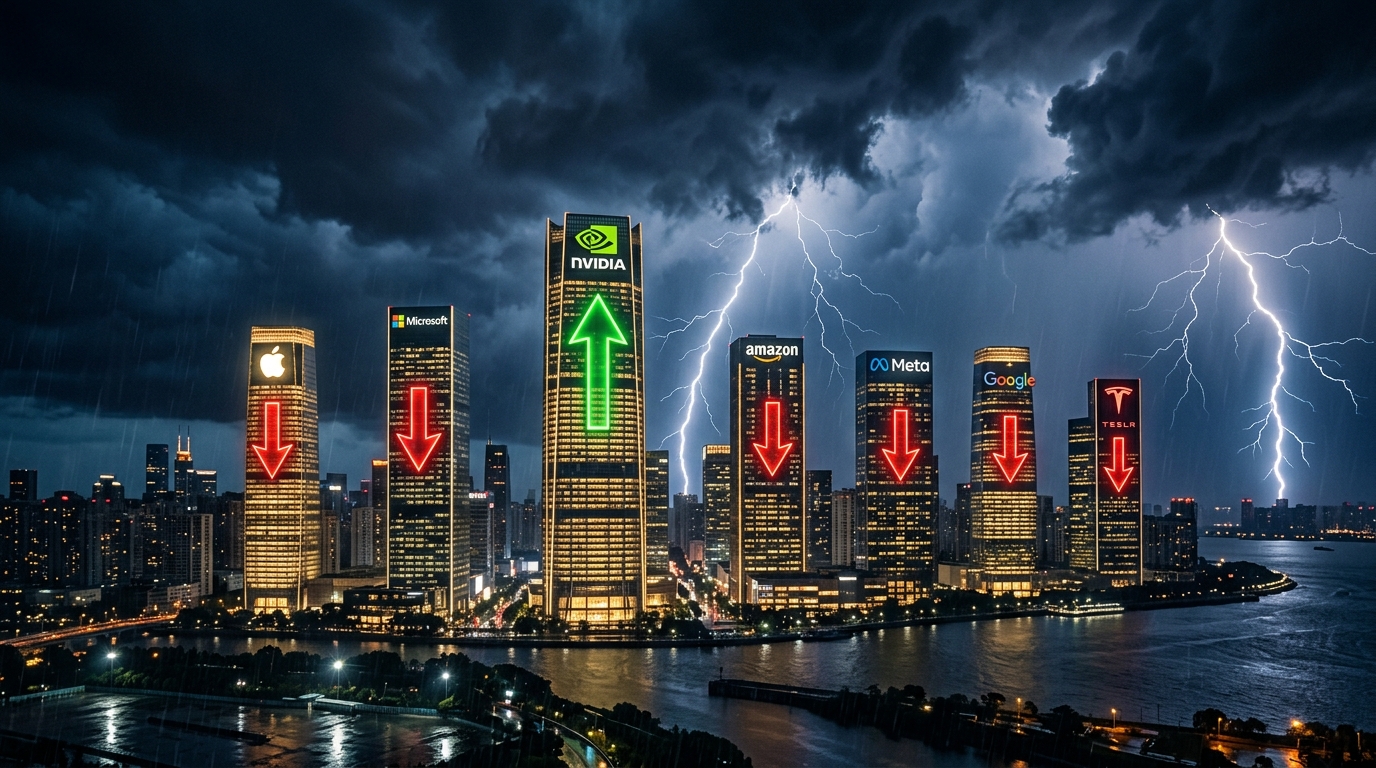
$2 trillion+ — total market cap erased from the Magnificent 7 during the first two weeks of June (S&P 500 tracking data)
5.44% — Meta (META)'s single-day decline on June 17 alone, its worst one-day drop in months
$84.75 billion — equity capital Alphabet (GOOGL) raised to fund AI data center expansion, a deal that was upsized from $80 billion
0.5% — the Federal Reserve's signal this week of potentially higher rates later in 2026, reigniting growth-stock pressure
$200 billion — Amazon (AMZN)'s annual infrastructure spending commitment that continues to weigh on free cash flow projections
The Federal Reserve spoke on Wednesday. The Magnificent 7 listened. Most didn't like what they heard.
The Fed signaled that interest rates could stay higher for longer than the market had priced in. Tech stocks, especially the megacaps running trillion-dollar AI infrastructure build-outs, got hit fast. Meta dropped more than 5% in a single session. Amazon, Alphabet, and Microsoft (MSFT) all fell. The only place to hide in the group was Apple (AAPL), which managed a modest gain on the week as investors bet on AI feature announcements ahead.
Here is where each stock stood at Wednesday's close (June 17) versus last Friday (June 13) and what drove the move.
This Week's Scorecard
Performance from last Friday's close (June 13) through Wednesday's close (June 17).
Stock | Price | This Week |
|---|---|---|
AAPL | $295.95 | +1.7% — resilient; AI rollout speculation |
GOOGL | $363.79 | +1.6% — cloud growth justifying $84.75B raise |
$207.41 | Flat — chip demand intact; digesting buyback | |
AMZN | $237.50 | -0.4% — $200B capex story won't go away |
$396.38 | -2.5% — SpaceX merger talk cools | |
MSFT | $378.91 | -3.1% — Azure solid; capex scrutiny rising |
META | $567.58 | -6.2% — worst in group; subscription concerns |
The Big Story: Meta's Worst Day in Months
Meta dropped 5.44% on Wednesday alone. That's not a bad day. That's a statement. It made Meta the worst performer in the group for the week and erased roughly $180 billion in market cap in a single session.
The proximate cause: investor skepticism about Meta's paid subscription tier. The company launched paid access with features tied to AI tools and an ad-free experience. Wall Street looked at the pricing structure and the addressable audience and started questioning the revenue assumptions baked into the stock. At $600, Meta was trading as though that subscription model would materialize into meaningful recurring revenue. At $567 after Wednesday, the market is less sure.
Hold on. Let me stop here. This is not a fundamental story yet. Meta's advertising business is still generating around $14 billion in quarterly profit. The subscription revenue, even if it disappoints, is not the engine. But markets price expectations. And right now, the expectations that drove Meta from $450 to $600 over the past year are getting repriced alongside the rate signal from the Fed.
The question for Meta is whether the AI investment thesis still holds when rates stay higher for longer. AI-driven ad targeting, Llama model development, and the metaverse pivot all require sustained capex. At higher rates, that capex is more expensive to justify. The math changes. Not catastrophically. But enough to move a stock 5% in a day.
Apple Holds Its Ground
Apple was the only large gainer in the group this week. Up 1.7%, it held $295 and is trading within reach of its year-to-date highs.
The thesis here is specific: investors are betting that Apple Intelligence, the company's AI feature set now rolling out across iPhone, iPad, and Mac, will be the thing that breaks the upgrade cycle open. This is kinda like how the iPhone 6 triggered a supercycle upgrade in 2014. The AI features are not incremental. Siri is being rebuilt from the ground up. On-device processing is getting a hardware overhaul. When that combination lands cleanly on a consumer product 1.4 billion active users already hold, the upgrade conversation is different from anything a pure AI software company can offer.
Apple also benefits from a structural advantage that matters in a high-rate environment: its services business generates recurring revenue without heavy capital spending. While Amazon and Alphabet are writing $200 billion-plus annual capex checks, Apple's business model prints cash. That cash buys back stock. The buyback shrinks the share count. Earnings per share grow even without top-line acceleration.
You do not have to trust me. Trust the free cash flow yield. At current prices, Apple generates roughly $100 billion in free cash flow annually. That's a 5.5% FCF yield on its market cap. In a market where the 10-year Treasury is pushing toward 4.5%, a 5.5% yield from a company that also grows is not expensive. It is defensible.
"The Mag 7 AI arms race of 2026 is being repriced. Not abandoned. Repriced. The companies that generate cash today get the benefit of the doubt. The ones burning it need proof."
What to Watch Next Week
The Fed's next move will set the tone. The rate signal from June 17 was not a rate hike. It was language. Watch how the bond market reacts to incoming economic data over the next five trading days. If the 10-year yield pushes above 4.6%, the pressure on high-multiple tech names intensifies. If yields back off, expect a relief rally, particularly in the most beaten-down names like Meta and Amazon.
Nvidia is the number to watch. It closed Wednesday at $207 and was down about half a percent on a bad tape. That relative resilience matters. Nvidia's upcoming quarterly print will tell the market whether the AI hardware spending translating into actual chip orders has continued to accelerate or if the infrastructure pause at some hyperscalers is showing up in order flow. Until that print, the stock is in a holding pattern.
Tesla needs a new catalyst. The SpaceX merger speculation that pushed the stock above $420 in May has faded. FSD continues to expand in Europe. But without a concrete growth driver, Tesla is drifting. The robotaxi timeline and any Optimus production update are the two events that could re-energize buyers. Neither is imminent.
P.S. The Magnificent 7 shed $2 trillion in June. That's not destruction. That's a reset. The companies that can prove their AI spending generates real revenue will earn back those multiples. The ones that can't will stay under pressure until they do.


Comments
Log in or sign up to join the conversation.