

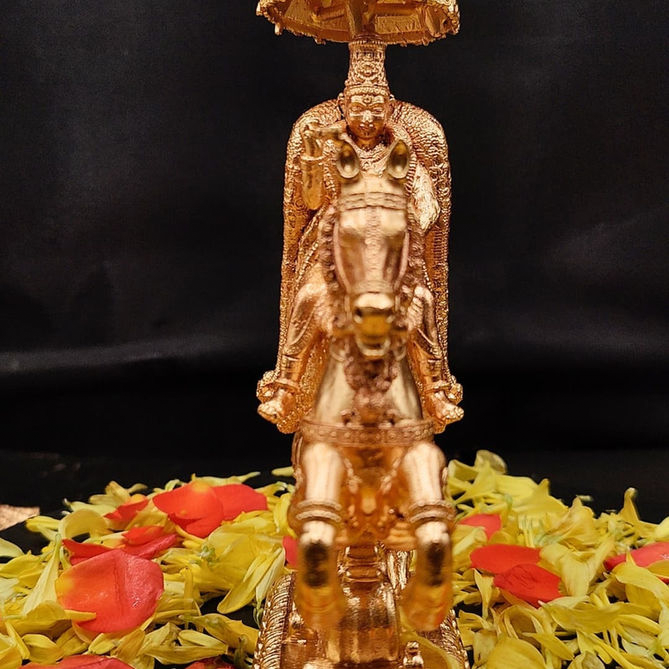
Kallalagar is the beloved Vishnu form worshipped at Alagar Kovil, a temple set against a wooded hillside just north of Madurai, where he is known formally as Sundararaja Perumal. A Bronze Kallalagar idol lets devotees bring this same graceful form of Vishnu into their own pooja room, cast with the same serenity that has drawn pilgrims to Alagar Kovil since the Sangam age.
Few deities in Tamil Nadu are woven as tightly into a city's identity as Kallalagar is into Madurai's. Every year, his journey toward the Vaigai river becomes one of the region's most anticipated devotional events - a story of brotherly devotion, folk tradition and divine grace that Gold plating art studio is glad to help carry into homes today.
Who Is Madurai Kallalagar?
Sundararaja Perumal of Thirumaliruncholai
Kallalagar's temple, known in Sangam literature as Thirumaliruncholai, is counted among the 108 Divya Desams - the sacred Vishnu shrines glorified by the Alvar saints in the Naalayira Divya Prabandham. Here Vishnu is worshipped as Kallalagar, "the beautiful lord of the Kallar," alongside his consort Sundaravalli Thayar. The temple, built on a hill north of Madurai, is believed to have been patronized as early as the reign of Malayadhwaja Pandyan, one of the earliest known Pandyan kings - and, notably, the father of Goddess Meenakshi herself.
Why "Kallalagar"?
The name Kallalagar carries a layer of meaning beyond simple beauty. During his annual procession, the deity is dressed in the attire of the Kallar community, a locally prominent group, and this folk association is reflected directly in his name. It is a striking example of how South Indian Vaishnavite worship has, over centuries, absorbed and honored local custom rather than standing apart from it - the divine choosing to dress, quite literally, as one among the people.
The Iconography and Symbolism of Kallalagar
Kallalagar is depicted in the temple in seated, standing and reclining forms, each showing Vishnu holding his customary discus (Sudarshana Chakra) and conch (Panchajanya), with a third hand in the gesture of blessing. During his most famous procession, he appears mounted on a golden horse, dressed in vivid green Kandangi silk, radiating the same protective, preserving energy associated with Vishnu across his many forms. The greenery of his attire is said to echo the lush, forested hill on which his temple stands, while the golden horse signals his stature and grace as he descends from Alagar Kovil to mingle with his devotees in the city below.
The Legend of Kallalagar and the Wedding at Madurai
An Invitation to His Sister's Wedding
The most cherished story associated with Kallalagar concerns his relationship with Goddess Meenakshi, whom tradition regards as his sister - both being children of King Malayadhwaja Pandyan. When Meenakshi was to be married to Lord Sundareswarar (Shiva) in Madurai, Vishnu, as Kallalagar, set out from his hillside abode to attend the wedding and give his sister away, as custom required of an elder brother.
Turning Back at the Vaigai
The journey from Alagar Kovil to Madurai, though not long in distance, unfolded slowly, and by the time Kallalagar reached the banks of the Vaigai river, word reached him that the wedding ceremony had already concluded without him. Furious at having missed the sacred moment, he turned back toward his hill in anger, refusing to enter the city. It was only through the intervention of Sundareswarar and Meenakshi themselves, who came to the riverbank to appease him, that his anger was soothed - a moment of reconciliation still commemorated every year.
A Festival Reborn from a Myth
This legend lives on today as the Chithirai festival, one of Madurai's grandest annual celebrations. Kallalagar's procession retraces that same journey - departing Alagar Kovil on a golden palanquin, crossing through Madurai's streets in the Kallar's Kandangi attire, and finally entering the Vaigai river on a golden horse, where he is received by Lord Veeraraghava Perumal on a silver horse. Before entering the river, his image is adorned with a tulsi garland sent especially from the Andal Temple at Srivilliputhur, a gesture said to express Andal's own devotion toward him.
Alagar Kovil: The Home of Kallalagar
Alagar Kovil, roughly twenty-five kilometers north of Madurai, sits at the base of the Alagar hills, surrounded by forest and fed by the sacred Noopura Ganga Teertham, a stream believed to have emerged from Vishnu's own anklet. The temple's impressive entrance tower, built under Pandyan patronage, is carved with scenes from Hindu epics, and the site itself finds mention in the works of Sangam-era poets, including the celebrated Tamil poet Nakkeerar, underscoring just how far back devotion to Kallalagar reaches in Tamil literary history.
Spiritual Significance of Kallalagar
Devotees turn to Kallalagar for a number of reasons rooted in this rich tradition:
Protection and preservation - as a form of Vishnu, he carries the discus and conch associated with cosmic order and safeguarding.
Familial devotion - his journey to Meenakshi's wedding, and his eventual reconciliation at the Vaigai, is honored as a model of sibling love and forgiveness.
Unity across tradition - his adoption of Kallar attire reflects the blending of elite temple worship with local, folk devotion.
Renewal and community - the annual Chithirai festival draws devotees from across Tamil Nadu, reaffirming collective faith each year.
Why Is Kallalagar Different from Other Vishnu Forms
While many Divya Desam forms of Vishnu are worshipped primarily within their own temple walls, Kallalagar is distinguished by how actively his story is re-enacted each year in a living festival that moves through an entire city. His myth is not read from scripture alone - it is walked, danced and sung through Madurai's streets annually, with hundreds of thousands of devotees dressing as Kallalagar and Karuppanasamy in celebration. Few other Vishnu forms are so deeply entwined with a specific city's civic identity, making Kallalagar as much a symbol of Madurai itself as he is a form of the preserver god.
Conclusion
Kallalagar's story is one of family, forgiveness and a divine journey that Madurai still walks every year. From his seat at Alagar Kovil's forested hillside, through the legend of his sister Meenakshi's wedding, to his golden-horse entry into the Vaigai river each Chithirai, Kallalagar represents a form of Vishnu deeply woven into Tamil life and land. For devotees seeking to honor that same spirit of grace and devotion at home, a handcrafted bronze Kallalagar idol offers a lasting connection to this cherished Madurai tradition.
Comments
Log in or sign up to join the conversation.