


It has been a while since we checked in on RDMIX. From my first blog post about it, that fund used to be the "Return Stacked 60/40 Absolute Return Index which is a portfolio of funds blended together with a lot of embedded leverage in pursuit of capital efficiency. It's a very sophisticated portfolio."
At the start of 2025, it changed to the ReturnStacked Balanced Allocation & Systematic Macro Fund, which allocates 50% to domestic equities, 50% to US bonds, and 100% to a systematic macro program that can go long or short just about everything. Like many of the ReturnStacked products, it leverages up to combine beta/simpler exposures with some sort of alternative diversifier/more complicated exposure to hopefully add alpha.
I've been skeptical of their funds. There's a lot to learn from their content and what they are trying to do, but too frequently, it appears to me they aren't really solving the problems they're trying to solve, and I think the latest iteration of RDMIX is another example. Since the new strategy was implemented at the start of 2025, testfol.io has the fund compounding at 10.38% with a max drawdown of 16.54% and a volatility of 12.65%. Gemini thinks the vol target for the fund is 10-12%.
Putting 100% into RDMIX is not what they have in mind for how to use it. A 50% allocation is closer to what they have in mind for how to use it, and then there's 50% left over for something, maybe more alternatives or just collecting interest or whatever else. Closer to the real-world application would be to figure out how much you want in macro and then do the arithmetic to size the overall equity and bond position accordingly. The leverage of their funds allows for not having to reduce equities or fixed income to add alternatives.
I started with the following to try to assess the fund. Even if it's not the exact intended use, I believe it allows for understanding the relative performance.
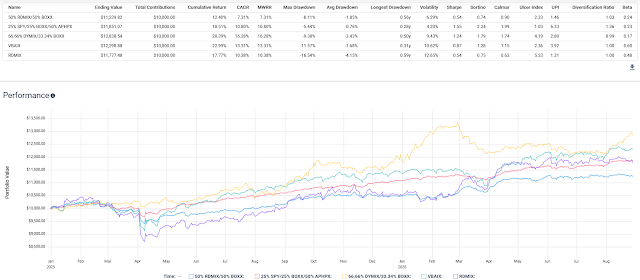
Portfolio 3 with DYMIX isn't really apples to apples. It has a macro component, so maybe there's context, but it has a much different volatility profile. I think the sort of low volatility number for the portfolio comes from having a lot of BOXX. The RDMIX/BOXX combo in Portfolio 1 lags Portfolio 2, which I think is reasonably comparable in terms of the allocations and the outcomes sought. Portfolio 2 also slightly outperformed putting 100% into RDMIX, which is interesting. Better growth rate with less volatility and without the complexity of leverage or potential drag from costs associated with financing the leverage. Macro is complex enough without the leverage that is part of RDMIX's structure.
The next chart isolates the macro sleeve of RDMIX by shorting out the equity and fixed income and comparing to a couple of different macro funds.
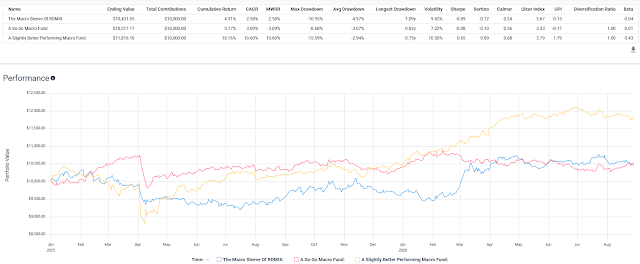
It's a short window because of RDMIX's current strategy inception. The next chart goes much further back. Maybe you look at it and aren't interested in macro, which would be fair, or maybe you do see some performance attribute you want to include, but if you're willing to entertain leverage to build some sort of portable alpha portfolio for yourself, I'm not sure it's worth leveraging up to make room for either of these two macro funds.
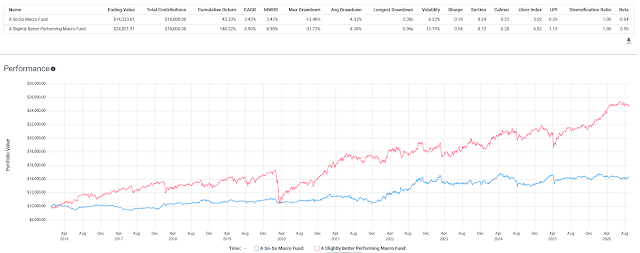
They each do different things. They are different enough that owning both isn't really doubling up on the same thing. The idea of 25% fixed income, 25% equities, and 50% macro is not one we've looked at before. For the following, the so-so fund is Fund 1, and the slightly better fund is Fund 2.
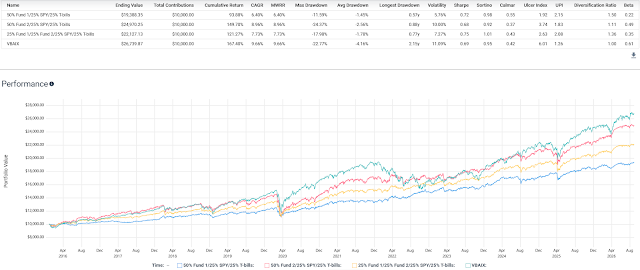
There's a little something for everyone here. Portfolio 1 is pretty much an absolute return result while Portfolio 2 looks very similar to VBAIX. Macro Fund 1 only has about 6% exposure to equities according to Finominal, while Macro Fund 2 has 49%, which accounts for most of the performance difference between the two macro funds. As I said, they do different things. Blending both together in Portfolio 3 doesn't shoot the lights out but has the highest Sharpe Ratio by a couple of ticks. If you go play around with this yourself, you will see that all three macro-heavy blends did much better than VBAIX in 2022, which is not a surprise, but they also did noticeably better in crashes of 2020 and 2025.
Circling back to the first backtest above, if we sub in Macro Fund 1 into Portfolio 2 and take out APHPX, the portfolio has the same CAGR as Portfolio 1 with a little less volatility, but it does lag putting 100% into RDMIX. If we sub in Macro Fund 2 into Portfolio 2 and take out APHPX, the portfolio has a better CAGR than 100% RDMIX but a little more volatility than Portfolio 1.
I have no serious interest in this idea beyond curiosity, but if you do, one of the box spread ETFs instead of T-bills should be more tax efficient, or of course you could try to get some sort of better result than T-bill-like returns, but for this post I wanted to isolate the macro strategies.



Comments
Log in or sign up to join the conversation.