


Record low water levels in the Rhine could shave 0.3 percentage points off Germany's GDP growth this year.
Some might know that I used to be, and still am, a passionate rower. Rowing on Frankfurt's Main River is not always a pleasure. High water levels and strong currents in winter, combined with commercial river traffic throughout the year, do not make it an ideal place to train. That is, except when water levels are low.
For rowers, low water levels mean calm currents, flat water and very little traffic. Against this backdrop, I have witnessed the effects of climate change during the 12 years I have lived in Frankfurt: fewer periods of high water in winter and longer stretches of flat water in summer. Unfortunately, what has been good for my favourite hobby has become a clear risk for the German economy: low water levels.
Why the Rhine matters for German industry
Yesterday, my colleague Rico Luman wrote about the impact of low water levels in the Rhine and the consequences for supply chains. For Germany, however, the Rhine is not simply one transport option among many. It is a piece of industrial infrastructure around which much of German industry was physically built.
Roughly 285 million tonnes of freight move along the river annually, making it Europe's most important logistics corridor after the open seas. It carries about 80% of all goods transported on Germany's inland waterways, while some 600 vessels cross the Dutch-German border every day. The corridor connects Rotterdam directly to three of Germany's largest industrial clusters: Rhine-Ruhr steel, Rhine-Main and the Ludwigshafen chemical complex.
This is no coincidence. The plants were built along the Rhine in the nineteenth century to benefit from barge transport and access to process water, and they have remained there ever since. When the Rhine runs low, the impact extends far beyond supply chains; it strikes at the heart of German industry.
The Rhine's historic importance also means there are no real alternatives. Replacing a single barge can require up to 100 trucks or an entire freight train. And that's before taking into account Germany's well-known infrastructure challenges. Rail and road simply cannot provide a like-for-like substitute for Rhine transport. This is not to say that industry has not reacted to more frequent and longer periods of low water levels. Think of shallow-water barges and higher inventory levels.
Economic impact of low water levels
On Monday, the water level at Kaub fell to 24cm, the lowest level since records began in 1880. The last record low was 25cm in October 2018. This highlights how severe the current situation is. Normally, periods of low water occur between September and November, not in the middle of summer. Yet current forecasts for the next two weeks show little rainfall, suggesting that conditions are likely to worsen.
Water level in Kaub
(average per calendar week in cm)
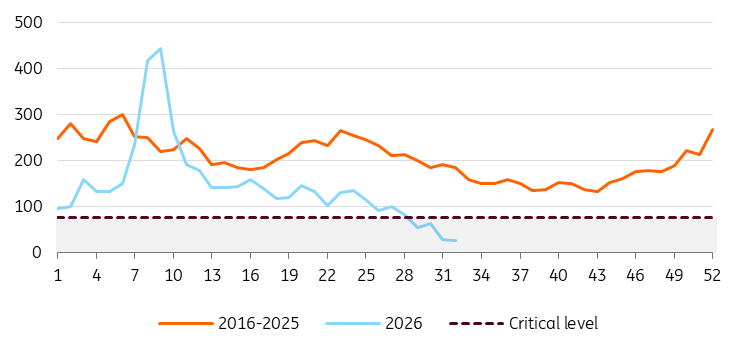
As the Rhine is home to crucial industries, the economic impact of supply chain constraints, and a potential reduction in production is much larger than the Rhine's c.6% share of total German freight volume would suggest.
A 2020 Kiel Working Paper found that low water levels in the Rhine, particularly during the 2018 drought, affected the German economy through both transport and production channels. A full month of low water reduced inland shipping volumes by about a quarter, while industrial production fell by roughly 1%. Overall, the 2018 episode is estimated to have shaved around 0.3 percentage points off German GDP growth.
The risk is high that this time around, the economic impact will be larger. The low water levels at the start of August are unprecedented and fully out-of-sample when taking the Kiel paper as a proxy. Obviously, the economic impact now highly depends on the length of the current drought. A week of heavy rain could change the economic picture for the better immediately – even if this currently appears unlikely to happen. Unless the German government finds a reliable rainmaker, we should prepare to see a repetition of 2018 with a negative impact of at least 0.3 percentage points of GDP growth. This comes as a big setback given that the German economy has grown for three quarters in a row and was on track to reach annual GDP growth of some 0.8% this year. A blow to the recovery but not enough to ignite recession fears.
In any case, the negative economic impact will probably make my next outing less enjoyable. Or perhaps not. I may simply find myself humming R.E.M.'s It's the End of the World as We Know It (And I Feel Fine).


Comments
Log in or sign up to join the conversation.