

Market Analysis
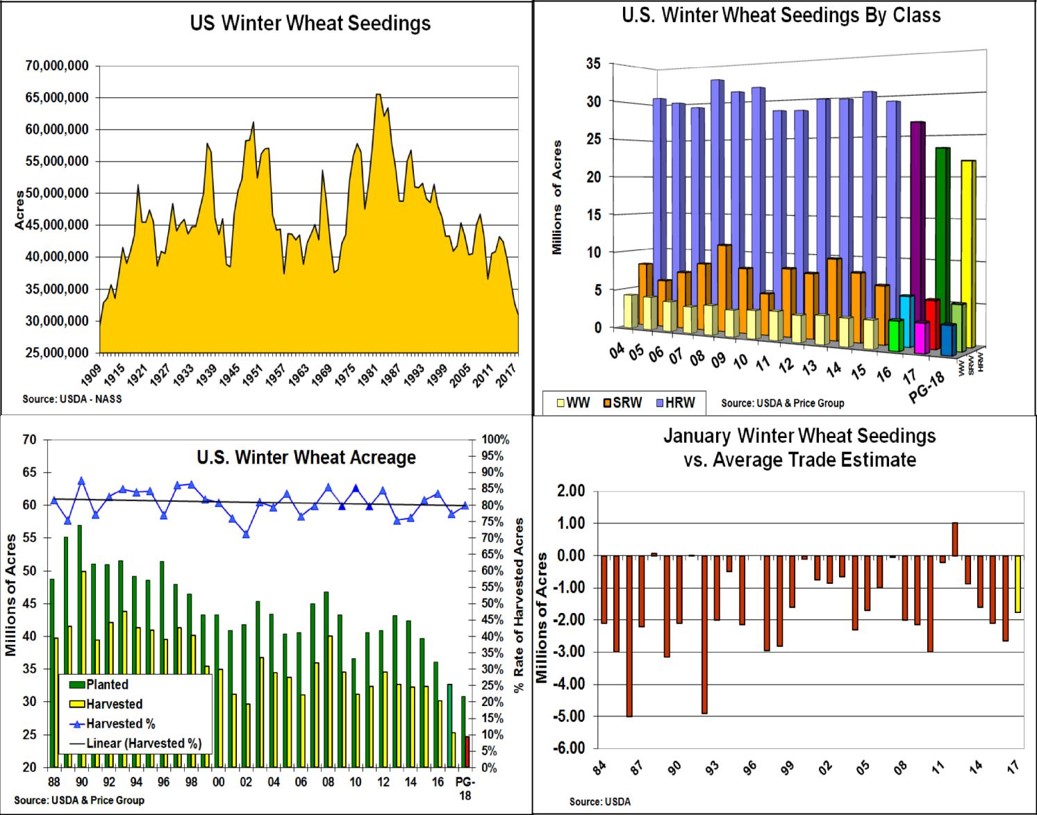
The combination of a record world wheat crop and a sizable US corn crop has weighed on wheat prices during the last half of 2017. Despite last summer’s price spike on US Plains dryness, wheat values have retreated to last year’s levels as world competitors had a record (FSU) or better-than-expected (EU & Canada) outputs. These strong crops helped push 2017’s total world wheat harvest to our fifth consecutive new record and our 8th over the last 10 years of higher world output. In this atmosphere, the US has cut its wheat seedings by 10.5 million acres from 2013 to 32.7 million last year and 1909’s 29.2 million level.
This trend has continued this past fall with US Plains producers leaving their land fallow because of low prices, dryness or previous alternative crops (soybeans) not being harvested in time to establish wheat growth before dormancy. Because of these factors, the Plains hard red seedings are likely down another 1.54 million acres to 21.89 million. Kansas may drop 500,000 to 7.1 million acres while cattle grazing may lessen the Southern Plains decline. Low prices and rains slowing the Eastern US double-crop soybean harvest may also reduce US soft red seedings by 4.7% (258,000 acres) to 5.475 million. US white winter wheat plantings may also slip this year by 52,000 to 3.4 85 million acres. The Pacific Northwest’s lack of alternatives crops are behind this modest decline.
Overall, 2018’s US winter wheat seedings report on January 12 will likely decline by 1.846 million to 30.85 million acres (a 5.65% drop). If 2018’s harvested rate returns to its trend of 80%, US combined area will be 24.68 million acres, 611,000 less than last year and the smallest gathered area in the USDA’s data series dating to 1909. The other amazing fact has been the trade’s over-estimating of the US initial winter wheat seedings. Only once (2012/13) since the 1984/85 crop year has the USDA’s January level been substantially above the trade’s average estimate.
(Click on image to enlarge)
What’s Ahead
With the trade’s focus on the record world wheat crop and stocks, the upcoming USDA winter wheat seeding report probably won’t garner much pre-report attention. However, if this year’s planting are 2-2.5 million lower than last year, this could switch more eyes to 2018 crops and their yield potential. Hold sales to see if any weather scares swing KC March to $4.50-$4.70 range to bring sales to 50%. Happy Holidays.



Comments
Log in or sign up to join the conversation.