

Since last year’s ‘Liberation Day’ collapse of the dollar, there has been a lot of focus on dollar hedge ratios. Low levels of dollar hedging heading into that April 2025 tariff announcement were widely seen as contributing to the sharp dollar sell-off. Data suggests those hedge levels are getting very low again
Everyone loves the dollar
US President Trump’s decision to launch a military assault on Iran at the end of February triggered widespread dollar buying. This was largely a function of the energy story, where the ‘haves’ – the US – were rewarded at the expense of the ‘have-nots’ – Europe and Asia. The dollar received a second fillip in June when it looked like new Fed Chair, Kevin Warsh, was about to restore the Fed’s inflation-fighting credibility with a rate hike.
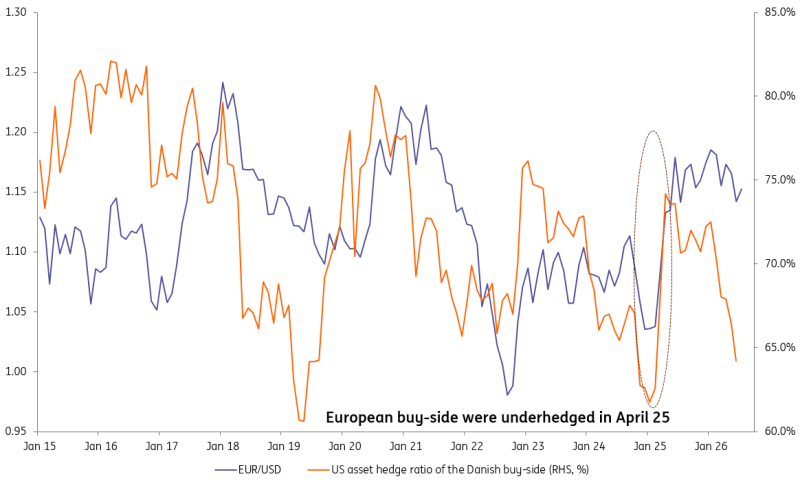
That summer optimism on the dollar looks to have carried through to the buy-side, where some estimates suggest that European FX hedge ratios on US investments have been cut back to their lowest levels since February 2025.
The data we show in the chart below comes from the Danish central bank and marks the FX hedge ratios from Denmark’s insurance and pension fund industry. We appreciate this is just a snapshot of a very broad European buy-side, but the data did capture the events of March/April 2025 pretty well. Back then, the Danish buy-side went into ‘Liberation Day’ tariffs with hedge ratios on US investments at 63%, only to rush them up to 74% by the end of April.
As of the end of June this year, these hedge ratios have been cut back to 64% – presumably on the conviction view that most roads lead to a firmer dollar.
European buy-side US hedge ratios fall again
Source: Danish Central Bank, Refinitiv
European buyside looks underhedged
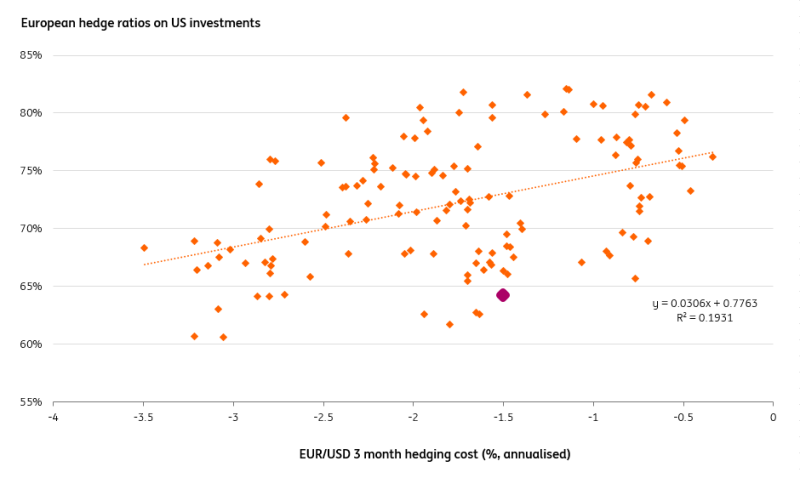
But looking at this data, it seems fair to describe the European buy-side as ‘underhedged’ when it comes to its US investments. While not as statistically significant as it could be, data since 2015 suggests that if hedge ratios were merely a function of hedging costs, European hedge ratios on US investments should be a lot higher. Current (relatively cheap) hedging costs of 1.5% per annum using the three-month EUR/USD forward would be more associated with a 73% hedge ratio rather than the 64% seen in the latest data in June.
This begs the question whether lightning will strike twice and some, presumably US-centric event, will trigger another dramatic European increase in dollar hedge ratios and a sharp dollar sell-off? We have no particular insights into the triggers here, but do note that the prediction market, Polymarket, currently attaches a 30% probability that President Trump declares a national emergency by the end of this year in response to interference in US elections or election processes. The reference here is clearly to the US midterm elections, which take place on 3 November. The FX option market has already marked this as a potentially big day, with volatility priced at 150% of a normal trading day.
None of the above is in our baseline FX forecasts, but low dollar hedge ratios are helpful to our EUR/USD 1.18 end-year forecast – a forecast largely premised on unchanged Fed policy this year.
US hedge ratios versus EUR/USD hedging costs



Comments
Log in or sign up to join the conversation.