

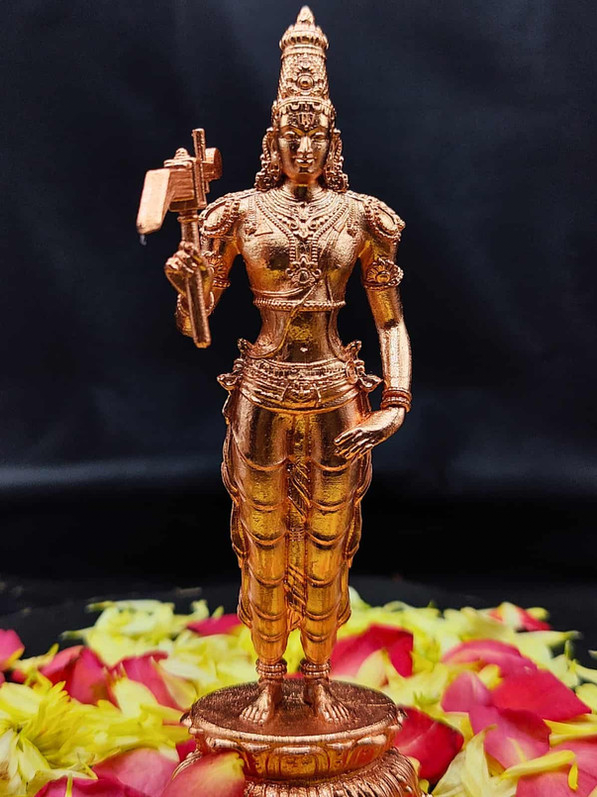
Parasuramar occupies a striking place among the Dashavatara, the ten principal avatars of Lord Vishnu - a warrior-sage who wields an axe rather than a discus, and whose story is driven by human injustice rather than cosmic or demonic threat. Those drawn to his fierce, penance-driven form can bring his image home through a handcrafted Parasuramar idol available in both brass and bronze, a striking devotional piece for those who honor his role as a restorer of dharma.
Positioned as the sixth avatar, between the dwarf-Brahmin Vamana and the ideal king Rama, Parasuramar marks a distinct turning point in the Dashavatara - the moment Vishnu's descents begin to take on a more fully human, morally complex character. His legend of a mother's beheading, a father's murder avenged, and a coastline pulled back from the sea makes him one of the most dramatic figures in the entire avatar tradition. At Gold Plating Art Studio, this intensity is rendered with the same craftsmanship devotees expect for any deity meant to anchor a serious pooja space.
Who Is Parasuramar?
The Sixth Avatar of Vishnu
In the sequence of the Dashavatara, Parasuramar stands sixth, arriving after Vamana and before Rama. This placement is significant: he is the first avatar to appear in a fully human form with no animal or dwarf characteristics, yet he is also the last avatar closely tied to a single act of destruction rather than sustained kingship or leadership - a bridge between Vishnu's earlier, more elemental interventions and the fully realized human avatars, Rama and Krishna, who follow.
Son of Jamadagni and Renuka, Grandson of Sage Bhrigu
Parasuramar was born to the sage Jamadagni and his wife Renuka, making him a descendant of the great sage Bhrigu - a lineage that earns him the name Bhargava Rama, "Rama of the Bhrigu clan." Raised in an ashram steeped in austerity and scriptural learning, he combined from birth the discipline of a sage with a latent capacity for ferocious action, a duality that defines his entire legend.
A Warrior-Sage Unlike Other Avatars
Where avatars like Narasimha or Varaha appear primarily to destroy a specific demonic threat, and later avatars like Rama or Krishna rule as kings, Parasuramar occupies unusual territory: he never rules a kingdom, never marries into royal duty, and remains, at heart, an ascetic who is provoked into war rather than born to wage it. This makes him one of the most morally textured figures among the ten avatars - a holy man forced by circumstance to become a warrior.
Iconography and Symbolism of Parasuramar
The Axe (Parashu) Gifted by Shiva
Parasuramar's defining weapon, the parashu or axe, gives him his very name — "Parasu-Rama," Rama of the axe. Tradition holds that he received this weapon directly from Lord Shiva after undertaking intense penance, a gift that marks him as a devotee whose spiritual discipline was rewarded with the power to enforce justice by force when persuasion failed.
Chiranjivi - The Immortal Sage
Parasuramar is counted among the Chiranjivis, a select group of figures in Hindu tradition believed to remain alive across the ages rather than passing through death in the ordinary sense. This immortality reframes his story: he is not merely a historical avatar whose task ended with his own era, but an enduring presence, traditionally believed to still perform penance in the mountains, available in principle to any age that needs his intervention.
A Fierce Yet Ascetic Form
Visually, Parasuramar is usually shown with matted hair and simple ascetic dress befitting a forest sage, yet armed with the axe and, in several depictions, a bow — a combination that captures his dual identity perfectly. He carries none of the ornamentation associated with kingly avatars, a deliberate reminder that his authority comes from spiritual discipline and divine sanction, not worldly rank.
The Legend of Parasuramar
Born to Restore Dharma
Like every avatar of Vishnu, Parasuramar's incarnation is tied to a specific need: a growing corruption among the Kshatriya warrior class, many of whom had begun abusing their power and oppressing the very people they were meant to protect. Into this imbalance, Vishnu descended not as a king to replace the corrupt rulers, but as a sage's son who would hold them to account.
The Beheading and Revival of Renuka
One of the most striking episodes in Parasuramar's early life involves his own mother, Renuka. When Jamadagni, sensing a lapse in her devotion, ordered his sons to behead her, only Parasuramar obeyed without hesitation. Recognizing his unwavering obedience, Jamadagni granted him a boon, which Parasuramar used at once to restore his mother to life — a moment that reveals both the severity of his discipline and the loyalty beneath it.
Avenging Jamadagni: The Feud With the Kshatriyas
The defining rupture in Parasuramar's life comes when the powerful king Kartavirya Arjuna's sons kill Jamadagni after a dispute involving a wish-fulfilling cow taken from the sage's ashram. Enraged by this injustice, Parasuramar takes up his axe and, according to tradition, wages war against the oppressive Kshatriya rulers of the age not once but twenty-one times, determined to root out the tyranny that had taken hold across the land.
Reclaiming Land From the Sea
In the aftermath of his campaigns, tradition credits Parasuramar with one final, transformative act: persuading the sea to recede and reveal new land along the western coast of India, associated with present-day Kerala and the Konkan coast. Where his earlier legend is defined by destruction, this closing episode reframes him as a creator and settler — the sage-warrior who, having cleared away corruption, makes way for new, dharmic life to take root.
Temples and Sacred Sites of Parasuramar
Parasuramar's legend is anchored to several sacred sites across India. Parshuram Kund, on the Lohit river in Arunachal Pradesh, is one of the most revered pilgrimage spots associated with him, drawing large numbers of devotees especially around Makar Sankranti. Along the Konkan coast, the Parashuram temple at Chiplun in Maharashtra commemorates his connection to the region's reclaimed land. Kerala itself is traditionally referred to as "Parashurama Kshetra," a land said to have been created through his intervention, embedding his legend directly into the region's own identity.
Spiritual Significance of Parasuramar
Guardian of dharma against abuse of power — his campaigns against corrupt rulers represent the principle that authority which turns oppressive must eventually be held accountable.
Guru to great warriors — Parasuramar is remembered as the teacher of legendary figures including Bhishma, Drona and Karna, passing on both weaponry and discipline to the next generation of the Mahabharata's warriors.
The union of renunciation and valor — his ascetic upbringing paired with his ferocity in battle reflects the idea that true strength is inseparable from spiritual discipline.
An eternal, ever-available protector — as a Chiranjivi, his presence is considered not confined to a single era, but continuously available to any age confronting the same imbalance he once corrected.
Why Is Parasuramar Different from Other Dashavatara Forms
Unlike Rama or Krishna, who accept the full responsibilities of kingship, Parasuramar deliberately remains outside worldly rule, acting only to correct an imbalance before withdrawing again into penance.
Where earlier avatars like Matsya, Varaha and Narasimha confront cosmic or demonic threats, Parasuramar's conflict is entirely human — a response to political and moral corruption rather than a supernatural danger.
His meeting with Rama at Sita's swayamvara, where he tests the younger avatar and ultimately yields his own bow and spiritual energy to him, is unique among the Dashavatara: one avatar consciously passing his authority to his successor.
Unlike most avatars whose stories conclude with their own era, Parasuramar's status as a Chiranjivi means his narrative has no true ending, setting him apart as a figure of continuing, rather than completed, presence.
Conclusion
From a son's unhesitating obedience, to a warrior's twenty-one campaigns against tyranny, to a sage's quiet act of reclaiming land from the sea, Parasuramar's story traces an unusual arc among Vishnu's avatars — one defined less by cosmic battle and more by the enforcement of justice among human rulers. His axe, his immortality, and his eventual meeting with Rama all point to a figure who exists at the hinge between eras, correcting one age's imbalance and quietly making way for the next. For devotees drawn to this fierce, disciplined form of dharma in action, a Parasuramar idol brings that same watchful, corrective energy into the home.
Comments
Log in or sign up to join the conversation.