

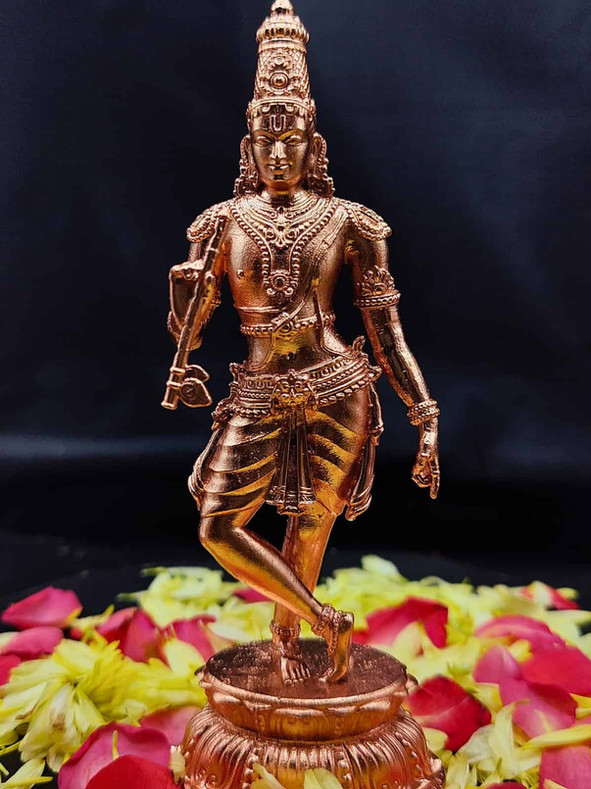
Krishna, the beloved avatar of Lord Vishnu in the Dashavataram, is the divine cowherd, charioteer and teacher whose life is celebrated in every corner of India, and devotees bring his presence home through a Krishna avatar idol available in brass and bronze. From his birth in a prison cell to his role as guide on the battlefield of Kurukshetra, Krishna's story blends tenderness, mischief, wisdom and dharma in a way no other avatar does.
His flute enchants, his words in the Bhagavad Gita guide, and his leelas delight devotees young and old. In this guide, we explore the story, symbolism and significance of Krishna, the eighth avatar of Vishnu, here on Gold Plating Art Studio.
Who Is Krishna?
The Avatar of Vishnu in the Dashavataram
The Dashavataram lists the ten major descents of Vishnu: Matsya, Kurma, Varaha, Narasimha, Vamana, Parashurama, Rama, Krishna, Buddha and Kalki. In the most widely followed list, Krishna is the eighth avatar, while some traditions count Balarama as the eighth and Krishna as the ninth. Many devotees regard Krishna as the fullest manifestation of Vishnu, the Purnavatara.
The Many Names of Krishna
Krishna is lovingly called Govinda, Gopala, Madhava, Vasudeva, Kannan, Kesava and Parthasarathy. Each name recalls a different aspect of his life, from tending cows to driving Arjuna's chariot.
Radha, Rukmini and Balarama
Krishna is closely linked with Radha, the embodiment of devotion, and with Rukmini and Satyabhama, his queens at Dwarka. His elder brother Balarama, often regarded as an incarnation of Adisesha, stands by him through his early life.
Iconography and Symbolism of Krishna
The Flute
Krishna's flute, the Venu, symbolises the call of the divine that draws every soul toward God. Its music is said to still the mind and awaken love.
The Peacock Feather
The peacock feather in his crown is a mark of beauty, grace and detachment. Its many colours reflect the diverse forms of the divine world.
The Yellow Garment and Dark Complexion
Krishna wears a yellow silk dhoti, the pitambara, and is shown with a dark blue complexion. The colour of the sky and the ocean represents infinity and the boundless nature of the divine.
The Tribhanga Pose
Krishna is often shown in the tribhanga pose, with the body bent gracefully in three places. It expresses ease, rhythm and playful joy, and is frequently accompanied by a cow or calf to recall his life as Gopala.
The Legend of Krishna: Birth and Escape from Mathura
Kamsa's Fear
King Kamsa of Mathura imprisoned his sister Devaki and her husband Vasudeva after a heavenly voice foretold that Devaki's eighth child would end his life. He killed their first six children, and the seventh was transferred to the womb of Rohini and born as Balarama.
The Midnight Birth
Krishna was born at midnight in Kamsa's prison on the eighth day of the dark fortnight. The shackles broke, the guards fell asleep and the gates opened by themselves.
Crossing the Yamuna
Vasudeva carried the newborn in a basket across the Yamuna, which parted for him while the serpent Adisesha sheltered the child from the rain. He left Krishna with Nanda and Yashoda in Gokul, and returned with their newborn daughter.
Childhood Leelas in Gokul and Vrindavan
The Butter Thief
Young Krishna was famous for stealing butter and curd, earning the names Makhan Chor and Navaneeta Chora. These stories celebrate the tender bond between the Lord and his devotees.
Kaliya and Govardhana
Krishna danced on the hoods of the serpent Kaliya to cleanse the Yamuna of its poison. He also lifted Mount Govardhana on his little finger to shelter the villagers from Indra's storm, humbling the god's pride.
The Rasa Lila and Radha
In the forests of Vrindavan, Krishna's flute drew the gopis to the Rasa Lila, the divine dance that symbolises the soul's yearning for union with God. Radha's devotion remains the highest ideal of bhakti.
The Defeat of Kamsa and the Founding of Dwarka
Return to Mathura
As a young man, Krishna returned to Mathura, defeated Kamsa and freed his parents. He restored the rightful king, Ugrasena, to the throne.
The City of Dwarka
Facing repeated attacks, Krishna moved his people west and established the city of Dwarka on the coast of Gujarat. Dwarka is remembered as a prosperous and well-governed kingdom.
Rukmini and Sudama
Krishna married Rukmini, who had sent him a message asking to be rescued from an unwanted marriage. His friendship with the poor Brahmin Sudama is remembered as a model of humble, sincere devotion.
Krishna in the Mahabharata and the Bhagavad Gita
Parthasarathy, the Charioteer of Arjuna
In the Mahabharata war, Krishna chose not to take up weapons and served as Arjuna's charioteer. This is why he is worshipped as Parthasarathy, the guide who steers the soul in its greatest trials.
The Bhagavad Gita
On the field of Kurukshetra, Arjuna was overcome by doubt and refused to fight. Krishna delivered the Bhagavad Gita, teaching duty without attachment, devotion, knowledge and self-mastery.
The Vishvarupa
Krishna also revealed his cosmic form, the Vishvarupa, to Arjuna, in which the entire universe appeared within him. This vision remains one of the most awe-inspiring moments in Hindu scripture.
The End of Krishna's Earthly Life
The Departure at Prabhasa
According to tradition, after the war and years of rule, Krishna retired to the forest near Prabhasa. A hunter named Jara mistook his foot for a deer and struck it with an arrow, and Krishna returned to his divine abode.
The Beginning of Kali Yuga
Tradition holds that Krishna's departure marked the beginning of Kali Yuga. Dwarka is said to have been submerged by the sea soon afterwards.
Krishna Temples and Festivals
Sacred Krishna Shrines
Famous Krishna temples include the Udupi Krishna Matha in Karnataka, the Guruvayur Temple in Kerala, the Dwarkadhish Temple in Gujarat, the Banke Bihari Temple in Vrindavan and the Parthasarathy Temple at Triplicane in Chennai. Puri's Jagannath Temple is also dedicated to Krishna in the form of Jagannath.
Janmashtami
Krishna Janmashtami, also known as Gokulashtami, celebrates his birth with fasting, midnight prayers, decorated cradles and little footprints drawn to welcome the child into the home. In some regions, human pyramids break clay pots of curd, recalling his butter-stealing pranks.
Spiritual Significance of Krishna
Dharma and Righteous Action
Krishna's teaching in the Gita is to perform one's duty without clinging to the results. This idea of Karma Yoga has guided devotees for centuries.
Bhakti and Divine Love
The stories of Radha, the gopis and Sudama show that sincere devotion matters more than wealth or status. Krishna is the beloved friend as much as the Lord.
Wisdom in Adversity
From his prison birth to the battlefield, Krishna remained calm in crisis. Devotees turn to him for clarity, courage and guidance when they face difficult choices.
Joy and Playfulness
Krishna reminds us that spiritual life need not be solemn. His leelas celebrate laughter, music, friendship and the joy of being alive.
Why Is the Krishna Avatar Different from Other Avatars of Vishnu?
Compared with Rama: Rama is the Maryada Purushottama, who upholds every rule of conduct, while Krishna is the Leela Purushottama, who teaches dharma through playful and unconventional means.
Compared with Narasimha and Varaha: These avatars appear to destroy a specific evil in a dramatic moment, whereas Krishna's life unfolds over decades of childhood, love, statecraft and war.
Compared with Vamana and Parashurama: These avatars are remembered for a single decisive act, while Krishna is a teacher, friend, ruler and lover in one lifetime.
A teacher of philosophy: Krishna is the only avatar who delivers a complete spiritual discourse, the Bhagavad Gita, to a disciple.
The Purnavatara: Many devotees regard Krishna as the complete manifestation of Vishnu, embodying every aspect of the divine.
Conclusion
Krishna, the eighth avatar of Vishnu in the Dashavataram, is the child who steals hearts, the friend who guides and the teacher who reveals the highest wisdom. His story of the midnight birth, the flute of Vrindavan and the Gita on the battlefield continues to inspire devotion, courage and joy. For devotees around the world, Krishna remains the Lord who is close to every heart.
Comments
Log in or sign up to join the conversation.