
Be safe near retirement.
· At $5 trillion and growing, target date funds (TDFs) dominate 401(k) assets but expose near-retirees to excessive risk during the critical Retirement Risk Zone.
· Academic lifetime investing theory is 70-80% risk free near retirement, contrasting sharply with typical TDF practice that is 85% risky.
· TDFs did not protect during the 2008 market crash, with near-retirement TDFs losing more than 30%, versus a 5% loss for the academic path.
· Baby boomers in TDFs should consider moving to safer investments, especially if their fund is not as conservative as the Federal Thrift Savings Plan’s TDF .

We each have our own lifetime investing path that could follow academic research, or not. Most of us just guess. But the growing popularity of target date funds (TDFs) in 401(k) plans has drawn attention to reducing risk as we age. At $5 trillion and growing, TDFs are the darlings of 401(k) plans, constituting more than half of all 401(k) assets. That’s why many advisors use them in IRAs or design their own lifetime investing paths.
According to academic theory, we want our money to work hard for us when we’re young and then we want it to relax when we’re old. The theory doesn’t care if you’re in a 401(k) plan or not because it’s for everyone.
In this article, we discuss academic lifetime investing theory and contrast it to TDF practice. Theory is much safer than practice, leaving those near retirement in TDFs exposed to the risk of the next stock market crash.
IRA investors should also be aware of the theory because those near retirement might not be optimizing their risk choice at this critical time in their lives. Are you safe?
Lifetime investing theory for the risk averse
Here are the articles that introduce academic lifetime investing theory. Please read them.
Behavioral scientists tell us that we are risk averse because we want to avoid investment losses even if it means sacrificing potential gains. Academics have developed a lifetime investing approach for the risk averse that recognizes that we all have two types of capital: our Human Capital that we earn and our Financial Capital that we save.
Early in life our Human Capital is large because we have a lifetime of paychecks ahead of us, and our Financial Capital is meager because we have just begun to save. Through time our Human Capital depletes as the number of future paychecks declines , while our Financial Capital (savings) grows.
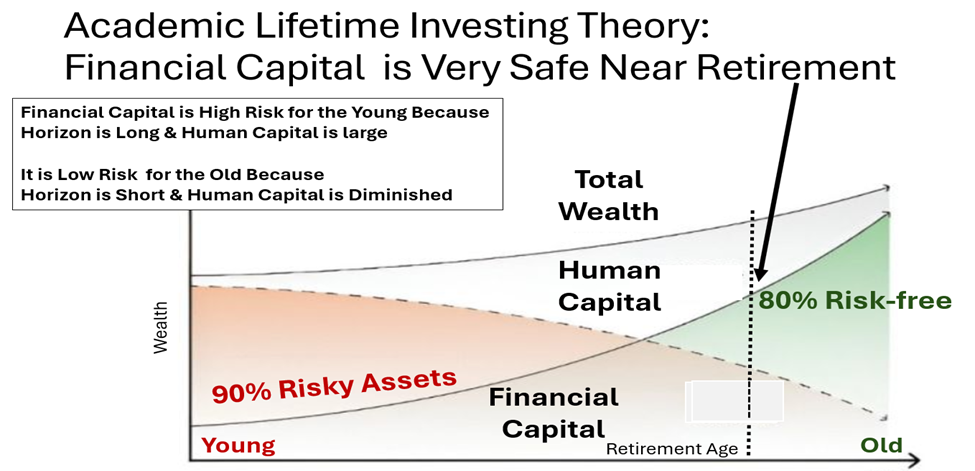
In theory our money should work hard for us when we’re young, with 90% in risky assets, but then it should relax as we age, down to 80% risk-free near retirement. Risky assets include diversified equities and long-term bonds. Risk-free assets include Treasury bills and other very safe investments.
But some of us who are not risk averse will view the theory as too safe and will take a more aggressive investment lifepath.
Beyond theory: Lifepaths for risk takers
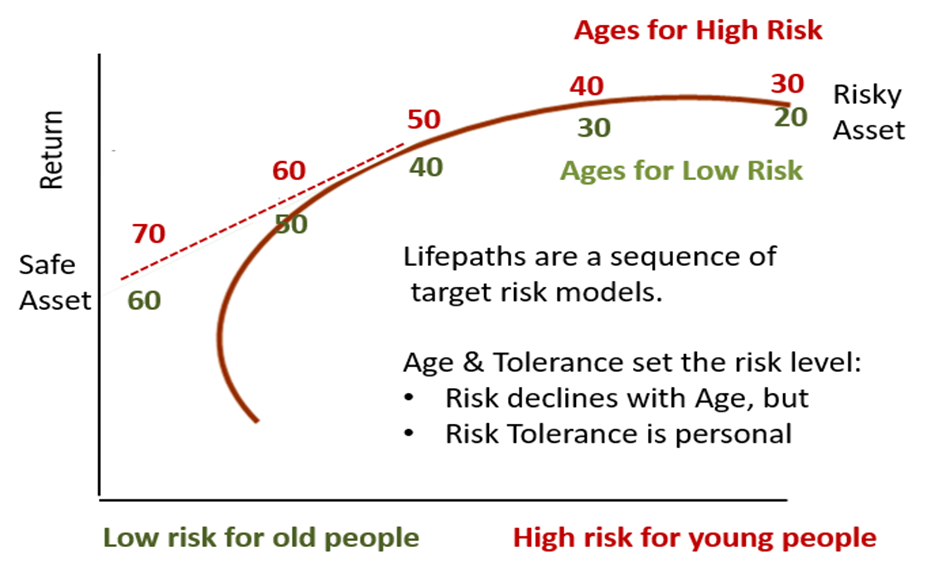
The theory recommends a sequence of target risk models along the efficient investment frontier where your position on the frontier is a function of your age, as shown in green in the following.
Risk takers still want to earn the best return for their risk choice along the efficient frontier, but they want to take more risk than theory. Risk takers are shown in the red in the graph below where they are 10 years older than risk-averse people when they take the same risk. So, for example a 50 year old risk taker is exposed to the same risk as a 40 year old risk averse person.
Investing in retirement creates a U-shaped lifepath
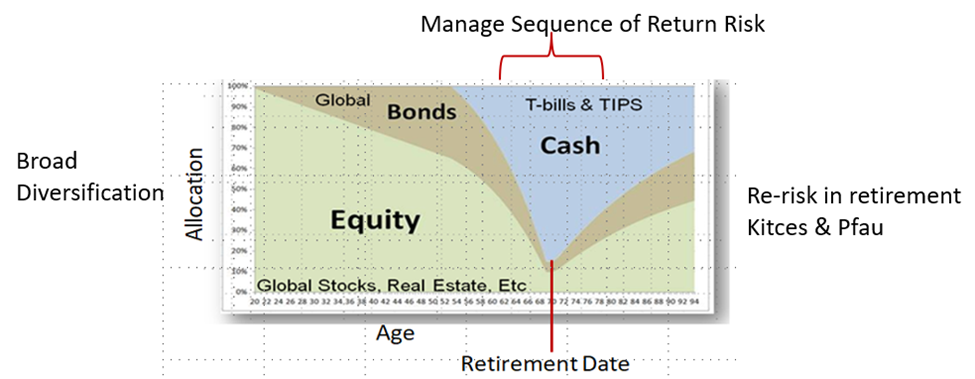
The academic theory we’ve discussed so far is for our working lives. There is special academic theory for investing in retirement that was introduced in Kitces and Pfau’s 2013 paper on Reducing Retirement Risk with a Rising Equity Glide-Path. Michael Kitces & Wade Pfau make a very persuasive case for entering retirement with low risk and then re-risking in retirement. We all pass through 3 stages of investing where the second stage of transitioning from working life to retirement should be very safely invested.
Responding to criticism of re-risking in retirement, Michael Kitces points out that many consultants use a bucket approach that recommends spending down the bond bucket as you enter retirement in order to give the risky bucket time to run. This is in fact re-risking in retirement.
Connecting pre- and post-retirement theory, the pre-retirement path needs to end safely to connect with a post-retirement path that starts safely, creating a U shape.
Multiple lifepaths versus common TDF practice
To summarize, academic lifetime investing theory is very safe near retirement with 80% in risk-free assets, which could be too safe for investors who are not risk averse, although most of us are risk averse.
Risk averse people want to be on a low risk lifetime investing path. Risk takers want to be riskier than theory, taking an aggressive lifetime investing path. There’s a path between these two extremes that we call moderate.
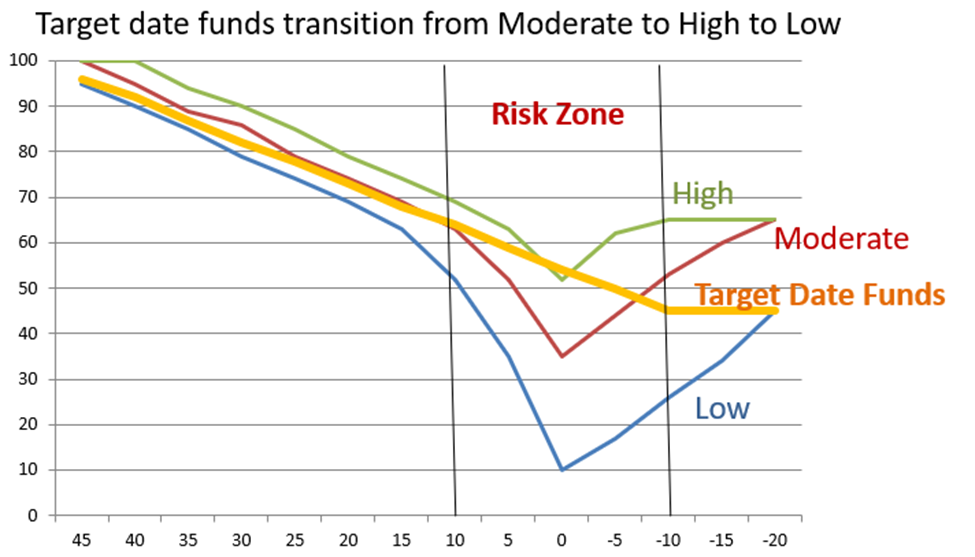
Common TDF practice is a mix of academic lifetime paths. It is moderate risk during working life up until it reaches the Retirement Risk Zone when it becomes high risk, and then it becomes low risk in retirement. The Retirement Risk Zone is the 5 years before and after retirement during which sequence of return risk jeopardizes the rest of life.
Here are the four lifetime investing paths. Note that the Target Date Funds path is far riskier in the Retirement Risk Zone than the low risk academic path designed for risk averse investors. In other words, unless you are a risk taker the typical TDF is far too risky for you when it matters most -- in the Retirement Risk Zone. To reinforce the point, the typical 2010 TDF lost more than 30% in 2008 while the low risk path lost only 5%.
Performance update for target date funds
So how does theory compare to practice so far in TDFs? The 2010 TDF funds have completed their lifetime journey. Assuming retirement at age 65, participants in 2010 funds are now 80 years old, and 15 years into their retirement, at which point paths level out.
Academic lifetime investing theory has performed a little better than the typical TDF because it defended against the losses in 2008 and then re-risked, starting in 2015.
If you are in an IRA, how does your performance stack up?
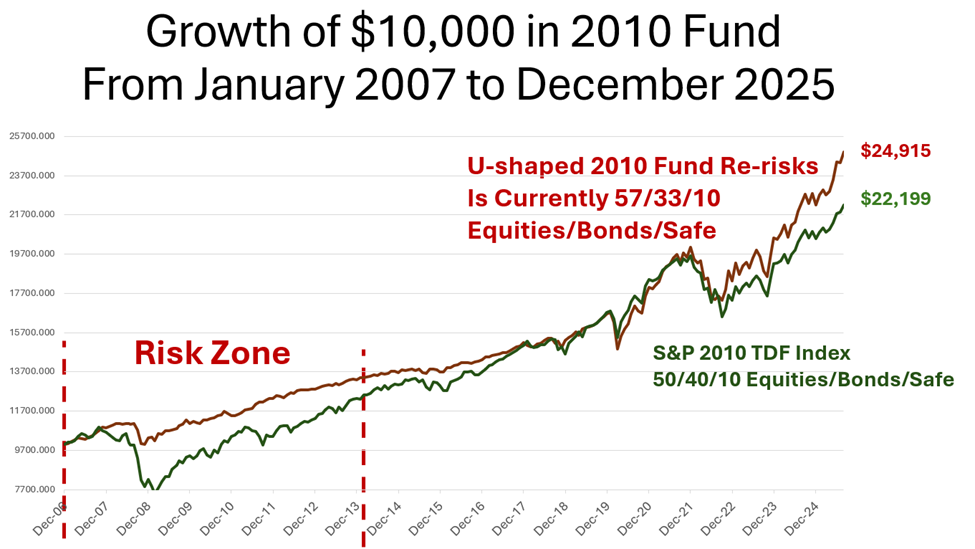
The next fund to complete its journey is the 2020 fund. The academic version is lagging the industry so far, but the next 10 years will tell the story. Stay tuned.
Directionless 2026 stock market
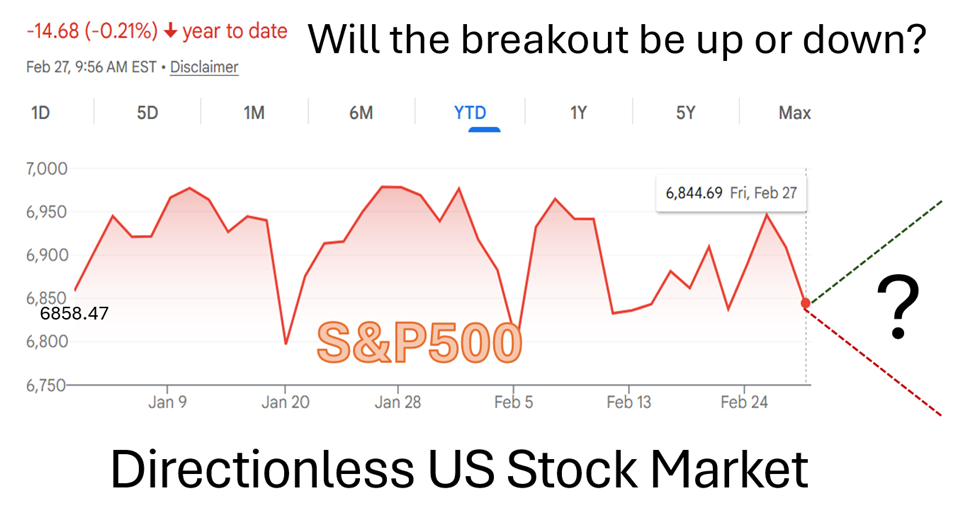
The question isn’t “Will the stock market crash?” It’s “When?” If it crashes in this decade, baby boomers in TDFs will be crushed because they are in the Retirement Risk Zone. So far this year, the market has not made up its mind. It’s vacillating up and down with no apparent direction. It will eventually breakout to the upside or the downside. Baby boomers in TDFs are not protected against a breakout to the downside.
In which direction will stocks move in response to the outbreak of war with Iran?
Conclusion
What lifetime investing path are you on? How does it compare to the academic version? We will all be tested by the next stock market crash. The current situation in TDFs is reminiscent of the 1960s auto industry. The muscle cars of the 1960s were fast and fun, but not safe. Such is the case with today’s TDFs.
Safer approaches will gain traction when TDFs crash in the next stock market correction. Risk has been winning for a long time, but that will end. Perhaps then risk will be disclosed in the fund name, as it should be.
IRA investors should consult their advisors and share this article to determine if you are on the right investment path. Good chance you’re taking more risk than theory if you are near retirement. Feeling lucky?
Baby boomer TDF investors should sell out of their TDF unless their TDF is safe, like the Federal Thrift Savings Plan (TSP). They should move to safety while they are in the Risk Zone.
People over age 55 hold about 45% of the wealth in the US. They are in or near retirement, mostly in the Retirement Risk Zone. Investment losses at this time in their lives will get ugly for most, including younger people.
Endnote
Results for academic theory are represented by the SMART TDF Index and results for common practice are represented by the S&P TDF Index. Both indexes are available on Morningstar Direct.


Comments
Log in or sign up to join the conversation.