

Working at height remains one of the most critical safety concerns across construction sites, industrial facilities, warehouses, rooftops, and infrastructure projects. In Saudi Arabia, where large-scale development and industrial activity continue to expand, lifeline safety has become an important part of protecting workers who perform tasks in elevated or exposed areas.
A properly designed lifeline system gives workers a secure connection point while allowing them to move efficiently across the work area. Rather than relying only on personal protective equipment, companies can integrate engineered lifeline safety systems into their overall fall-protection strategy.
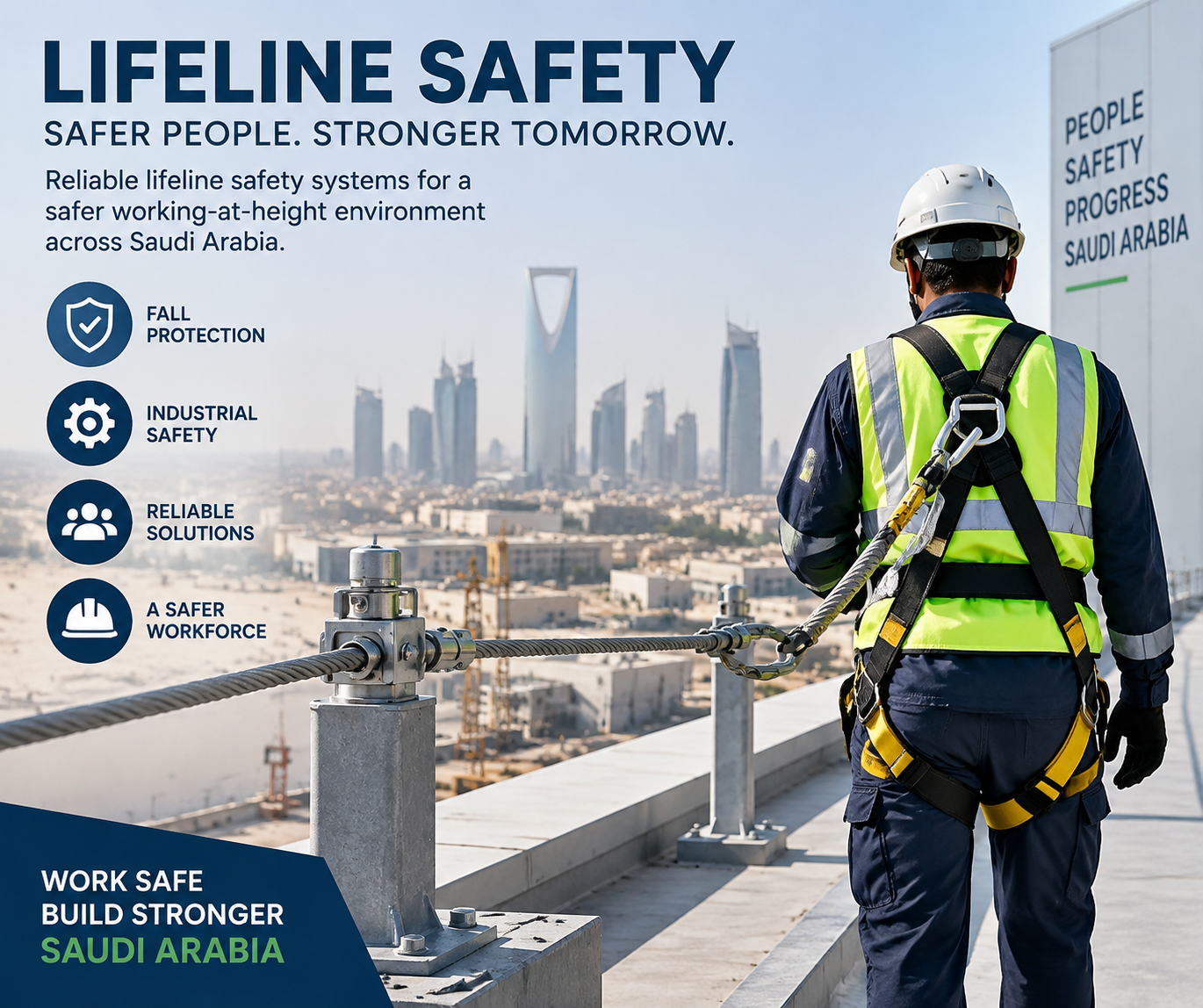
What Is a Lifeline Safety System?
A safety lifeline system is designed to reduce the risk of serious injury when employees work near roof edges, elevated platforms, maintenance zones, or other areas where falls may occur.
Depending on the application, the system may include anchor points, lifeline cables or rails, connectors, energy-absorbing components, harnesses, and travelling devices. Together, these elements create a controlled connection between the worker and the supporting structure.
A horizontal lifeline system, for example, allows workers to move along a defined horizontal path while remaining continuously connected. This makes it particularly useful for rooftop maintenance, industrial facilities, warehouses, factories, and large commercial buildings.
Why Lifeline Safety Matters in Industrial Environments
Industrial facilities often contain locations where traditional barriers or guardrails cannot provide complete protection. Workers may need access to roofs, machinery, elevated maintenance zones, or other restricted areas.
In these situations, industrial lifeline safety solutions can provide additional protection without significantly restricting movement.
An effective industrial lifeline system can help organizations:
Maintain worker connection while working at height
Improve access to rooftop and elevated maintenance areas
Reduce exposure to unprotected fall hazards
Support safer inspection and maintenance activities
Create clearly defined working and access zones
Improve overall site safety planning
The exact system should always be selected according to the structure, working environment, number of users, required movement, and potential fall distance.
Selecting the Right Lifeline Fall Protection Solution
Not every project requires the same configuration. The appropriate lifeline safety equipment depends on how workers access and move through the area.
For long rooftop paths, a horizontal system may provide greater mobility. Other applications may require fixed anchor points, vertical systems, or a combination of different lifeline safety solutions.
A professionally engineered lifeline fall protection system should consider structural suitability, system layout, user requirements, clearance distances, compatible personal protective equipment, and safe access procedures.
These factors are especially important because the effectiveness of any system depends on more than simply installing a cable or anchor. Each component must work as part of a complete fall-protection arrangement.
Benefits of Lifeline Safety Systems
1. Enhanced Worker Protection
A lifeline safety system provides workers with a secure connection while performing tasks at height. By connecting the worker’s harness to an engineered lifeline, the system helps reduce the risk of severe injuries caused by accidental falls from rooftops, platforms, and elevated work areas.
2. Continuous Fall Protection
Unlike temporary safety measures, a properly installed lifeline system allows workers to stay connected throughout their work activity. Workers can move along the designated area while maintaining attachment to the system, providing continuous protection during maintenance and inspection tasks.
3. Improved Workplace Safety
Lifeline systems create a planned and controlled approach to working at height. They help organizations identify hazardous areas and provide workers with a safer method for accessing elevated locations such as roofs, industrial structures, and maintenance zones.
4. Greater Mobility and Safe Access
A horizontal lifeline system allows workers to travel across larger work areas without repeatedly disconnecting and reconnecting their safety equipment. This improves efficiency while maintaining a higher level of protection during movement.
5. Suitable for Various Industrial Applications
Lifeline safety solutions can be adapted for different environments, including factories, warehouses, commercial buildings, power facilities, construction projects, and rooftop maintenance areas. The system can be designed according to the specific requirements of each site.
6. Reduction of Fall-Related Risks
By providing a reliable anchorage and connection point, lifeline systems help reduce exposure to unprotected edges, open areas, and elevated hazards. They support a proactive safety approach by preventing accidents before they occur.
Importance of Professional Installation
Proper lifeline system installation in Saudi Arabia requires careful site assessment and engineering consideration. Roof construction, structural anchorage, worker movement, environmental exposure, and system compatibility should all be reviewed before installation.
Working with an experienced lifeline safety system supplier can help project teams identify suitable components and develop a system aligned with the site's actual operating conditions.
Inspection and maintenance are equally important. Lifelines, anchors, connectors, and associated lifeline safety equipment should be checked regularly so that damage, corrosion, deformation, or excessive wear can be identified before the equipment is used.
Building a Safer Working-at-Height Environment
A strong safety program combines planning, worker training, appropriate equipment, safe access procedures, and reliable fall-protection systems.
As construction and industrial development continue across Saudi Arabia, lifeline safety systems can play an increasingly important role in protecting personnel who regularly work at height.
The most effective approach is to treat lifeline safety as part of the overall site design rather than as an isolated piece of equipment. When properly selected, installed, inspected, and used, a lifeline fall protection system can support safer movement, better access control, and more responsible working-at-height practices across industrial and commercial facilities.
Final Thought
A reliable lifeline safety system is more than equipment — it is an essential part of creating a safer working environment. With proper planning, professional installation, and regular inspection, organizations can improve worker protection and support safer operations across industrial and commercial facilities in Saudi Arabia.
#LifelineSafety
#LifelineSafetySystems
#FallProtection
#LifelineFallProtection
#SafetyAtHeight
#WorkplaceSafety
#IndustrialSafety
Comments
Log in or sign up to join the conversation.