

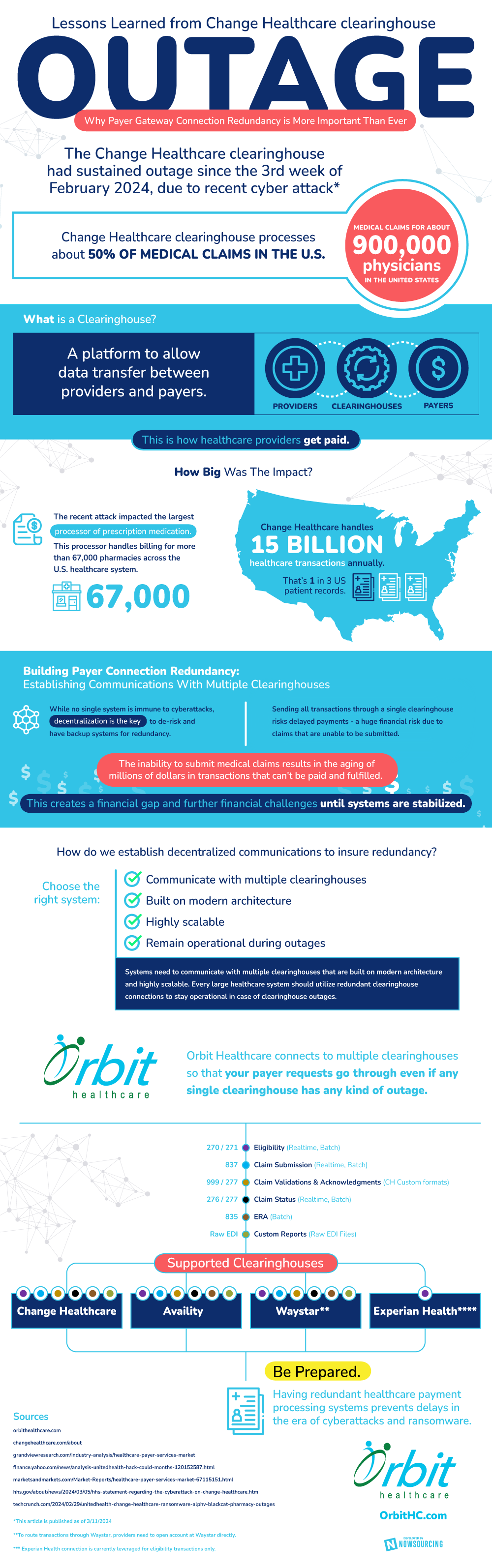
Change Healthcare is one of the biggest healthcare clearinghouses in the United States. A clearinghouse acts as an intermediary platform for the healthcare industry, facilitating the flow of data between payers and providers. They are responsible for making sure healthcare providers are being paid for their services. Change Healthcare is one of the largest clearinghouses in the United States, processing about 50% of medical claims in the United States and serving over 900,000 physicians throughout the country. They are responsible for handling over 15 billion healthcare transactions, or one in three patient records in the States.
Change Healthcare clearinghouse had a major disruption in late February 2024 as a result of a cyberattack. This occurrence, which has a significant impact on the processing of medical claims, has brought attention to serious flaws in the healthcare payment processing system. This crucial platform in the healthcare center had its processor of prescription medicine attacked, which handled over 67,000 pharmacies’ invoicing. As a result, there are now serious worries about the effectiveness and security of healthcare transaction processing nationwide due to this attack.
A compromised clearinghouse can present a serious financial risk for the healthcare sector, because when medical claims can’t be submitted, millions of dollars’ worth of unfulfilled or unpaid transactions can be generated. The consequences of this cyberattack highlight the risks associated with using a single clearinghouse to handle all transaction processing. In order to prevent future occurrences of this kind of cyberattack and to prevent a huge loss of financial information, it is imperative that redundant communication channels be established and that strong cybersecurity measures be implemented.
In order to reduce these risks and guarantee that operations will continue even in the event of a cyberattack, healthcare organizations must implement decentralized communications and incorporate redundancy into their payer connection networks. Creating a system where multiple clearinghouses carry the same type of information can help protect against single points of failure and guarantee that operations continue uninterrupted during outages. This is especially true for clearinghouses constructed on contemporary, scalable architectures.
One system that links several clearinghouses to each other is Orbit Healthcare, which guarantees uninterrupted processing of payer requests even in the case of a cyberattack on a single clearinghouse. This is done through having connections to redundant payer systems. There are already a variety of supported clearinghouses that have adopted this decentralization method, including Change Healthcare, Availity, Waystar, and Experian Health. This system supports a variety of transaction types, including eligibility checks, claim submissions, claim validations and acknowledgments, claim status inquiries, and electronic remittance advice (ERA). Custom reports are also supported.
In conclusion, the recent cyberattack on Change Healthcare has made it more clear than ever that decentralization and redundancy is a best practice when it comes to processing healthcare claims. By having duplicate healthcare payment processing systems, it can ensure that there will be no major data loss scenarios where millions of dollars of healthcare claims become aged. In a time when cyberattacks are becoming a greater threat, these precautions are necessary for avoiding delays and guaranteeing the stability of healthcare payment systems.
Source: Orbit Healthcare



Comments
Log in or sign up to join the conversation.