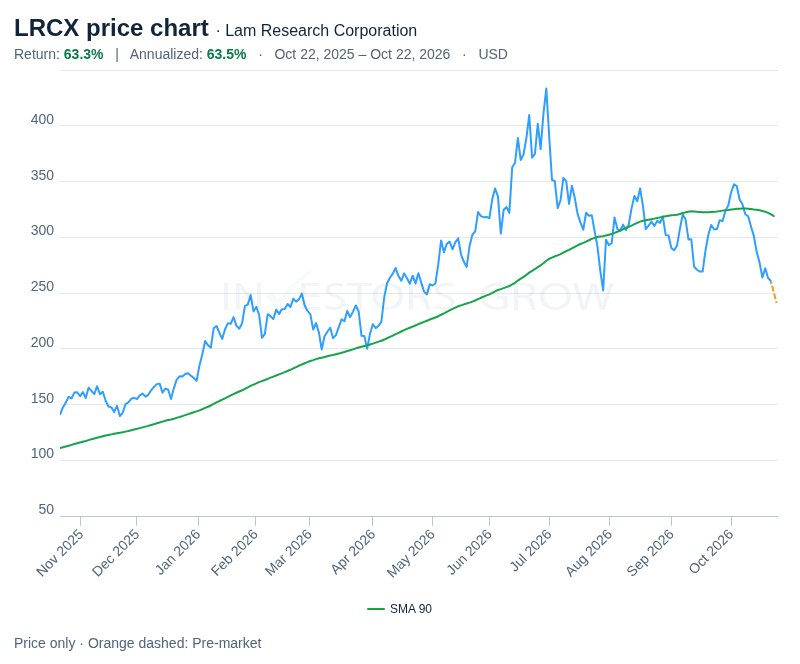
The sales surge came mainly from new equipmentLam Research reported $8.22 billion in revenue for the quarter ended September 27, 2026, up 22% from the June quarter. Operating expenses increased much more slowly, leaving more of each sales dollar as operating profit.
|
In yesterday's results release, the chipmaking equipment supplier reported an operating margin of 40.0%, up from 37.4%, under generally accepted accounting principles, or GAAP. Operating margin measures the share of revenue left after production and operating costs, before other income and expenses and income taxes. A higher margin on a larger revenue base meant operating profit grew faster than sales.
|
That is an attractive combination. Understanding whether it can last starts with what Lam sells and why customers buy it. |
|
Selling machines, then supporting their working livesLam makes equipment used to build chips on wafers, the surfaces on which semiconductor devices are formed. Its manufacturing processes do three important jobs: deposition adds thin layers of conducting or insulating material, etch selectively removes material to shape features, and cleaning removes unwanted particles and residues between steps.
|
Customers buy equipment to add manufacturing capacity or to make more demanding chip designs. A manufacturer can need more capable equipment even without building a new factory. That gives Lam an opportunity as manufacturing technology advances, provided customers choose its products.
|
Lam reports new equipment for advanced manufacturing in its systems revenue category. Its customer support related category includes services, spare parts, upgrades and equipment from the Reliant product line that is not at the leading edge of manufacturing technology.
|
Those purchases have different drivers. Parts and maintenance help keep machines running. Upgrades and additional equipment depend on customers' investment plans. Calling the entire category recurring services would make it sound more predictable than it is.
|
In September, systems revenue rose sharply from June while support related revenue was almost unchanged. The quarter's sequential revenue increase came predominantly from systems.
|
Follow the money from sales to operating profitAfter the cost of goods sold, Lam had $4.30 billion in gross profit, compared with $3.48 billion in the June quarter. Its GAAP gross margin improved to 52.3% from 51.7%, so it kept a little more of each revenue dollar at this stage.
|
Next come operating expenses, including research and development, sales and administration. Those increased to $1.02 billion from $965.3 million. That increase was much smaller than the increase in gross profit, leaving more money as operating profit. All dollar figures are in US dollars.
|
This is operating leverage. When some costs grow more slowly than revenue, a company spreads its expense base over more sales. Lam increased both research and development spending and selling, general and administrative spending. It improved its operating margin while spending more on both.
|
Accounting also helped the comparison. Lower expenses from changes in the value of deferred compensation obligations contributed to the GAAP improvement. These obligations relate to compensation employees elect to receive later. Lam's adjusted, or non GAAP, operating margin excludes those valuation effects and certain other items. It also rose, reaching 40.2% from 38.4%.
|
The improvement therefore extends beyond those accounting adjustments. But the release does not fully separate the effects of scale, product mix, pricing and other costs. September shows how growth can improve profitability; it leaves open how much of the margin gain Lam can sustain.
|
An installed machine is an opportunity, not a subscriptionStrong chip demand reaches Lam through its customers' investment decisions. A manufacturer considers how much capacity it has, what technology it needs and when to install equipment. Factory schedules and technology transitions help determine when that demand becomes revenue for Lam.
|
Equipment already in use creates another source of business. How intensively customers run their factories can affect demand for parts and service, while upgrade spending depends on customers' investment plans. More installed machines expand the opportunity, but customer activity influences how much revenue that opportunity produces.
|
History offers a useful check on the idea that support revenue is dependable in every environment. Lam's September 2023 support related revenue was below its September 2022 level. Management described 2023 as a cyclically soft year for chipmaking equipment spending. Supporting existing machines remains exposed to the industry cycle.
|
Operating leverage can reverse, too. If equipment purchases slow while Lam continues funding research and manufacturing capability, a smaller sales base must cover those costs. The expense structure that helped September can pressure margins in a weaker period.
|
What would make the stronger margins more convincing?Management forecasts revenue of $8.60 billion, plus or minus $400 million, for the quarter ending December 27, 2026. The next results will test whether customer demand turns into the revenue Lam expects.
|
Three questions will help put those results in context: |
Geographic exposure also deserves attention. China represented 35% of September revenue in Lam's geographic table. To assess the potential effect of export restrictions, an investor needs to know which products, customers and licenses are affected. The geographic percentage alone cannot quantify potential lost sales.
|
September demonstrates why higher sales can make Lam more profitable. Sustaining that benefit depends on customers continuing to invest while Lam manages the spending needed to serve them. |
|





Comments
Log in or sign up to join the conversation.