

The Lalitha Parameshwari idol is one of the most graceful and spiritually profound goddess forms found in South Indian homes and temples, embodying beauty, wisdom and the very play of creation itself. Regarded as the foremost among the ten Mahavidyas and worshipped as the chief deity of the Srividya tradition, Lalitha Parameshwari represents Adi Parashakti in her most luminous and approachable form — serene, smiling, and seated in perfect stillness on a lotus.
For devotees drawn to Shakti worship, Lalitha Parameshwari offers a doorway into some of the deepest philosophical and devotional traditions within Hinduism, while remaining a deeply personal deity for everyday home pooja. This blog explores her story, her symbolism and the reasons she continues to be cherished by devotees across generations, brought to you by IdolBronze.
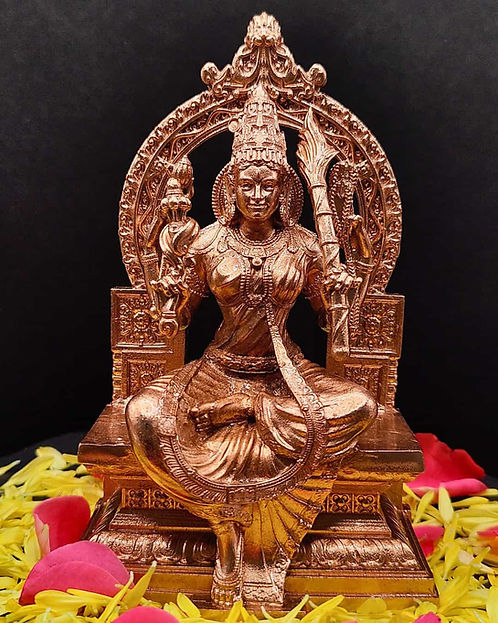
Who Is Lalitha Parameshwari?
Lalitha Parameshwari — also known as Lalita, Tripura Sundari, Shodashi and Rajarajeshwari — is considered the foremost among the Dasha Mahavidyas, the ten great wisdom goddesses of Shakta tradition. Where the other Mahavidyas each represent a distinct aspect of divine power, Lalitha is regarded as the source from which all their wisdom, or "vidya," ultimately flows — which is why the entire tradition built around her worship is named Srividya, the supreme knowledge.
Her name itself means "she who plays," reflecting the belief that the entire universe — its creation, its sustaining and its eventual dissolution — is nothing more than her divine, effortless play. She is praised extensively in the Lalita Sahasranama, the thousand names of the goddess, and in the Saundarya Lahari, a hymn dedicated to her beauty and grace.
Her Consort and Divine Family
Lalitha Parameshwari's consort is Kameshwara, a form of Lord Shiva, and together they represent the inseparable union of Shiva and Shakti — consciousness and energy — without which neither can exist in a complete state. Within the wider Shakta tradition, Goddess Parvati is regarded as the complete earthly incarnation of Lalitha Maha Tripura Sundari, linking this supreme form to the more familiar household goddess many devotees already know. She is also spoken of as the mother of Bala Tripura Sundari, a youthful form worshipped for her own purity and protective power.
Lalitha Parameshwari Among the Mahavidyas
Among the ten Mahavidyas, Lalitha is considered "Shodashi," the sixteen-syllabled one, and is placed at the very center of the group as the supreme, unifying presence. While goddesses like Kali or Chinnamasta are approached through fierce, transformative energy, Lalitha is approached through beauty, harmony and grace — showing that the same ultimate power can be worshipped through radically different, yet equally valid, forms.
The Philosophy of Sri Chakra and Srividya
Srividya worship is unique in that it teaches devotees to approach the goddess through three simultaneous forms: the gross form (sthula), the subtle form (sukshma) and the supreme form (para). Lalitha Parameshwari's idol — as an object of devotion — represents her gross, tangible form, allowing devotees to connect with her through sight, ritual and daily worship.
The Sri Chakra as Her Cosmic Body
Her subtle form is represented by the Sri Chakra, also called the Sri Yantra — an intricate geometric diagram of interlocking triangles said to map the entire structure of the universe and the human body's own energy centers. Meditating upon the Sri Chakra is considered equivalent to meditating upon the goddess herself, since tradition holds that her very form and the yantra's geometry are one and the same.
Union of Shiva and Shakti
Her supreme form is accessed only through mantra — the Srividya mantra transmitted through initiation — said to dissolve the boundary between the seeker and the divine entirely. Across all three forms, the underlying philosophy remains the same: Lalitha Parameshwari is the living demonstration that Shiva's stillness and Shakti's dynamic energy are two faces of a single, undivided reality.
The Legend of Bhandasura and the Birth of Lalitha Parameshwari
The Tyranny of Bhandasura
According to the Lalitopakhyana, a section of the Brahmanda Purana, a powerful demon named Bhandasura arose from the ashes of Manmatha, the god of love, after Manmatha was reduced to ashes by Shiva. Bhandasura grew immensely powerful through severe penance and began tormenting the three worlds, leaving the gods with no way to counter him.
The Great Yaga and Her Manifestation
Unable to defeat the demon on their own, the devas performed a great fire sacrifice and prayed to Adi Parashakti for deliverance. In answer to their devotion, the goddess manifested from the sacred fire in a radiant, eight-armed form, ready to confront the chaos Bhandasura had unleashed upon creation.
The Battle and the Goddess's Fury
The goddess waged a fierce war against Bhandasura and his forces, ultimately destroying him and restoring balance to the universe. Having expended such formidable, fiery energy in battle, she remained in an intense and unsettled state even after her victory, and the celestial beings had to find a way to calm her.
Her Return to a Serene, Smiling Form
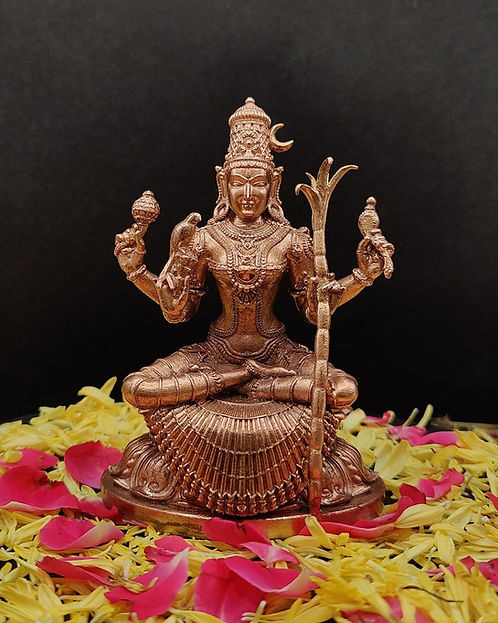
To soothe her, the devas built a sacred pavilion, seated her within it and worshipped her through the night. When the doors were opened again, she was no longer seen in her fierce battle form — she now sat in a calm padmasana posture, smiling gently, radiating grace rather than fury. It was in this tranquil form that she came to be known and worshipped as Lalitha Parameshwari, the playful, beautiful mother who protects even as she blesses.
Kanchipuram and the Sacred Shrine of Kamakshi
Lalitha Parameshwari's most revered shrine is the Kamakshi Amman Temple in Kanchipuram, Tamil Nadu, regarded as one of the principal Shakti Peethas of India. Tradition holds that it was here, after the Bhandasura episode, that the goddess chose to remain permanently, seated in her serene padmasana form for the benefit of devotees.
The temple is especially significant because Adi Shankaracharya is credited with installing the Sri Chakra within the sanctum, formally establishing the site as a center of Srividya worship that continues uninterrupted to this day. The Gayatri Mandapam within the temple complex, with its twenty-four pillars representing the syllables of the Gayatri mantra, is closely associated with the goddess's calming after her fierce battle. Her annual festival, centered on Masi Poornam in the Tamil month of Masi, remains one of the most important devotional occasions for followers of the Srividya tradition across South India.
Spiritual Significance of Lalitha Parameshwari
Embodiment of Divine Play
Her very name reflects the idea that creation itself is play, not labor — encouraging devotees to approach life's cycles with lightness rather than fear.
Union and Balance
As the living expression of Shiva-Shakti union, she represents the harmony between stillness and energy, thought and action, that devotees seek to cultivate within themselves.
Bestower of Beauty and Grace
Central to her worship is the belief that she grants not just outer beauty but inner radiance, dignity and self-assurance to her devotees.
Path to Self-Realization
Through the three-tiered Srividya practice — form, yantra and mantra — she offers a complete framework for spiritual growth suited to devotees at different stages of their journey.
Compassionate Motherhood
Praised as "Sri Mata" — the first name in the Lalita Sahasranama — she is approached above all as a nurturing, accessible mother figure, even by devotees who may not follow the deeper tantric aspects of her worship.
Why Is Lalitha Parameshwari Different from Other Devi Forms
Many Devi forms worshipped in South Indian homes — such as Durga, Kali or Angalamman — are approached primarily through their fierce, protective energy, often depicted mid-battle or bearing weapons. Lalitha Parameshwari's enduring iconography, by contrast, emphasizes her calm, seated, smiling form, even though her own legend includes the destruction of a powerful demon.
This makes her worship distinct: devotees are invited to connect with the goddess after her victory, in a state of restored balance and grace, rather than in the heat of battle. It is this serenity, paired with her position as the foremost of the Mahavidyas and the source of the Srividya tradition, that sets her apart from nearly every other Amman idol form worshipped across Tamil Nadu.
Conclusion
Lalitha Parameshwari stands as one of the most philosophically rich and visually serene goddess forms in Hindu tradition — a deity whose story moves from fierce battle to lasting grace, and whose worship spans everything from simple home devotion to the deepest currents of Srividya philosophy. Her presence continues to remind devotees that power and peace, energy and stillness, are never truly separate.
Comments
Log in or sign up to join the conversation.