

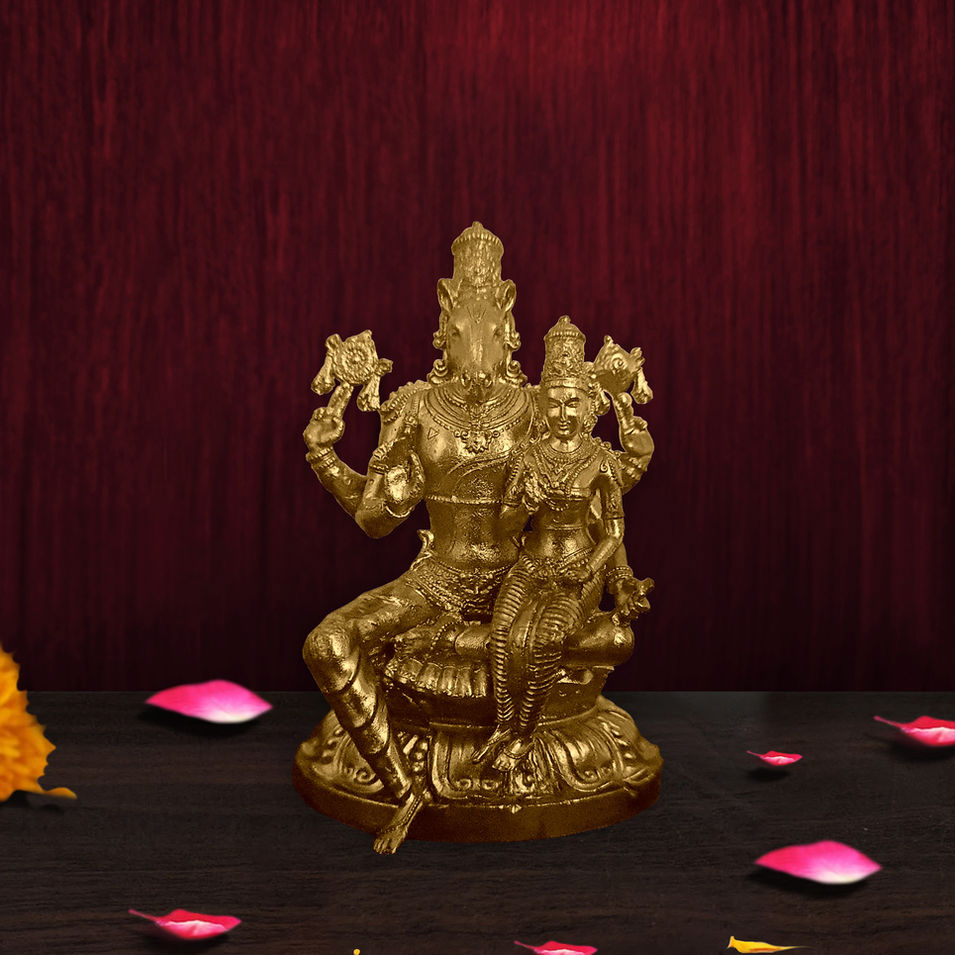
Lakshmi Hayagreevar is a devotional form that brings together two blessings rarely pictured side by side: the wisdom of a horse-headed god and the wealth of the goddess seated on his lap. Rather than treating knowledge and prosperity as separate rewards to be earned one after the other, this form suggests they were always meant to be sought together.
For students preparing for exams, scholars beginning new research, and families who simply want both learning and abundance to flourish under one roof, a Lakshmi Hayagreevar idol has become a quietly popular choice. This piece looks at who Hayagreeva and Lakshmi are individually, why they appear together in this form, and what makes this idol, available in fine brass through Idol Brass, worth understanding before you bring one home.
Who Are Lakshmi and Hayagreeva?
Hayagreeva, the Horse-Headed God of Knowledge
Hayagreeva is a horse-headed avatar of Lord Vishnu, worshipped specifically as the deity of knowledge and wisdom. He is traditionally depicted with a human body and the head of a horse, brilliant white in color, dressed in white garments and seated on a white lotus - every detail of his iconography pointing toward purity and clarity of mind. Devotees invoke Hayagreeva at the start of both sacred and secular studies, making him a favored deity among students, researchers and teachers alike.
Lakshmi, the Goddess of Abundance
Lakshmi needs little introduction in Hindu households - she is the goddess of wealth, fortune and prosperity, whose presence is invited into homes and businesses through daily worship. In the combined Lakshmi Hayagreevar form, she is shown seated gracefully on Hayagreeva's lap, her presence signaling that true prosperity is never far from true knowledge.
The Symbolism of the Combined Form
Reading the Iconography
In most Lakshmi Hayagreevar idols, Hayagreeva's upper hands hold the conch (shankha) and discus (chakra), the classic emblems of Vishnu, while his lower hands are shown in a gesture of blessing or holding sacred texts, representing the transmission of learning. Lakshmi sits at his side or on his knee, often holding a lotus, completing a composition where devotion, knowledge and wealth all occupy the same frame.
Why Wisdom and Wealth Are Shown Together
The pairing is not incidental. Classical thought held that wealth gained without wisdom rarely lasts, and wisdom without the means to act on it remains incomplete. By placing Lakshmi in Hayagreeva's care, the icon suggests that lasting prosperity flows from a foundation of genuine understanding - a message as relevant to a student's exam preparation as to a family's long-term financial well-being.
The Legend Behind Hayagreeva's Form
The Vedas Are Lost
According to the Puranic accounts collected in texts like the Bhagavata Purana, the sacred knowledge of the Vedas was, at different points, stolen away by demonic forces intent on plunging the world into ignorance. Without the Vedas, humanity was left without access to the wisdom needed to live rightly or worship correctly.
Vishnu sRestores the Veda
To recover this lost knowledge, Vishnu is described as taking the Hayagriva form — a being whose horse head symbolizes speed, strength and unwavering focus, qualities considered essential for guarding something as precious as sacred knowledge. Through this form, the Vedas were restored to the world, and Hayagreeva became forever associated with the protection and transmission of learning.
A Goddess Joins the Guardian of Knowledge
Over time, Lakshmi came to be depicted alongside Hayagreeva in devotional worship, reflecting a belief that knowledge safeguarded by the divine naturally draws prosperity along with it. The combined form became especially popular in Sri Vaishnava tradition, where scholarship and devotion have always been closely intertwined.
Where Hayagreeva Worship Flourished
The philosopher-poet Vedanta Desika, active in the 13th century, composed the widely recited Hayagriva Stotram in devotion to this form, and Hayagreeva is still honored today as the presiding deity of the historic Parakala Matha in Mysuru. Special worship is observed on Shravana Purnima, the August full moon associated with his incarnation, and again on Mahanavami, the ninth day of Navaratri - both considered especially auspicious for seeking his blessings on new learning.
Spiritual Significance of Lakshmi Hayagreevar
Academic clarity - sought by students before exams, competitive tests, or the start of a new course of study.
Prosperity with purpose - a reminder that wealth is meant to support wisdom, not replace it.
Protection of true knowledge - guarding against confusion, misinformation and shallow understanding.
Balance in the home - a single idol offering both intellectual and material blessings under one roof.
Why Is Lakshmi Hayagreevar Different from Other Forms
Unlike idols that represent a single deity or a single blessing, Lakshmi Hayagreevar is unusual for combining two distinct domains - wisdom and wealth - into one composed, seated figure. Where a Saraswati idol speaks purely to learning and a Lakshmi idol purely to abundance, this pairing offers something more integrated: a visual reminder that the two are meant to be pursued together, not traded off against each other.
Conclusion
Lakshmi Hayagreevar is a quiet but powerful reminder that knowledge and abundance were never meant to compete for space in a person's life. From the ancient legend of the Vedas being restored to the world, to Vedanta Desika's centuries-old hymns of praise, this form has consistently stood for the idea that wisdom, properly guarded, brings its own kind of wealth. A handcrafted brass idol of this pairing offers a daily, tangible way to keep both intentions - learning and prosperity - close at hand.
Comments
Log in or sign up to join the conversation.