

Lab-grown diamonds have changed the way many people approach engagement rings and fine jewelry. They offer the fundamental properties of a diamond while being created through modern technology rather than geological formation.
This guide explains the essential facts in a simple format.
What Is a Lab-Grown Diamond?
A lab-grown diamond is created in a controlled environment using technology that allows carbon to form into a diamond crystal.
It shares the essential chemical, physical, and optical properties associated with natural diamonds.
The primary difference is origin.
Natural diamonds form beneath the Earth, while lab-grown diamonds are produced using advanced technology.
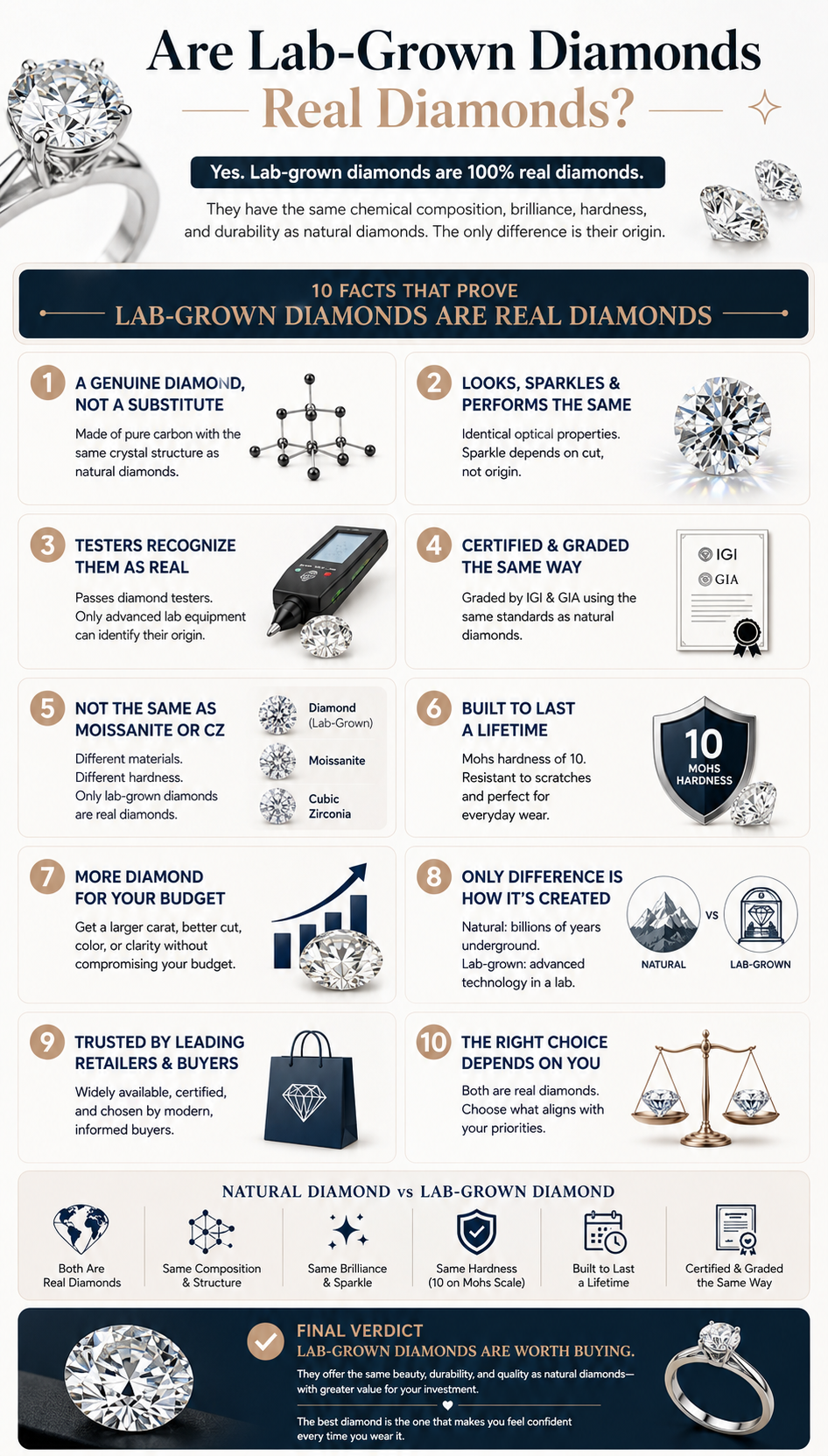
Real Diamond or Imitation?
Lab-grown diamonds should not be confused with diamond simulants.
Lab-Grown Diamond
Made from crystallized carbon
Mohs hardness of 10
Diamond optical properties
Suitable for fine jewelry
Moissanite
Made from silicon carbide
Different optical properties
Separate gemstone
Cubic Zirconia
Diamond alternative
Softer material
Commonly used in fashion jewelry
A lab-grown diamond is therefore fundamentally different from stones that simply imitate the appearance of a diamond.
How Are Lab-Grown Diamonds Created?
Two major technologies are commonly used.
HPHT
High Pressure High Temperature uses controlled heat and pressure to support diamond crystal growth.
CVD
Chemical Vapor Deposition allows carbon to accumulate around a diamond seed inside a controlled chamber.
Both methods produce laboratory-grown diamond material, although the growth process differs.
What Creates Diamond Sparkle?
Many buyers assume a natural diamond will automatically sparkle more.
That is not necessarily true.
A diamond's visual performance depends greatly on:
Cut quality
Proportions
Symmetry
Facet alignment
Light interaction
A well-cut diamond can return light effectively and produce strong brilliance, fire, and scintillation regardless of whether it is natural or laboratory-grown.
Are Lab-Grown Diamonds Durable?
Yes.
Diamond has a Mohs hardness rating of 10, making it highly resistant to scratching.
Lab-grown diamonds have diamond's characteristic hardness, which makes them suitable for jewelry such as:
Engagement rings
Wedding bands
Earrings
Pendants
Necklaces
Bracelets
Like any fine jewelry, proper setting, cleaning, and routine inspection can help maintain its condition.
Why Do Buyers Consider Lab-Grown Diamonds?
For many people, the appeal comes from greater flexibility when selecting a diamond.
Depending on specifications and current market pricing, buyers may be able to prioritize:
Larger Size
Consider a larger center stone within a planned budget.
Cut Quality
Focus more strongly on proportions and light performance.
Color & Clarity
Explore different combinations of visual quality.
Jewelry Design
Allocate more of the budget toward the setting and craftsmanship.
The goal is not simply to find the largest diamond, but to balance appearance, quality, and price.
Natural vs. Lab-Grown Diamonds
Natural Diamond
Formed through geological processes beneath the Earth's surface.
Lab-Grown Diamond
Created using controlled technology such as HPHT or CVD.
Both Can Offer
Diamond hardness
Strong brilliance
Long-lasting wear
Multiple shapes and cuts
Fine jewelry applications
Gemological documentation
Their different origins allow buyers to choose according to their own priorities.
What Should You Check Before Buying?
Before selecting a diamond, consider more than the label “natural” or “lab-grown.”
Look at:
Cut and proportions
Color
Clarity
Carat weight
Overall visual appearance
Gemological documentation
Setting quality
Jewelry craftsmanship
Warranty and aftercare
Total price
Evaluating the complete piece can lead to a more informed purchase.
Final Thought
Lab-grown diamonds offer buyers another way to approach fine jewelry without confusing them with diamond substitutes.
They have a different origin from natural diamonds but share the fundamental properties that define diamond material.
Whether you prefer natural or lab-grown diamonds, the best choice is one that fits your priorities, design preference, quality expectations, and budget.
Learn More:
https://lockstonejewels.com/
Comments
Log in or sign up to join the conversation.