

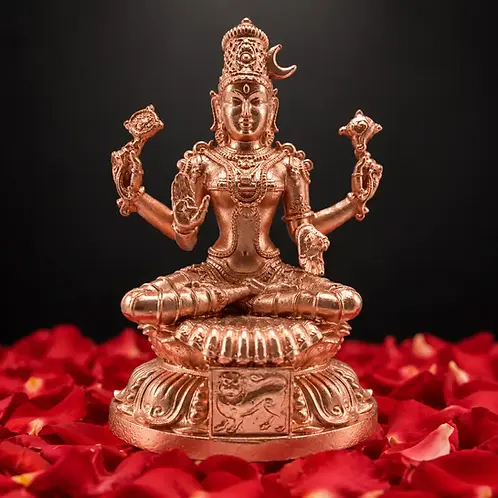
Kollur Mookambika, the Divine Mother of the Kodachadri hills, is one of the most cherished forms of Shakti in South India, and a bronze Mookambika idol brings her calm, protective presence into the home pooja room. Devotees from Karnataka, Kerala and Tamil Nadu travel to her shrine at Kollur to seek wisdom, courage and the blessing of learning, and many keep her image at home to carry that grace into everyday life.
The story of Mookambika is a rich blend of legend, philosophy and living tradition. It speaks of a sage's penance, a demon silenced by the Goddess, and Adi Shankaracharya's journey to install her at Kollur. In this blog, we explore who Mookambika is, what her form symbolises, the legend behind her name, and why she is worshipped with such devotion. This guide is brought to you by Idol Bronze, home of handcrafted South Indian bronze idols.
Who Is Kollur Mookambika?
Kollur Mookambika is the presiding goddess of the Mookambika Temple at Kollur, in the Udupi district of Karnataka. The temple stands on the banks of the Souparnika river, at the foot of the Kodachadri hills in the Western Ghats. Devotees revere her as Adi Parashakti, the primal feminine power behind creation, preservation and dissolution.
The Meaning of the Name "Mookambika"
The name combines Mooka and Ambika. Ambika means "Mother," while Mooka means "mute." According to the temple legend, the Goddess is the Mother who overcame the mute demon Mookasura, and so the name carries both her protective and her victorious side. Devotees also see a gentler meaning in it: the Mother who gives voice and wisdom to those who turn to her.
Mookambika as the Three Great Goddesses
Tradition holds that Mookambika embodies the combined power of Mahakali, Mahalakshmi and Mahasaraswati. She is therefore worshipped for strength, prosperity and knowledge together, rather than for any single blessing. This is one reason her devotees include students, artists, business families and those seeking courage in difficult times.
Iconography and Symbolism of Mookambika
The presiding image at Kollur is a panchaloha idol of the Goddess, which tradition says was installed by Adi Shankaracharya. Bronze and brass idols of Mookambika follow this iconography closely.
Padmasana and the Lotus
Mookambika is shown seated in padmasana, the lotus posture. The lotus stands for purity and spiritual awakening, and the meditative pose reflects her stillness and unshakable strength.
Shankha and Chakra
In her upper hands, the Goddess holds the conch (shankha) and the discus (chakra). The conch represents the primordial sound of creation, while the discus signifies the power that removes evil and protects dharma. These are attributes usually associated with Vishnu, and their presence in her hands reflects the union of divine powers within her.
Abhaya and Varada Mudras
Her lower hands display gestures of fearlessness (abhaya) and boon-giving (varada). Together they express her nature as a mother who removes fear and grants blessings to those who approach her with faith.
The Jyotirlinga and the Swarna Rekha
A unique feature of the Kollur shrine is the Jyotirlinga in the sanctum. A golden line, the swarna rekha, divides it into two halves. Devotees understand the two halves as Shiva and Shakti, present together in a single form. The panchaloha idol of the Goddess is placed before this lingam, so worshippers see both aspects of the divine in one sanctum.
The Legend of Mookambika
The origin of the Kollur shrine is told in several connected stages, each of which explains part of the Goddess's identity.
Kola Maharshi's Penance
The place takes its name from Kola Maharshi, a sage who performed intense penance here to please Lord Shiva. He sought protection for the world and for the sages who lived on the Kodachadri hills. His long tapasya is said to have made the land sacred, and the place came to be called Kolapura, which later became Kollur.
The Rise of Kaumasura
At the same time, a demon named Kaumasura was performing severe penance of his own. His aim was to win a boon from Shiva that would make him invincible. Had he succeeded, his power would have threatened the three worlds and the peace of the devotees and sages living around Kodachadri.
The Goddess Silences the Demon
Alarmed by the danger, the gods and sages turned to Shakti. As Kaumasura was about to receive his boon, the Goddess intervened and struck him mute so that he could not ask for it. From then on he was known as Mookasura, the mute demon. Devi then vanquished him, and the world was spared. Because of this act, the Goddess came to be worshipped as Mookambika.
Shiva and Shakti Take Up Abode at Kollur
Kola Maharshi then prayed that the divine presence remain at Kollur for the good of all devotees. According to tradition, Shiva manifested as the self-formed lingam with the golden line, and the Goddess took her abode beside it. Kollur has been regarded as a living seat of Shiva and Shakti ever since.
Adi Shankaracharya and the Journey to Kollur
Tradition also associates Mookambika with Adi Shankaracharya. It is said that he meditated on the Kodachadri hills and that the Goddess appeared before him. When he wished to take her to Kerala, she agreed to follow him on one condition: that he must not look back. As he walked, he heard the sound of her anklets behind him. When they reached Kollur, the sound stopped, and Shankaracharya turned to look. The Goddess said she would remain at that spot, and Shankaracharya installed her image there, along with a Sri Chakra. In some versions of this tradition, a Moola Mookambika shrine on Kodachadri marks the place where he first meditated.
The Mookambika Temple at Kollur
The Mookambika Temple is one of the most important Shakti shrines in South India and is counted among the seven Mukti Sthalas of the Parashurama Kshetra in coastal Karnataka.
Location: Kollur, Udupi district, Karnataka, beneath the Kodachadri hills
Sacred river: The Souparnika, which is believed to carry the healing essence of the herbs and plants it passes through on its way from the hills
Sanctum: The Jyotirlinga with the swarna rekha, and the panchaloha idol of the Goddess
Navaratri: The most important festival at the temple, drawing devotees from across the country
Vidyarambham: On Vijayadashami, parents bring young children to be initiated into learning under the Goddess's blessing
Rathotsava: The annual chariot festival, when the Goddess is taken out in procession before thousands of devotees
Spiritual Significance of Mookambika
Devotees turn to Mookambika for many reasons, and her worship speaks to several areas of life.
Goddess of Knowledge and Learning
Because of the Vidyarambham tradition, Mookambika is deeply associated with education, speech and the arts. Students and parents often seek her blessings before beginning a new stage of learning.
Protector Against Fear and Evil
As the Mother who silenced Mookasura, she is worshipped as a fierce protector who removes obstacles, fear and negative influence from the lives of her devotees.
Bestower of Strength and Prosperity
Her identity as Mahakali, Mahalakshmi and Mahasaraswati makes her a source of strength, abundance and wisdom at once.
Symbol of Shiva–Shakti Unity
The Jyotirlinga with the golden line reminds devotees that masculine and feminine divine energy are inseparable, and that creation itself rests on their union.
Why Is Mookambika Different from Other Devi Forms?
Many goddesses are worshipped across India, but Mookambika stands apart in several ways.
Shiva and Shakti in one sanctum: The Jyotirlinga with the swarna rekha places both aspects of the divine within a single shrine.
Three goddesses in one: She is revered as the combined form of Mahakali, Mahalakshmi and Mahasaraswati.
A name rooted in victory over silence: Her very name recalls the legend of the mute demon Mookasura.
Vishnu-associated attributes: She holds the conch and discus in her upper hands, which reflects the blending of divine traditions in her worship.
A link to Adi Shankaracharya: Her shrine is tied to the philosophical tradition of Advaita through Shankaracharya's association with Kollur.
A living tradition of learning: Vidyarambham at Kollur draws families every year seeking her blessings for their children's education.
Conclusion
Kollur Mookambika is far more than a temple deity. She is the Mother who protects, the Goddess who gives wisdom, and the divine presence in whom Shiva and Shakti are joined. Her legend, from Kola Maharshi's penance to Adi Shankaracharya's journey, has inspired generations of devotees. Keeping her bronze image in the pooja room is a way to carry that grace into your daily life.
Comments
Log in or sign up to join the conversation.