

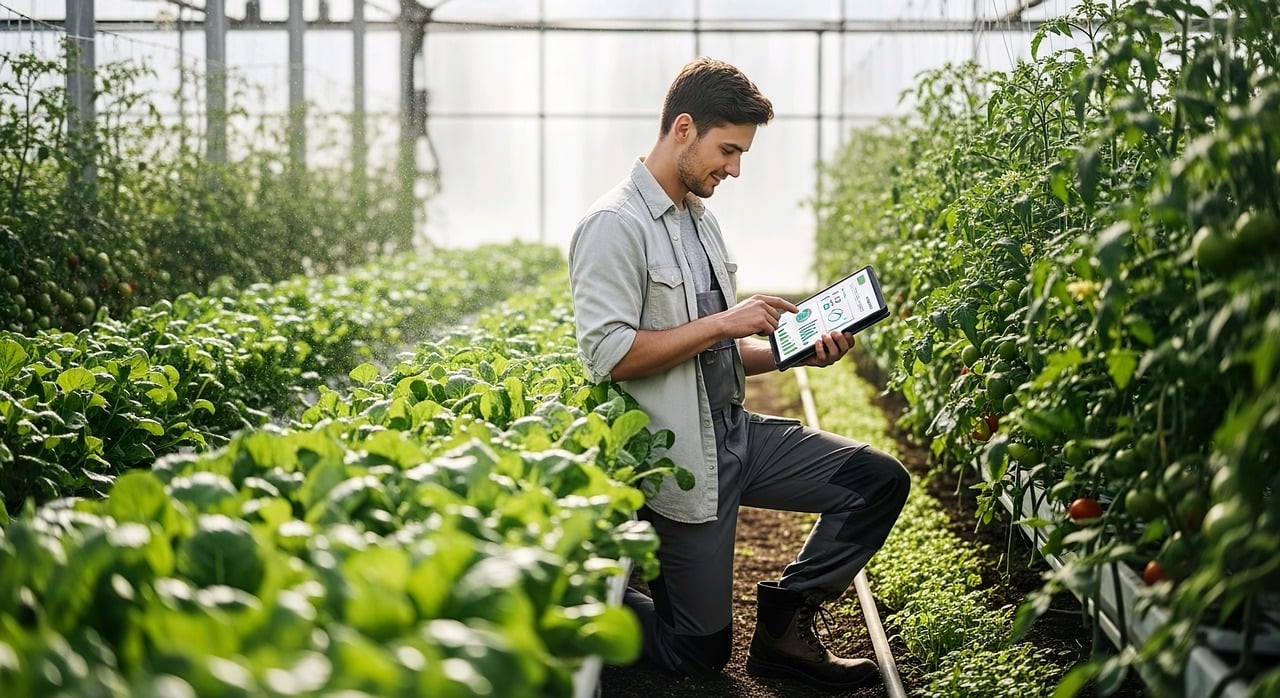
AgTech is no longer a niche innovation category. It has become a layered market spanning agricultural inputs, precision equipment, farm software, financing models, carbon programs, and biotechnology-enabled protein production.
The sector has entered a more disciplined phase. Capital is more selective, valuations have reset, and several high-profile companies have restructured or exited. Yet activity remains meaningful. Agrifoodtech startups raised $5.1 billion in the first half of 2025 across 551 deals, according to AgFunder.
The more important question for investors and operators is not how much money is flowing, but where durable business models and operational leverage are forming.
Below are 19 companies, from global incumbents to focused specialists, grouped by the role they play in modern agriculture.
Agribusiness and inputs giants adding digital layers
1. Cargill (US): Digital tools tied to animal nutrition and supply chains
Best for: livestock producers and nutrition teams that want better data flow around ingredients, nutrients, and formulation.
Why it stands out
Expanded digital capabilities around nutrition workflows (not just generic analytics).
Positions its tools as a way to connect ingredient, nutrient, and supplier data in one system.
Key AgTech plays
Nutrition platform designed to streamline feed formulation decisions
Digital tooling designed to improve efficiency across the nutrition value chain.
2) ICL Group: Fertilizer innovation focused on nutrient efficiency
Best for: growers and advisors focused on nutrient timing, efficiency, and reducing losses.
Why it stands out
Promotes a fully biodegradable controlled-release technology aimed at improving nutrient use efficiency.
Frames controlled-release fertilizers as a way to better sync nutrient availability with crop demand.
Key AgTech plays
Controlled-release fertilizer technologies aimed at improving nutrient use efficiency while reducing environmental losses.
3. ADM (US): Regenerative tracking and supply-chain-linked farmer programs
Best for: growers and grain buyers who need credible tracking of practices and outcomes.
Why it stands out
Backed a platform approach that tracks regenerative/sustainable practices and outcomes.
Designed to help farmers participate in programs and help buyers source against sustainability goals.
Key AgTech plays
Practice/outcome tracking for regenerative and sustainable agriculture
Farm-level data to support more transparent sourcing
4) Bayer (Germany): FieldView and farm decision support at scale
Best for: farms that want a major digital platform to learn from their season and improve decisions.
Why it stands out
Climate FieldView is positioned as a digital farming platform focused on “what worked and what didn’t.”
Built for operational improvement using farm data and digital tools.
Key AgTech plays
Digital platform to collect, analyze, and learn from field operations over time
Precision equipment, guidance, and automation
5) AGCO Corporation (US): Precision ag portfolio (PTx) spanning multiple brands
Best for: farms and dealers looking for a portfolio approach to precision (factory-fit + retrofit).
Why it stands out
Launched PTx as a precision ag portfolio, including go-to-market brands like PTx, Trimble, and Precision Planting.
Clear signal that precision is becoming a core pillar inside major equipment companies.
Key AgTech plays
Portfolio of precision technologies designed to scale across equipment ecosystems.
6) Trimble (US): Precision ag backbone, now amplified via PTx Trimble
Best for: mixed fleets that want precision ag capabilities that work across brands.
Why it stands out
Combined its precision agriculture business into a joint venture (PTx Trimble) designed to serve mixed-fleet “factory-fit and retrofit” needs.
Reinforces Trimble’s long-running role in precision ag as infrastructure, not a one-off tool.
Key AgTech plays
Mixed-fleet precision agriculture solutions via the PTx Trimble JV structure
7) Topcon Agriculture (US): Guidance and autosteering for everyday field work
Best for: operators who want steering and guidance options that can fit different machines and field realities.
Why it stands out
Emphasizes customizable guidance and steering solutions ranging from manual guidance to full autosteering.
Built around practical accuracy + adaptability (the stuff that actually matters in-season).
Key AgTech plays
Guidance and autosteering solutions designed for daily farm operations
8) DeLaval (UK): Dairy automation through robotic milking systems
Best for: dairy farms pushing for labor efficiency, consistency, and cow-focused automation.
Why it stands out
Positions the VMS V300 as a “voluntary milking system” designed to support healthier, calmer cows and stronger productivity outcomes.
Represents one of the clearest “automation changes daily life” categories in agriculture.
Key AgTech plays
Robotic milking systems designed to improve milking workflow and animal outcomes.
Farm software, sensors, and operational “data plumbing”
9) Conservis (US): Farm management software built to unify messy data
Best for: farms that want one interface to manage the business side of farming across tools.
Why it stands out
Described as integrating disparate farm technologies into a streamlined interface for managing farm operations.
A good example of “boring software” that makes complex operations run cleaner.
Key AgTech plays
Farm management platform focused on integrating multiple farm data sources.
10) CropX (US): Farm management expansion through “digital twins” strategy
Best for: operations that want sensor-and-platform-driven decision support and a broader management layer.
Why it stands out
Acquired Dacom Farm Intelligence as part of expanding its farm management software platform footprint.
Signals the consolidation trend: building broader platforms rather than single-point tools.
Key AgTech plays
Platform expansion via acquisition to broaden farm management capabilities
11) Ceres Imaging (US): Now Ceres AI for computer vision agriculture analytics
Best for: agribusiness and ag financial services that need high-quality field intelligence at scale.
Why it stands out
Rebranded to Ceres AI and emphasized computer vision + machine learning as the foundation.
Oriented toward faster, more accurate decisions for large agribusiness and financial services customers.
Key AgTech plays
Computer vision and machine learning analytics for agriculture stakeholders.
12) Gro Intelligence (US): Data-platform era, followed by asset acquisition
Best for: understanding how the market is consolidating around actionable ag intelligence.
Why it stands out
Its IP/assets were acquired by Almanac after Gro Intelligence shut down, highlighting both demand and difficulty in scaling pure data platforms.
A strong “market signal” company for the ag/climate intelligence category.
Key AgTech plays
Agricultural intelligence platform legacy; consolidation into other analytics ecosystems
Smallholder-first AgTech (where distribution + finance is the innovation)
13) AgroStar (India): Advisory + inputs + market linkages in one ecosystem
Best for: Indian farmers who want practical agronomy support and access to quality agri-inputs.
Why it stands out
Positions itself as an end-to-end agritech platform spanning advice, inputs, and market connections.
Emphasizes a “connected ecosystem” powered by technology, data, and expert guidance.
Key AgTech plays
Tech-enabled farm advisory and access to agricultural inputs.
14) Apollo Agriculture (Kenya): Bundled financing + inputs + training + insurance
Best for: small-scale farmers who need capital and risk protection tied to better farming outcomes.
Why it stands out
Very clear bundled model: seed-to-sale support including financing, training, inputs, and insurance.
Represents how AgTech looks in markets where credit access is the main constraint.
Key AgTech plays
“Bundle” approach to helping small-scale farmers improve harvest results.
Sustainability programs, carbon, biotech, and alternative proteins
15) Indigo Ag (US): Carbon markets and verified outcomes at scale
Best for: growers evaluating carbon programs and practice-based sustainability incentives.
Why it stands out
Reported completion of its third carbon crop and production of 163,048 carbon credits (a key scale signal).
Positions itself as a trusted partner for sustainable agriculture programs tied to measurable outcomes.
Key AgTech plays
16) Benson Hill (US): Crop innovation story with a major bankruptcy milestone
Best for: tracking the “crop genetics + ingredients” side of AgTech and its financial realities.
Why it stands out
Its bankruptcy cases were converted to Chapter 7 on September 23, 2025, making it a notable market signal for the sector.
Useful as context for how hard it is to finance long-cycle crop innovation.
Key AgTech plays
Historical role in crop/ingredient innovation, now shaped by liquidation proceedings.
17) Impossible Foods (US): Food tech powered by fermentation + biotech
Best for: anyone tracking how AgTech and “future food” collide.
Why it stands out
Explains that it makes “heme” using yeast genetically engineered with the gene for soy leghemoglobin.
Shows how biotech can reshape protein supply chains and demand signals upstream.
Key AgTech plays
Fermentation-enabled ingredient production to mimic meat flavor.
Vertical farming and controlled environment agriculture
18) Plenty Inc (US): Vertical farming platform that restructured and continued
Best for: observers of indoor farming who want to see which models survive a reset.
Why it stands out
Announced it successfully emerged from Chapter 11 after confirmation of a reorganization plan.
Continues to position itself as an indoor vertical farming platform company.
Key AgTech plays
Controlled environment agriculture platform development under a restructured business.
19) Bowery Farming (US): High-profile vertical farming company that shut down
Best for: understanding the risk side of the indoor farming category.
Why it stands out
Reported to have ceased operations (a major “reality check” moment for vertical farming economics and funding).
Remains an important reference point when people talk about scaling indoor agriculture.
Key AgTech plays
Controlled-environment vertical farming systems (historical footprint).
Simple side-by-side comparison
If you want “inputs + data + programs”: Cargill, ADM, Bayer, ICL Group
If you want “machines that farm smarter”: AGCO, Trimble, Topcon, DeLaval
If you want “systems that run the farm”: Conservis, CropX, Ceres AI
If you want “smallholder scale models”: AgroStar, Apollo Agriculture
If you want “sustainability + carbon + biotech”: Indigo Ag, Impossible Foods (and Benson Hill as a market signal)
If you’re tracking indoor farming: Plenty, Bowery Farming
Closing thoughts
AgTech isn’t a single race for “the best app.” It’s a set of battles across labor, inputs, water, risk, transparency, and resilience. The companies above matter not just because they build tools, but because they influence how operational decisions are made, from soil and seed to supply chains and food manufacturing. Some are scaling through integration and platform strategy. Others serve as reminders of how capital-intensive and complex agricultural innovation can be.
Together, they reflect a sector that is consolidating, recalibrating, and continuing to evolve.



Comments
Log in or sign up to join the conversation.