
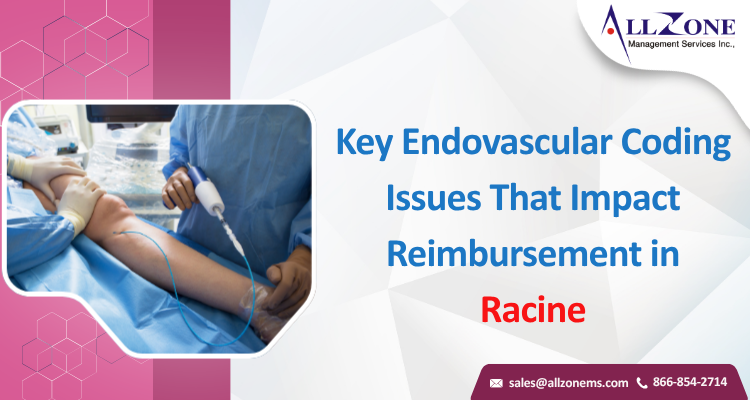
Endovascular procedures allow physicians to treat vascular conditions through minimally invasive techniques, but the billing process behind these procedures can be highly detailed. Catheter placement, angiography, angioplasty, stent placement, atherectomy, embolization, and other interventions may involve specific CPT reporting rules and documentation requirements.
For practices seeking Medical Billing Services in Racine, coding accuracy is particularly important because even a small discrepancy between the operative report and submitted claim can affect reimbursement. Allzone's endovascular coding guide highlights bundling, component coding, selective catheterization, vascular hierarchy, laterality, and payer requirements as important areas for accurate reporting.
Why Endovascular Coding Creates Reimbursement Problems
Endovascular procedures frequently involve several technical components during a single encounter. A procedure may include vascular access, catheter placement, diagnostic imaging, lesion treatment, stent placement, and additional imaging or guidance.
The challenge is determining which services are included in a comprehensive CPT code and which services may be separately reportable. Incorrectly separating bundled services can create claim issues, while failing to report an appropriate service can result in underbilling.
This makes Medical Coding Services in Racine an important part of maintaining accurate endovascular claims.
CPT Selection Must Match the Procedure Performed
CPT selection is one of the most important parts of endovascular coding because the reported code must accurately represent the procedure documented by the physician. Endovascular procedures can involve catheterization, angiography, angioplasty, stent placement, atherectomy, and embolization, each requiring careful review of the applicable coding guidelines. Providers can also refer to Allzone Management Services’ Endovascular CPT Codes Guide for additional information on procedure-specific coding considerations:
The CPT code should accurately represent the procedure documented by the physician. Endovascular coding requires attention to the specific vascular territory, procedure performed, treatment method, and other documented details.
Allzone's endovascular CPT resource explains that endovascular coding includes catheter placement, diagnostic angiography, angioplasty, stent placement, atherectomy, and embolization categories.
Incorrect CPT selection can create a mismatch between the operative report and the claim. This can result in payer questions, claim rejection, denial, or reimbursement delays.
Bundling and Unbundling Can Affect Payment
Bundling is one of the most significant coding considerations in endovascular billing. Certain procedures and related services may already be included within a comprehensive code.
For example, Allzone's endovascular guide explains that some stent procedures include catheterization, imaging guidance, and angioplasty. Reporting these components separately without appropriate justification can create duplicate or unbundling concerns.
Therefore, Endovascular Coding Services should include a careful review of code relationships before claims are submitted.
2026 Lower Extremity Revascularization Changes Add Complexity
Endovascular coding also requires attention to current code-set changes. Allzone's 2026 lower-extremity revascularization update states that the previous 37220–37235 code range was replaced effective January 1, 2026, with new codes in the 37254–37299 range. The update also describes changes involving vascular territories, lesion complexity, and bundled services.
This demonstrates why relying on older coding references can create problems. Coding teams handling current claims need to verify the applicable code set and reporting requirements for the date of service.
Documentation Gaps Can Affect Endovascular Claims
Clinical documentation must support the codes reported on the claim. For endovascular procedures, important details may include the vascular family treated, selectivity level, laterality, lesion characteristics, interventions performed, and whether diagnostic imaging was separately medically necessary.
When documentation does not clearly establish these details, the coder may have difficulty selecting the appropriate code.
Allzone identifies documentation gaps involving vessel order, laterality, medical necessity, and lesion details as potential sources of claim problems.
ICD-10 Diagnosis Coding Must Support Medical Necessity
Procedure coding is only one part of an endovascular claim. The diagnosis code should accurately represent the patient's documented condition and support the medical necessity of the service.
Allzone's endovascular billing resource identifies diagnosis categories involving peripheral arterial disease, aneurysms, arterial embolism or thrombosis, and vascular-device complications. It also emphasizes that diagnosis codes must reflect medical necessity and clinical documentation.
This makes ICD-10 Coding Services another important component of an endovascular billing workflow.
Modifier Errors Can Create Additional Claim Issues
Modifiers communicate additional information about a service and can be particularly important when multiple procedures are performed.
Allzone's endovascular billing information identifies modifiers such as 59, 76, 77, and other applicable modifiers as areas requiring careful review.
A modifier should not be added simply to force separate reimbursement. The documentation and applicable payer rules need to support its use. Incorrect modifier application can result in bundling edits, claim denials, or requests for additional information.
Diagnostic Angiography Requires Careful Review
Diagnostic angiography is another area where coding decisions require attention. Not every imaging service performed during an intervention is automatically separately reportable.
Allzone's endovascular CPT guide explains that diagnostic angiography may be separately billed when it is medically necessary and not already included in the intervention, while imaging performed solely to guide treatment may be bundled.
For this reason, coders need to distinguish diagnostic intent from imaging performed as an inherent part of the therapeutic procedure.
Specialty-Based Coding Helps Address Complex Procedures
Endovascular procedures require knowledge beyond basic medical coding. The coding team needs to understand vascular anatomy, procedure terminology, CPT guidelines, ICD-10 diagnosis reporting, modifiers, documentation, and payer-specific requirements.
Allzone describes its specialty coding services as including CPT, HCPCS, ICD-10, and coding audits, with endovascular support covering procedures such as angioplasty, stent placement, embolization, thrombectomy, EVAR, diagnostic angiography, and IVUS.
This specialized approach can help Racine providers identify coding discrepancies before claims are submitted.
Endovascular Billing Requires More Than Code Selection
Endovascular Billing Services involve more than assigning CPT and ICD-10 codes. The overall process can include charge capture, documentation review, claim submission, payer follow-up, payment posting, denial management, and appeals.
A coding error identified after claim submission may already have created additional administrative work. Reviewing claims before submission can help identify inconsistencies earlier.
Allzone's endovascular billing service describes documentation review, coding, payer-specific billing, prior authorization verification, claim submission, and follow-up as components of its workflow.
Coding Audits Can Identify Recurring Problems
Individual claim corrections solve immediate problems, but recurring coding errors may indicate a broader workflow issue.
A coding audit can examine patterns involving CPT selection, ICD-10 diagnosis coding, modifier usage, bundling, documentation, and missed charges. This can help practices determine whether problems are isolated or occurring repeatedly across providers or procedures.
For Racine practices, regular review can provide useful feedback for improving documentation and coding processes before errors become repeated denial patterns.
How Endovascular Coding Problems Can Affect Reimbursement
Coding inaccuracies can affect reimbursement in several ways. A claim may be denied, payment may be delayed, a service may be underreported, or additional documentation may be requested.
Allzone's endovascular billing resource specifically identifies incorrect or missing CPT/ICD codes, inadequate medical-necessity documentation, unbundled or duplicated procedures, missing modifiers, and authorization issues among potential causes of endovascular claim denials.
Addressing these issues requires coordination between clinical documentation, coding, billing, and payer follow-up.
Building a More Reliable Endovascular Coding Workflow
Racine providers can strengthen endovascular billing by reviewing documentation before claim submission, verifying the current CPT code set, checking bundling rules, validating diagnosis codes, and confirming modifier requirements.
The process should also account for the date of service because coding rules and code sets can change over time. The 2026 lower-extremity revascularization changes are a clear example of why coding teams need current references.
A structured workflow can help identify potential coding problems before they become reimbursement issues.
How Allzone Supports Endovascular Coding and Billing
Allzone Management Services provides endovascular billing and coding support covering CPT and ICD-10 coding, documentation review, charge capture, claim submission, payer-specific billing, denial management, payment posting, and A/R follow-up.
For Racine providers, specialized support can help connect clinical documentation with accurate code selection and claim submission while also addressing recurring denial and reimbursement problems.
Conclusion
Endovascular coding requires careful attention to CPT selection, ICD-10 diagnosis coding, bundling rules, modifiers, documentation, medical necessity, and current code-set changes. These factors can directly affect how claims are processed and reimbursed.
Racine providers can reduce avoidable billing problems by strengthening documentation review, maintaining current coding knowledge, conducting periodic audits, and using specialized Specialty Based Coding Services when appropriate.
Accurate coding is not simply about selecting a procedure code. It requires ensuring that the submitted claim accurately represents the documented service and follows applicable reporting and payer requirements.
Industry blog:
https://www.allzonems.com/blogs/
Bundling and Unbundling in Medical Billing
For more information about our specialized Medical Billing Services in Kenosha, WI, visit Allzonems.com. You can also contact our team at +1 866-854-2714 or reach us at [email protected]. Address: 450 N. Brand Blvd., Suite 613, Glendale, CA 91203
Comments
Log in or sign up to join the conversation.