

The headline data this month showed no improvement in consumer income and little improvement in spending.

Analyst Opinion of Personal Income and Expenditures
This is an annual update month, and everything seems to have been revised downward.
Consumer spending with this revision shows it is far outpacing income - not good news. And the savings rate has been significantly revised downward.
Inflation grew this month.
The backward revisions this month SIGNIFICANTLY affected the year-over-year rate of growth for income and expenditures.
- The market looks at current values (not real inflation adjusted) and was expecting (from Bloomberg):.
| Consensus Range | Consensus | Actual | |
| Personal Income - M/M change | 0.2 % to 0.5 % | +0.4 % | +0.0% |
| Consumer Spending - M/M change | 0.0 % to 0.3 % | +0.1 % | + 0.1 % |
| PCE Price Index -- M/M change | 0.0 % to 0.0 % | +0.0 % | + 0.0 % |
| Core PCE price index - M/M change | 0.1 % to 0.2 % | +0.1 % | + 0.1 % |
| PCE Price Index -- Y/Y change | 1.3 % to 1.4 % | +1.3 % | + 1.4 % |
| Core PCE price index - Yr/Yr change | 1.4 % to 1.5 % | +1.4 % | + 1.5 % |
- The monthly fluctuations are confusing. Looking at the inflation adjusted 3 month trend rate of growth, disposable income growth rate trend is decelerating while consumption's growth rate is also decelerating.
- Real Disposable Personal Income is up 1.2 % year-over-year (published 2.2 % last month - now revised to 1.4 %), and real consumption expenditures is up2.4 % year-over-year (published 1.4 % last month - now revised to 2.7 %)
- The 2Q2017 GDP estimate indicated the economy was expanding at 2.6 % (quarter-over-quarter compounded). Expenditures are counted in GDP, and income is ignored as GDP measures the spending side of the economy. However, over periods of time - consumer income and expenditure grow at the same rate.
- The savings rate continues to be low historically, and declined to 3.8 % this month [last month it was published the savings rate was 5.5% - and it was downwardly revised to 3.9 %].
(Click on image to enlarge)

z pce_table.png
The inflation adjusted income and consumption are "chained", and headline GDP is inflation adjusted. This means the impact to GDP is best understood by looking at the chained numbers. Econintersect believes year-over-year trends are very revealing in understanding economic dynamics.
Per capita inflation adjusted expenditure has exceeded the pre-recession peak.
Seasonally and Inflation Adjusted Expenditure Per Capita
(Click on image to enlarge)

Backward revisions this month:
Revisions to the personal income and outlays estimates reflect the results of the recent annual update of the national income and product accounts (NIPAs). These updates, usually made each July, incorporate newly available and more comprehensive source data, as well as improved estimation methodologies. This year's update covers the period January 2014 through May 2017.
Revisions to annual estimates of personal income and outlays for 2014 through 2016 are shown in table 12. Revised and previously published monthly estimates of personal income, DPI, PCE, personal saving as a percentage of DPI, real DPI, and real PCE are shown in table 13. Revised and previously published annual and quarterly estimates are shown in table 14.
Personal income was revised up $8.5 billion, or 0.1 percent, in 2014; $94.5 billion, or 0.6 percent, in 2015; and revised down $58.0 billion, or -0.4 percent, in 2016.
- For 2014, revisions to personal income and its components were generally small, and primarily reflecteda $21.6 billion downward revision to nonfarm proprietors' income that was partly offset by a $15.8 billion upward revision to personal dividend income.
- For 2015, the revision to personal income primarily reflectedupward revisions of $68.7 billion to personal dividend income and $64.5 billion to personal interest income that were partially offset by a downward revision of $71.7 billion to nonfarm proprietors' income.
- For 2016, the revision to personal income primarily reflectedan upward revision of $100.8 billion to personal interest income that was more than offset by downward revisions of $94.3 billion to compensation of employees and $91.0 billion to nonfarm proprietors' income.
DPI was revised up $9.9 billion, or 0.1 percent, in 2014; $95.2 billion, or 0.7 percent, in 2015; and revised down $57.2 billion, or -0.4 percent, in 2016. The percent change from the preceding year in real DPI was revised up 0.1 percentage point to 3.6 percent in 2014, revised up 0.7 percentage point to 4.2 percent in 2015, and revised down 1.2 percentage points to 1.4 percent in 2016.
Personal outlays was revised down $2.9 billion, or less than -0.1 percent, in 2014; revised up $50.5 billion, or 0.4 percent, in 2015; and revised up $60.9 billion, or 0.5 percent, in 2016. Revisions to personal outlays primarily reflect revisions to PCE.
The personal saving rate was revised up 0.1 percentage point to 5.7 percent in 2014, revised up 0.3 percentage point to 6.1 percent in 2015, and revised down 0.8 percentage point to 4.9 percent in 2016.
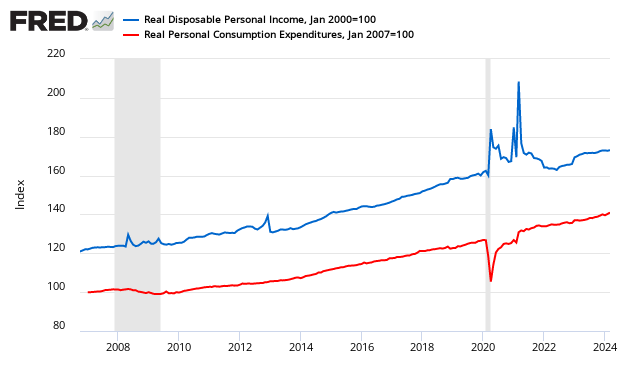
The graph below illustrates the relationship between income (DPI) and expenditures (PCE) - showing clearly income and expenditures grow at nearly the same rate over time.
Indexed to Jan 2000, Growth of Real Disposable Income (blue line) to Real Expenditures (red line)
(Click on image to enlarge)
The short term trends are mixed depending on the periods selected - but spending remains historically elevated.
Seasonally Adjusted Spending's Ratio to Income (a declining ratio means consumer is spending less of its Income)
(Click on image to enlarge)

PCE is the spending of consumers. In the USA, the consumer is the economy. Likewise, personal income is the money consumers earn to spend. Even though most analysts concentrate on personal expenditures because GDP is based on spending, increases in personal income allow consumers the option to spend more.
There is a general correlation of PCE to GDP (PCE is a component of GDP).
Seasonally and Inflation Adjusted Year-over-Year Change of Personal Consumption Expenditures (blue line) to GDP (red line)
(Click on image to enlarge)

Econintersect and GDP uses the inflation adjusted (chained) numbers. Disposable Personal Income (DPI) is the income after the taxes.
Seasonally & Inflation Adjusted Percent Change From the Previous Month - Personal Disposable Income (red line) and Personal Consumption Expenditures (blue line)
(Click on image to enlarge)

Yet year-over-year growth for income and expenditures is below GDP year-over-year growth.
Seasonally & Inflation Adjusted Year-over-Year Change - Personal Disposable Income (red line) and Personal Consumption Expenditures (blue line)
(Click on image to enlarge)

The savings rate has been bouncing around - but the general trend is down. In an economy driven by consumers, a higher savings rate does not bode well for increased GDP. This is one reason GDP may not be a good single metric of economic activity.
Personal Savings as a Percentage of Disposable Personal Income
(Click on image to enlarge)

And one look at the different price changes seen by the BEA in this PCE release versus the BEA's GDP and BLS's Consumer Price Index (CPI). We should note that the inflation adjustment is for PCE and Personal Income is usually lower than the ones used for GDP and CPI.
Year-over-Year Change - PCE's Price Index (blue line) versus CPI-U (red line) versus GDP Deflator (green line)
(Click on image to enlarge)

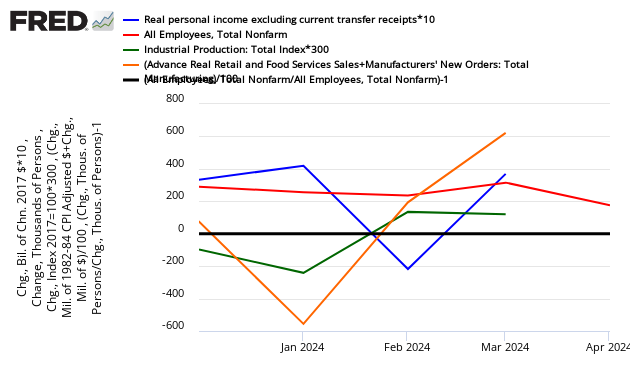
Finally for recession watchers, here is the graph below, here are the elements used to mark a recession. (1) personal income less transfer payments, in real terms and (2) employment. In addition, we refer to two indicators with coverage primarily of manufacturing and goods: (3) industrial production and (4) the volume of sales of the manufacturing and wholesale-retail sectors adjusted for price changes.
If a line falls below the 0 (black line) - that sector is contracting from the previous month. Personal income is the blue line. Note - the below graph uses multipliers to make movements more obvious (ignore the value of the scale, only consider whether the graph is above [good] or below [bad] the zero line).
Month-over-Month Growth Personal Income less transfer payments (blue line), Employment (red line), Industrial Production (green line), Business Sales (orange line)
(Click on image to enlarge)
Caveats on the Use of Personal Income and Consumption Expenditure Data
PCE is a fairly noisy index and subject at times to significant backward revision. This index cannot be relied upon in real time.
This personal income and personal consumption expenditure data by itself is not a good tool to warn of an upcoming recession. Econintersect has shown that PCE is a distraction for recession watchers, with moves over a few months having a 30% accuracy of indicating a recession start, and a 70% incidence of indicating a non-recessionary event. The graph below shows the lack of correlation. Note, however, that PCE does have prolonged declines over many months associated with recessions but these long declines are not very good in "predicting" a recession until it is already underway.
(Click on image to enlarge)

Readers are warned that this article is based on seasonally adjusted data. Monthly non-adjusted data is available with a delay of several months.


Comments
Log in or sign up to join the conversation.