

Image: Bigstock
The Federal Reserve's annual stress tests once again confirmed the strength of America's largest banks, giving management teams the green light to return more capital to shareholders.
Following the results, JPMorgan Chase (JPM - Free Report) has announced a 10% dividend increase and authorized a massive $50 billion share repurchase program, while Goldman Sachs (GS - Free Report) raised its quarterly dividend by 11% but didn't announce a new buyback authorization.
For income investors, higher dividends are certainly welcome. However, the more important question is whether either stock still offers attractive value after a tremendous run over the past two years, with GS surging over 130% and JPM rising more than 70%.
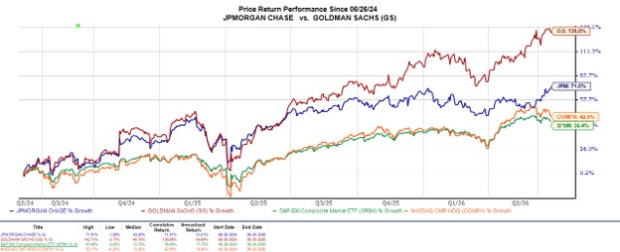
Image Source: Zacks Investment Research
JPMorgan Continues to Reward Shareholders
JPMorgan announced plans to increase its quarterly dividend from $1.50 to $1.65 per share, representing a 10% increase, subject to board approval. At the same time, the bank's authorization of a new $50 billion stock repurchase program signals confidence in both its balance sheet and earnings outlook.
CEO Jamie Dimon has consistently emphasized maintaining a "fortress balance sheet", and the latest capital return announcement reinforces that message.
The buyback authorization is particularly notable because it allows JPMorgan to reduce its share count over time, boosting earnings per share while returning excess capital to investors.
Goldman Sachs' Dividend Hike
Goldman Sachs also rewarded shareholders, increasing its quarterly dividend from $4.50 to $5.00 per share, an 11% increase following the favorable stress test results. That said, unlike JPMorgan, Goldman stopped short of announcing a new share repurchase authorization.
That doesn't necessarily signal weakness, as Goldman has historically been opportunistic with buybacks, often repurchasing shares when management believes the stock trades below intrinsic value.
Still, the absence of a buyback announcement makes JPMorgan's capital return package somewhat more shareholder-friendly in the near term.
P/E Analysis: JPM Looks Cheaper Than GS
Although both banks have delivered outstanding returns since late 2023, valuation alludes to the notion that JPM may have more room to run, especially when considering the stock price to earnings (P/E).
Outside of a cheaper stock price of around $337 a share, JPM trades at 14X forward earnings compared to GS at over $1,000 a share and 18X forward earnings.
Both stocks trade above their long-term median forward P/E multiples, but Goldman appears considerably more expensive relative to its own history.
GS is trading at a decade-long high in regard to its forward P/E multiple and is noticeably above its median of 11X during this period. This suggests investors have already priced in much of the optimism surrounding investment banking, capital markets activity, and an expected pickup in mergers and acquisitions.
Meanwhile, JPM is trading modestly above its decade-long forward P/E median of 12X, and is still more than 30% from a high of 21X.
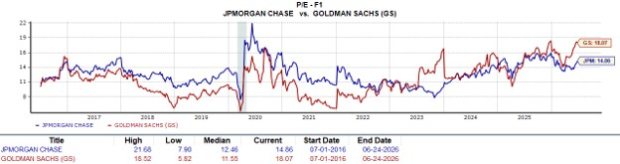
Image Source: Zacks Investment Research
The Deciding Factor
Both banks remain exceptionally well-managed businesses with strong capital positions and attractive long-term growth prospects.
However, if choosing between the two today, JPMorgan appears to offer the better risk-reward profile.
While neither stock looks outright cheap, JPMorgan trades at a lower forward P/E multiple on top of the fact that the newly announced $50 billion buyback program also provides an additional tailwind for earnings per share.
Conclusion & Strategic Thoughts
The dividend increases from JPMorgan and Goldman Sachs underscore the strength of the U.S. banking sector following another successful round of Federal Reserve stress tests.
For investors seeking dependable dividend growth, both remain excellent choices. At the moment, JPMorgan and Goldman Sachs stocks both land a Zacks Rank #3 (Hold).
To that point, neither stock is a bargain, but investors who already own either company may have little reason to sell, considering their dividend hikes. However, new buyers may want to be patient and look for market pullbacks before initiating positions.


Comments
Log in or sign up to join the conversation.