

So much for fears, the banks would drag down Q1 earnings season.
In a big reversal from the sharp slump in Q4 bank earnings, moments ago JPMorgan put bank stocks on the front foot and saw its stock price surge when it reported revenue, earnings and most importantly FICC profits that beat expectations across the board.
The biggest US bank reported record GAAP revenue of $29.1 billion and "managed revenue" of $29.9 billion, beating expectations of $28.36 billion. This translated into Q1 EPS of $2.65 (and adjusted EPS of $2.60), also handily beating the $2.35 estimate.
Commenting on the results, CEO Jamie Dimon said that "in the first quarter of 2019, we had record revenue and net income, strong performance across each of our major businesses and a more constructive environment. Even amid some global geopolitical uncertainty, the U.S. economy continues to grow, employment and wages are going up, inflation is moderate, financial markets are healthy and consumer and business confidence remains strong."
While some were expectation net interest income to drop as a result of the collapse in the yield curve, this did not happen, and in fact NII rose $100MM from Q4 and $1.1 billion from Q1 2018 to $14.6 billion; as JPM wrote, "net interest income was $14.6 billion, up 8%, predominantly driven by the impact of higher rates, as well as balance sheet growth and mix." Don't expect this to sustain, however, with the yield curve collapsing and inverting in March and barely rebounding in recent days. Meanwhile, non-interest revenue also increased by an impressive $0.2BN from last year, rising to $15.3 billion.
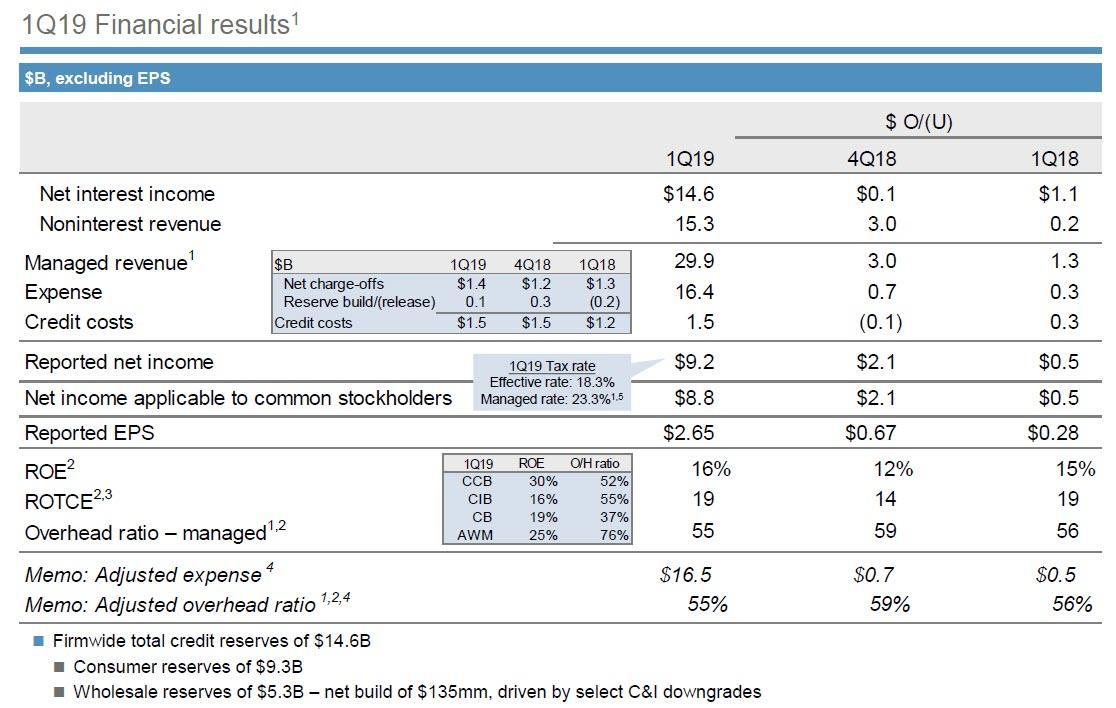
Of note, JPM recorded a provision for credit losses of $1.495 billion, just above the $1.487 billion analysts were expecting. JPMorgan said this includes a $135 million net reserve build on select downgrades of commercial clients. As Bloomberg notes, expect questions during the call about what industry those clients are from because it's a signal of where JPMorgan is seeing stress.
It is also worth noting that JPM's net interest margin climbed for the ninth consecutive quarter to 2.56% even as the yield curve inverted, which will likely prompt more questions how the bank managed to offset this move in the bond market.
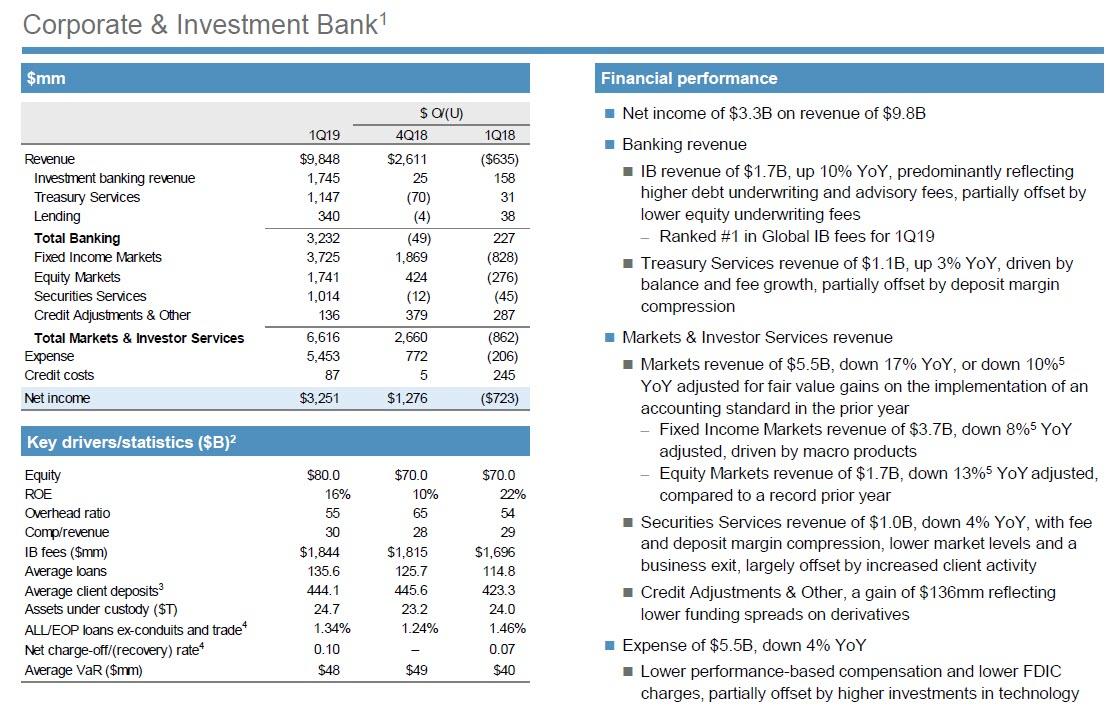
Breaking down the bank's impressive revenue number, analysts immediately honed in on the Investment Banking revenue, which hit $1.75BN in Q1, up 10% from a year ago, and roundly beating expectations of $1.63 billion. The jump reflected "higher debt underwriting and advisory fees, partially offset by lower equity underwriting fees."
Also closely watched was the $3.73 billion print in Q1 FICC revenues, which also beat estimates of $3.67 billion. Equity trading did well as well, reporting a solid $1.74 billion, just above the $1.73 billion expected. Still, overall markets revenue of $5.5B was down 17% YoY, or down 10% YoY adjusted for fair value gains on the implementation of an accounting standard in the prior year. Overall, despite beating expectations, trading revenues were well below the same period last year, as Fixed Income Markets revenue of $3.7B, was down 8%YoY. According to JPM, "fixed Income Markets revenue of $3.7 billion reflected lower revenue in Currencies & Emerging Markets and Rates, driven by lower client activity compared to the prior year, which benefited from strong performance. This decline was partially offset by improved performance in Credit Trading and Commodities from higher client flows. "
Equity Markets revenue of $1.7B, was down 13% YoY which in turn "reflected lower client activity, predominantly in derivatives. Securities Services revenue was $1.0 billion, down 4%, predominantly driven by fee and deposit margin compression, lower market levels and the impact of a business exit, largely offset by increased client activity."
Commenting on the Investment Banking group, Dimon said "as the environment stabilized, the Markets business performed solidly, although down from a particularly strong prior-year quarter. And Asset & Wealth Management grew AUM 4% with continued net long-term inflows."
Turning to expenses, costs rose 2% to $16.4 billion, in line with what analysts were expecting. The bank says the increase was driven by investments in technology, marketing, real estate, and front-office hires. Within investment banking, expenses were $5.5 billion, down 4% Y/Y due to "lower performance-based compensation and lower FDIC charges, partially offset by higher investments in technology."
Looking at the bank's consumer banking group, JPMorgan reported average loans up 1% and core loans up 4% YoY; at the same time, average deposits rose 3% YoY. Revenue of $13.8B was up 9% YoY and driven by higher NII on higher deposit and card margins and balance growth. Expenses also rose to $7.2B, up 4% YoY, "driven by investments in the business and higher auto lease depreciation, partially offset by expense efficiencies and lower FDIC charges."
Of note here, the bank said that the average it pays on interest-bearing deposits climbed modestly during the quarter to 0.8%, compared with 0.72% in the fourth quarter and 0.41% in the year-ago period.
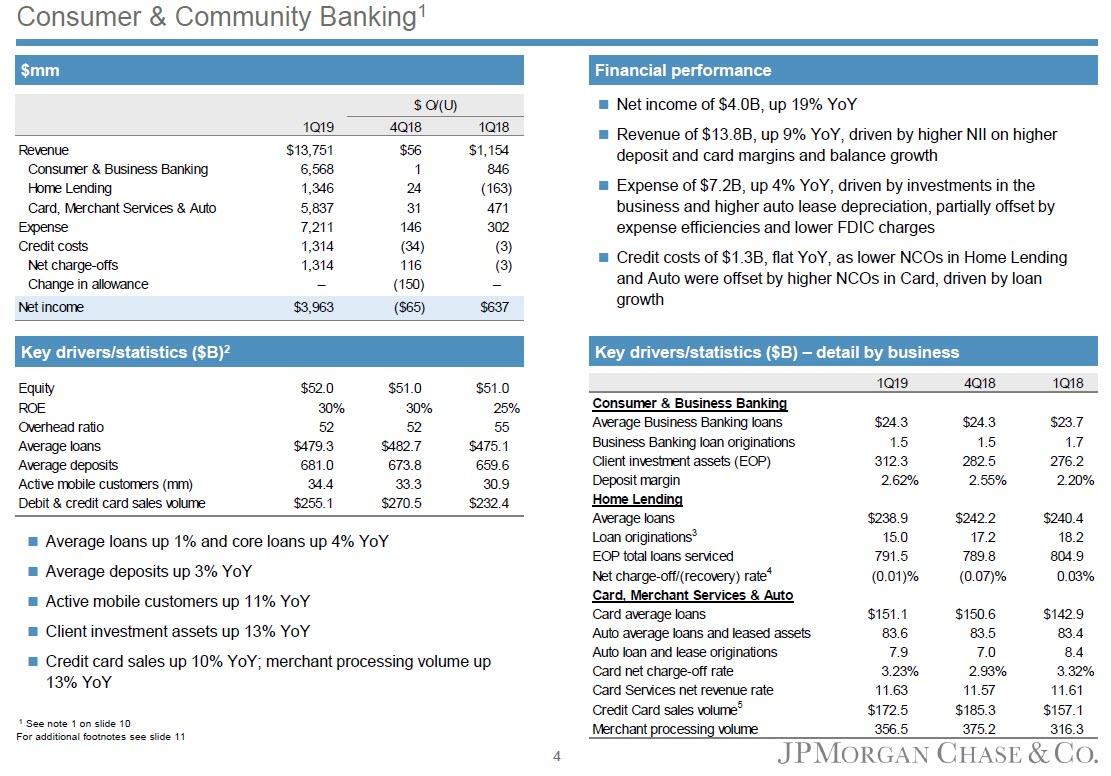
Addressing this business, Dimon said that "in Consumer & Community Banking, client investment assets topped $300 billion, with record new money driven by our physical and digital channels. Consumer spending remains robust with credit card sales and merchant processing volume up double digits. We continued to execute on our expansion plans, announcing 90 branches this year in new markets, and creating tremendous opportunities for each of our businesses to better serve our clients.”
Finally, looking ahead, the company provided its brief forecast, noting that it continues to expect net interest income to be above $58 billion for the year, but notes that's market dependent. It also expects adjusted expenses below $66BN in 2019, and less than $5.5BN in charge offs.
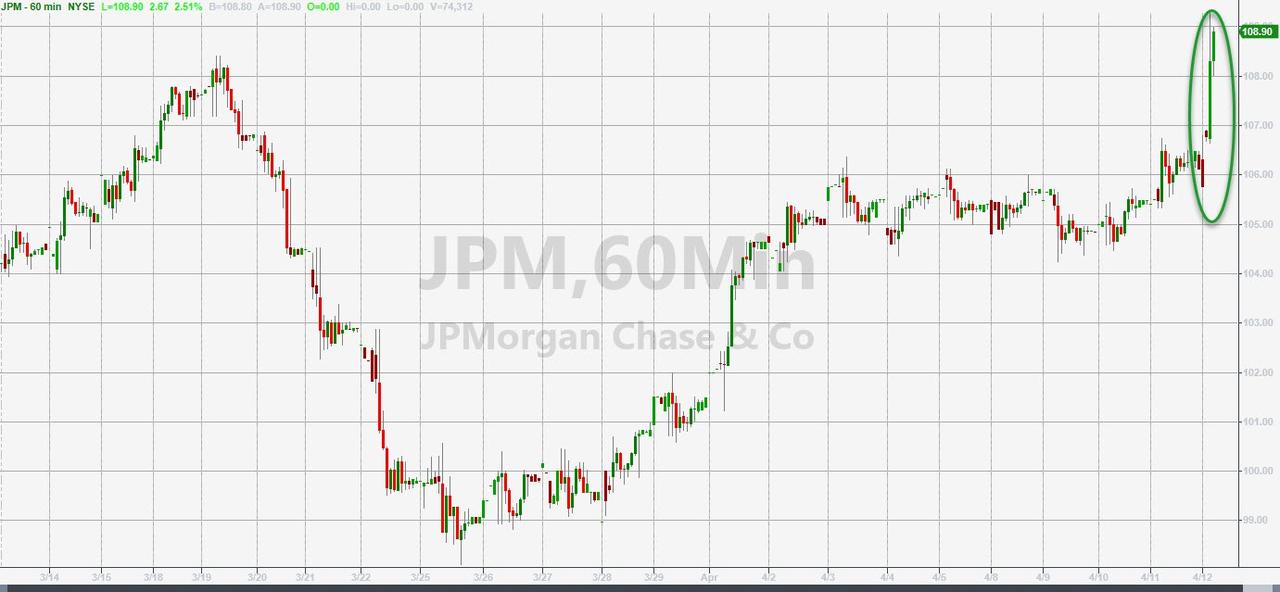
Not surprisingly, in light of these impressive results, JPM's stock is up 2.5% premarket.



Comments
Log in or sign up to join the conversation.