
JPMorgan spent October telling clients a Democratic sweep was the base case, not a shock. On Tuesday night the map stopped being a research note.
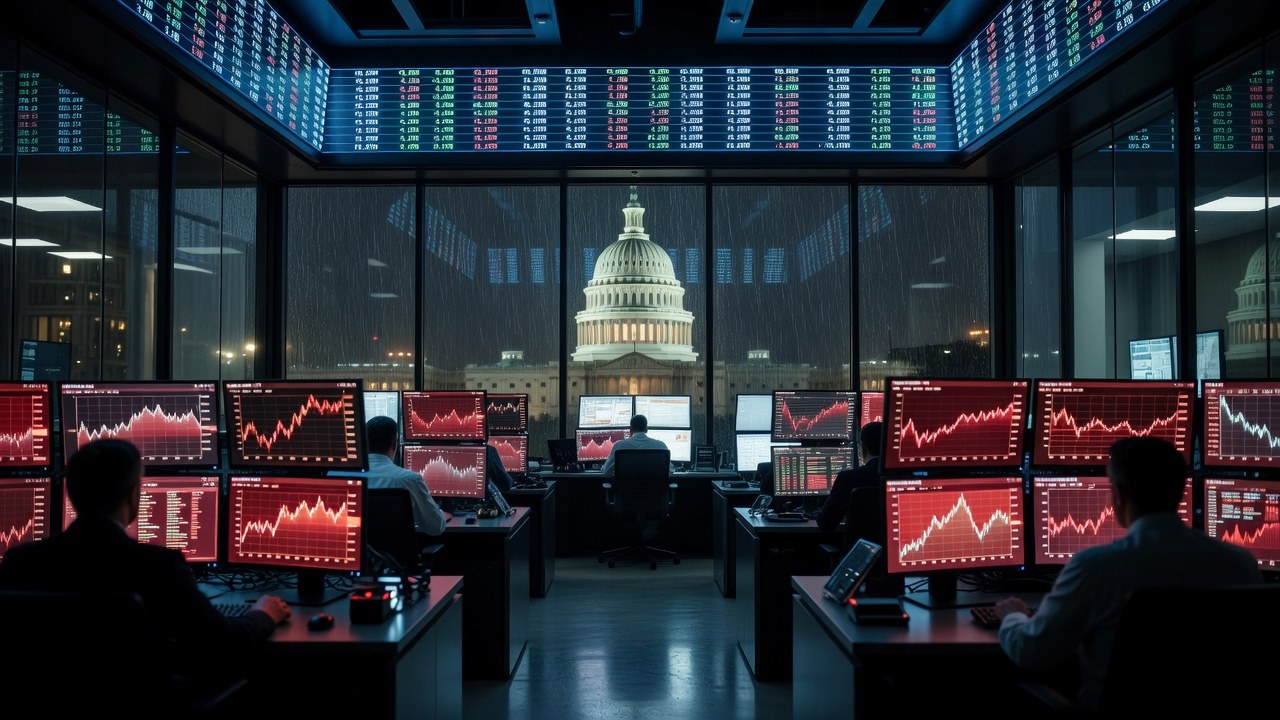
Democrats took the House and the Senate in a broad blue wave that reached deep-red states, and overnight futures followed the bank’s softer path. The broad market slipped a little. Tech and AI names took the harder hit. Bonds caught a lift from people hunting safety.
My take is straightforward. Investors just got the scenario Wall Street already saw as most likely and least exciting for the S&P 500. Separate a one-night fear trade from the multi-year AI build, and watch the sectors JPMorgan already flagged as relative winners under Democratic control.
What JPMorgan said before the vote
Strategist Dubravko Lakos-Bujas and the JPMorgan desk laid out four paths near Election Day.
A full Democratic sweep sat at about 66%. Under that path, the bank put the S&P 500 in a tight band from down about a quarter point to up half a point. A Democratic House with a Republican Senate sat near 26%, with stocks up roughly half a point to a full point. A Republican sweep was only about 7%, and that was the strongest near-term setup, with gains closer to 1% to 1.25%.
The most likely outcome was also the only path that left room for a small decline in the index. Everything else leaned higher.
JPMorgan was clearer on why a blue wave would feel sticky. Markets would worry about tighter rules around AI and data centers, more oversight of big tech, and investigation risk for executives tied to Trump-world money. Healthcare names could catch a lift if Democrats try to unwind Medicaid cuts from the One Big Beautiful Bill Act. Clean power and renewables got the same relative nod. Longer Treasury yields could ease if Democrats put a firmer hand on deficit spending.
Midterms favor stock picking more than 2024-style sector sweeps. A blue wave shifts the margin through funding fights, oversight, and attempts to peel back existing policy. It does not rewrite the whole economy overnight, especially with a Republican still in the White House.
What the night delivered
Democrats flipped the Senate with wins that would have looked impossible on a normal midterm map, including Texas, Kansas, South Carolina, and Iowa. The House flipped too.
Markets did not wait for every county. S&P futures slipped around half a percent. Nasdaq futures sold off harder, at one point down a couple percent before cutting some of the damage. Chip names and data-center proxies caught the first punch. Treasuries rallied and the 10-year yield fell as money moved toward safety.
That is the textbook first reaction to JPMorgan’s blue-wave script: index soft, AI loud, bonds calm. It is not proof the AI boom is over.
What matters next
The overnight selloff is about assumed regulation and slower data-center growth. JPMorgan already pushed back on the extreme version of that fear. Bills that try to choke AI expansion still have to clear a presidential veto, and Democrats do not walk in with a veto-proof supermajority. The firm’s pre-vote line was blunt: treat AI dips as opportunities if the scare is pure politics and the buildout still has real demand behind it.
State politics may matter as much as Capitol Hill. Texas just handed Democrats the governor’s mansion after a campaign that made data-center limits a live issue. Investors who only watch Washington will miss the zoning, power, and water fights that actually slow a concrete pour.
JPMorgan’s relative winners still make sense. Hospital and Medicaid-exposed managed care can benefit if funding cuts get delayed or reversed. Renewable utilities and clean-energy names get a friendlier funding climate. Defense can face a tougher spending conversation if Democrats use the purse more aggressively. Bonds are the quiet tell. If the blue wave means less runaway deficit theater, long yields can ease. If yields fall only because growth fear is rising, that is an uglier tape.
My take
I do not treat a Democratic Congress as an automatic bear market. Stocks often do fine after midterms once the uncertainty clears, and JPMorgan’s ranges were small either way. What I take seriously is concentration. When AI-linked names carry a huge share of the S&P 500’s weight, a regulation headline does not need to be finished law to move the whole index for a day.
Watch whether Congress can pass something hard on AI that survives a veto. Watch whether healthcare and clean power get real committee momentum or just victory speeches. Watch whether hyperscalers keep spending because customers still pull capacity, or slow because power, permits, and politics got expensive. And watch long bond yields for the deficit story, because that hits mortgages and valuations without a press conference.
Bottom Line
JPMorgan said a blue wave was the most likely midterm path and the softest near-term setup for the S&P 500, with AI regulation fear as the main scare and healthcare plus clean energy as the relative offsets. Democrats just delivered that sweep. Overnight futures followed the script. What comes next is stock picking under a live White House veto, louder data-center politics in the states, and a test of whether AI demand is real enough when the headline is politics rather than product.


Comments
Log in or sign up to join the conversation.