

Jensen Huang has resigned as Nvidia's president, CEO and director, effective immediately.
CFO Colette Kress is interim CEO; Harvey Jones becomes the board's first chair.
Nvidia stock was down about 10% in pre-market trading on Thursday.
Jensen Huang has resigned as Nvidia's president, chief executive and board member, the chipmaker said on Thursday, ending a 33-year run at the top after a fortnight of reports about his private life.
In a press release filed with an 8-K at 1:52pm GMT, the board said Huang had resigned "effective immediately". The filing says the board accepted his resignation on November 11.
Colette Kress, chief financial officer since 2013, will serve as interim chief executive while keeping the CFO job. Harvey C. Jones, a director since 1993 and a former Synopsys chief executive, becomes the board's "first-ever" chair.
The board said it would search for a permanent CEO and "consider internal and external candidates". The release does not name a successor or give Huang any continuing role.
Nvidia shares were at $155.71 in pre-market trading at 1:59pm GMT, down 10.4% from Wednesday's close of $173.73, according to Yahoo Finance data. Regular trading opens at 2:30pm GMT, and pre-market prices can move sharply on thin volume.
How Huang's exit unfolded
The pressure built in just over two weeks.
On October 29, The New York Times reported that US intelligence officials suspected Alice Huang, a former executive at Singapore's Megaspeed, of being a Chinese intelligence asset close to the Nvidia chief, according to TechCrunch. The two are not related, and China has denied the spying claims.
On November 8, Huang told staff he had been unfaithful to his wife. The board opened an independent review into whether he had been "the target of a foreign intelligence effort", while saying it had "confidence in Jensen and his leadership team".
Shares fell 4.3% on November 9 and 5.5% on November 10, when the independent directors said they had retained former acting US Attorney Joon H. Kim and Wachtell, Lipton, Rosen & Katz.
On November 11, the Times alleged a separate relationship with Kimberly Powell, Nvidia's vice president of healthcare and one of his direct reports. That claim rests on unnamed sources, and neither Nvidia, Huang nor Powell has confirmed it. Invezz's profile of Powell sets out what was reported.
Hours later, The Wall Street Journal reported that the board was preparing to oust Huang, and the board met that evening, a source told Reuters.
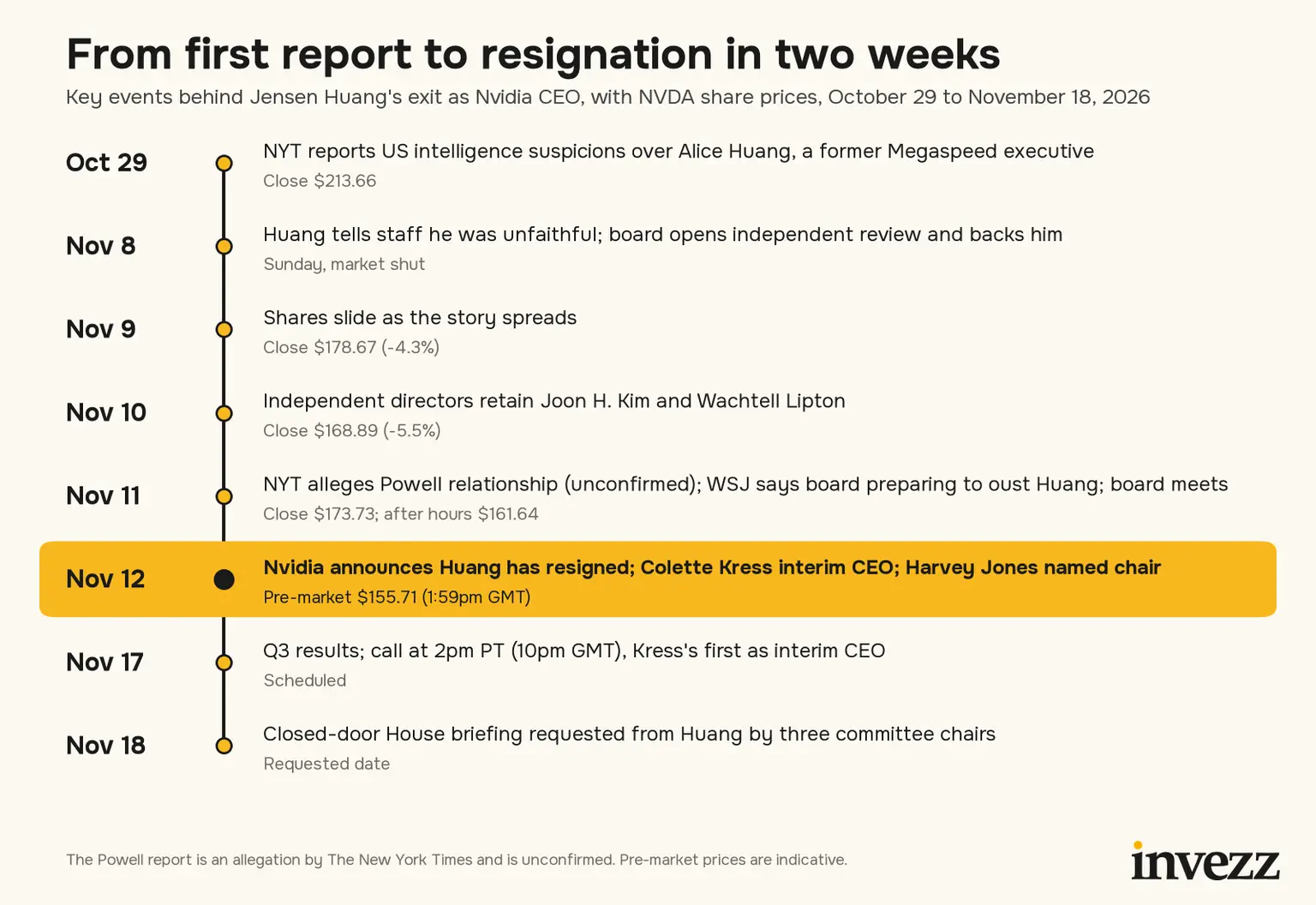
How Jensen Huang's exit unfolded, with Nvidia share prices at key points | Sources: Nvidia, SEC filings, The New York Times via TechCrunch, The Wall Street Journal via Reuters, Yahoo Finance
The stock closed at $215.38 on October 28, the day before the first Times report. At Thursday's pre-market price, it is down almost 28% since then.
Based on the 24.1 billion shares Nvidia reported in its latest 10-Q, that is a fall in market value from about $5.2 trillion to about $3.8 trillion, an Invezz calculation. Not all of that is down to Huang: chip stocks have also sold off in recent weeks.
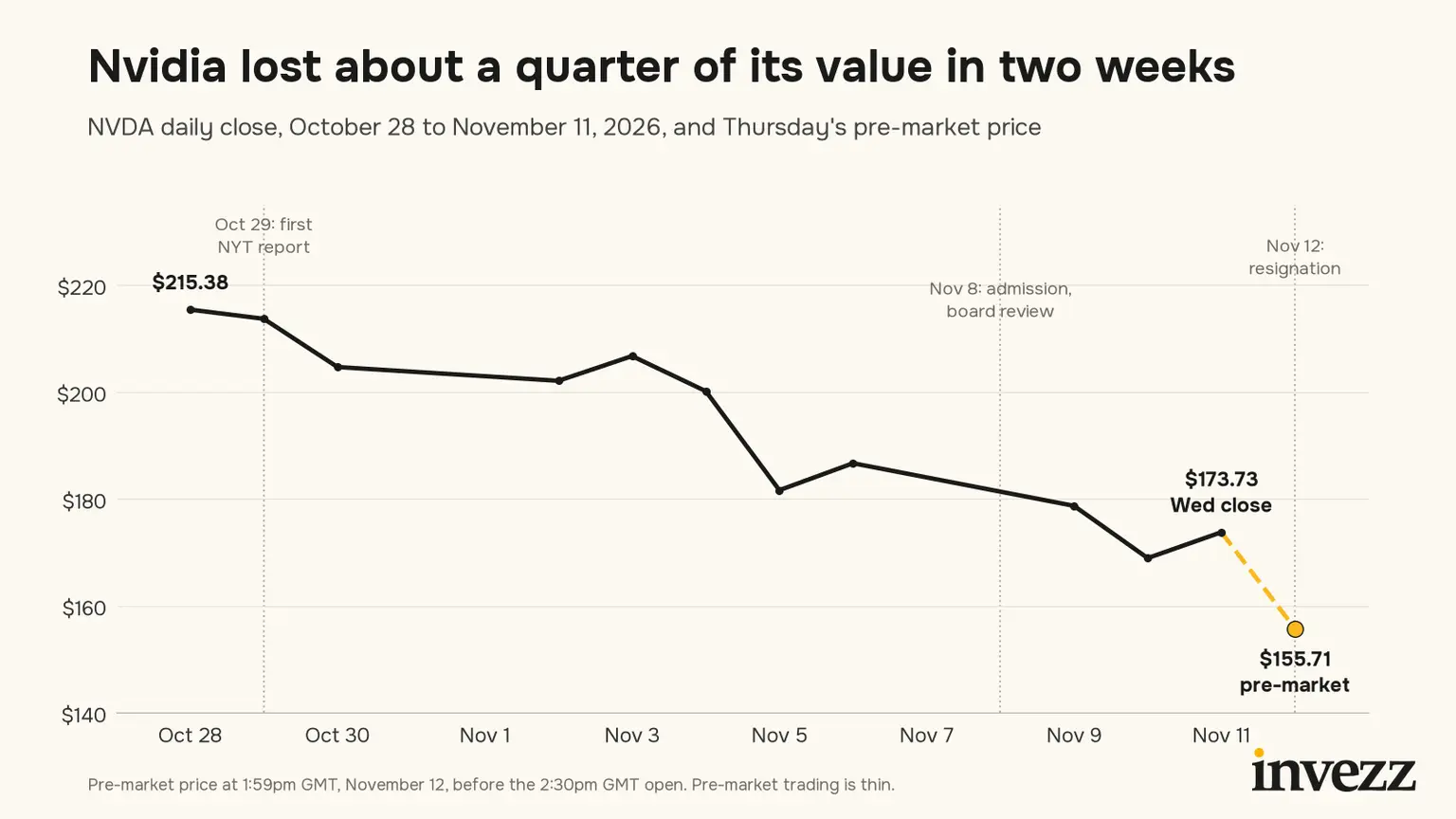
Nvidia share price, October 28 to November 12 (pre-market) | Source: Yahoo Finance
Who could take over permanently
Kress is now in charge, but only on an interim basis. Analysts had floated her for that role before the announcement, and Semafor reported that some directors favoured her.
"Colette has helped lead NVIDIA through a period of extraordinary growth," Jones said in the release, adding that the board expects operations, customer commitments and the product roadmap "to continue without interruption". Invezz has a separate profile of Kress.
For the permanent job, several analysts have pointed to an engineer. Josh Gilbert, lead analyst at eToro, told Reuters the board "would likely want an engineer in the chair", naming Ian Buck, the data centre executive credited with creating CUDA.
Armina Rosenberg of Minotaur Capital, which holds Nvidia shares, suggested to Reuters a possible pairing of Kress with a technology leader such as Buck.
Semafor reported, citing one person, that Apple hardware chief Johny Srouji was being considered, and that the board had discussed adding a chief operating officer. Bloomberg reported that an outside search firm is involved.
The Associated Press has mentioned co-founder Chris Malachowsky. Outsiders such as Google Cloud's Thomas Kurian and AWS's Matt Garman have been floated only by unnamed observers, according to Business Insider.
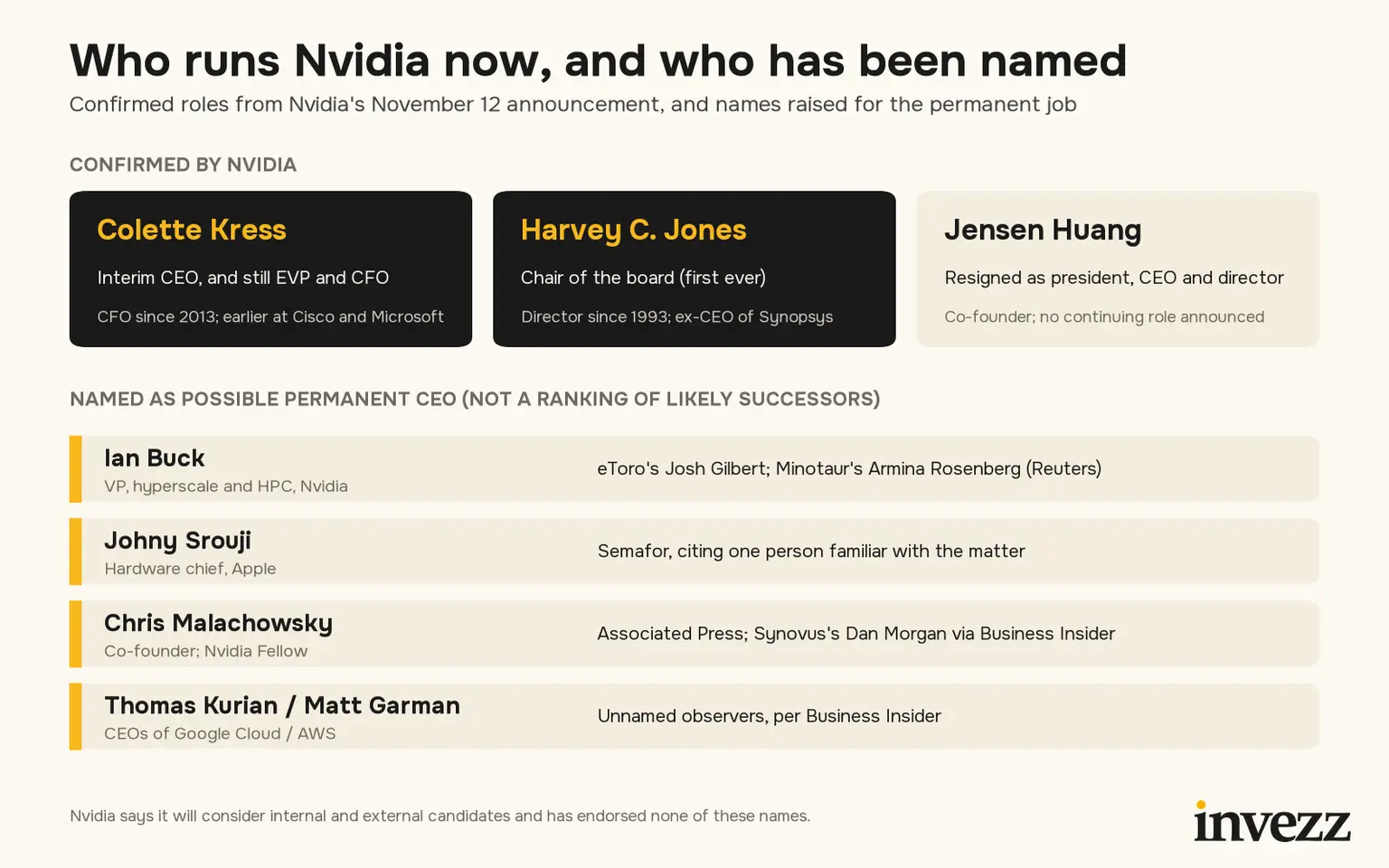
Who runs Nvidia now, and who has been named as a possible permanent CEO. This is not a ranking of likely successors | Sources: Nvidia, SEC filings, Reuters, Semafor, AP, Business Insider
None of these names has been endorsed by Nvidia.
What it means for Nvidia and the AI trade
Nvidia's annual report warns that it is "highly dependent on the services of our longstanding executive team" and that weak succession planning could hurt its execution. That risk has now arrived without a plan in place.
Analysts cut their ratings overnight, before the resignation was confirmed. Bernstein's Stacy Rasgon cut his target to $200 but told clients, according to CNBC, that the fundamentals "are clearly still intact".
Dan Ives of Yorkville Ives & Co. said in a note that Nvidia was worth $300 a share with Huang and $225 without him. KeyBanc's John Vinh said the exit warrants "a higher risk premium and lower valuation multiple".
Michael Feldman of ClearBridge Investments told the Guardian a new CEO would likely "want to establish credibility by setting a more conservative bar" than Huang's growth targets.
Nvidia's chip rivals were not falling in step. In pre-market trading at about 1:59pm GMT, AMD and Broadcom were each up 1.7%, while Nasdaq 100 futures were down 1.3%, Yahoo Finance data showed.
That split suggests investors are treating this, for now, as a Nvidia governance problem rather than a sign that AI demand is fading. UBS's Mark Haefele said the episode "reinforces the importance of investment diversification".
What comes next for Jensen Huang
Huang has not commented publicly on his resignation, and Nvidia's release says nothing about his plans.
He leaves with no executive or board role, but with a large stake. Nvidia's 2026 proxy put his holding at 3.58% in March, roughly $134 billion at Thursday's pre-market price, an Invezz estimate. His shares carry one vote each, so he cannot control the board.
He may still face questions. The board's review of the Megaspeed reports has not published findings, and three House committee chairs had asked Huang for a closed-door briefing on November 18.
Anything beyond that, whether a new venture, philanthropy or a quiet exit, would be speculation.
The next test is Nvidia's third-quarter results on November 17, with the call at 2pm PT (10pm GMT). It will be Kress's first as interim CEO, and investors will watch whether she keeps Huang's guidance.



Comments
Log in or sign up to join the conversation.