

Yesterday, the headline news in the financial world was the Federal Reserve announcing that, in an effort to address soaring inflation, it will be reducing its stimulus programme for the US economy more quickly than originally planned.
(Click on image to enlarge)

In their announcement, the Fed suggested that stimulus would end altogether in March and opened the door to three rate hikes in 2022.
However, as there is no shortage of articles dedicated to this subject already, this morning, we will be looking at why Chinese e-commerce company JD.com fell 5.14% yesterday, amidst a general decline in Chinese stocks.
To understand the reasons for this, we need to rewind a couple of weeks.
Earlier in December, the US Securities and Exchange Commission (SEC) finalized new rules which allow them to delist foreign companies from US exchanges if their auditors do not comply with requests from US regulators. Delisting is only mandated if the Public Company Accounting Oversight Board (PCAOB) is denied access to requested reports for three consecutive years.
But what has this got to do specifically with China?
For years, Chinese regulators have prevented US regulators from inspecting the audits of public Chinese companies, despite repeated requests to do so. Under the new rules, if this lack of transparency persists, Chinese stocks listed in the US will be forcibly removed from US exchanges.
At the time these rules were finalized on 2 December, US-listed Chinese stocks fell, and, yesterday, it happened again, after David Loevinger from TCW Group predicted that most Chinese stocks will be delisted from US exchanges by 2024.
Despite the fact that Chinese companies have three years to comply with the new legislation, Loevinger is doubtful that China is likely to change its stance within this timeframe, stating “it’s essentially game over” for Chinese stocks trading in the US.
So, what does this mean for JD.com? If JD.com is delisted from the US exchanges, shareholders will still own their shares. However, without a US listing, investors would only be able to liquidate their positions on the Hong Kong Stock Exchange, where the company has a second listing. Whilst this is not impossible, not all brokers provide access to the Hong Kong Stock Exchange, which could complicate the process.
Long-term, delisting in the US will have a negative impact on the liquidity of JD.com shares, resulting in less demand and possibly lower valuations. In the short-term, investors who have anticipated these long-term risks, or who simply do not want to face potential issues exiting their position in the future, may spark a sell-off before this scenario becomes a reality.
Taking the current situation into account, JD.com and other Chinese stocks could be set for further declines in the coming weeks and months.
(Click on image to enlarge)
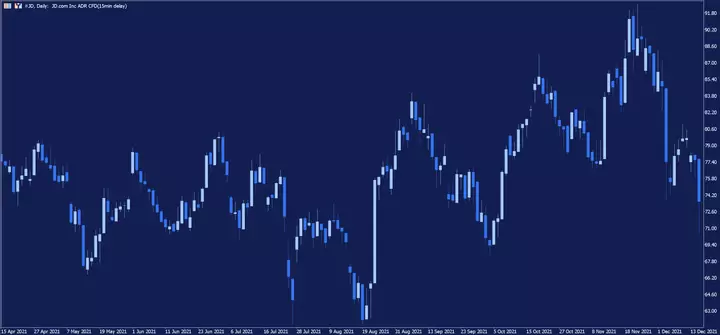
Depicated: Admirals MetaTrader 5 – JD.com Inc Daily Chart. Date Range: 15 April 2021 – 15 December 2021. Date Captured: 16 December 2021. Past performance is not a reliable indicator of future results.
Five-Year Evolution Of The JD.com Share Price:
(Click on image to enlarge)
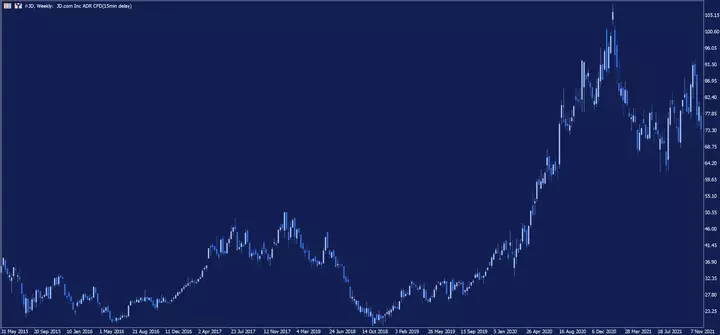
Depicted: Admirals MetaTrader 5 – JD.com Inc Weekly Chart. Date Range: 31 May 2015 – 15 December 2021. Date Captured: 16 December 2021. Past performance is not a reliable indicator of future results.



Comments
Log in or sign up to join the conversation.