


USD/JPY falls 0.30% on Wednesday and trades around 156.80 at the time of writing, as the US Dollar (USD) comes under selling pressure following softer-than-expected United States (US) inflation data. The pair remains on the back foot as investors reassess the timing of a potential further tightening by the Federal Reserve (Fed).
The US Personal Consumption Expenditures (PCE) Price Index showed that annual headline inflation remained unchanged at 3.4% in August, below the 3.7% expected by markets. July's reading was also revised lower to 3.4% from the previously reported 3.7%.
The core PCE Price Index, which excludes volatile food and energy components and is closely watched by the Fed as a measure of underlying inflation, remained steady at 3% YoY, below the 3.3% market forecast. July's reading was also revised down to 3% from 3.3%. On a monthly basis, headline PCE rose 0.3%, while core PCE increased 0.2%.
The softer inflation figures add to stronger US economic data. Automatic Data Processing (ADP) reported that private-sector employment increased by 90K jobs in September, exceeding expectations for a 70K rise and accelerating sharply from the 36K increase recorded in August after revision.
US economic growth also delivered an upside surprise. Annualized Gross Domestic Product (GDP) growth for the second quarter was revised higher to 2.2%, from the previous estimate of 1.5% and above the 1.5% expected. The revision means that economic growth accelerated from the 2.1% pace recorded in the first quarter, reversing the slowdown indicated by the previous estimate.
The softer inflation readings prompt markets to reconsider the timing of the Fed's next rate hike. According to the CME FedWatch tool, investors now assign around a 35% chance to a rate increase in October, down from nearly 51% a day earlier and 71% a week ago.
This repricing weighs on the US Dollar and adds downward pressure on USD/JPY. The US Dollar Index (DXY), which tracks the Greenback against a basket of six major currencies, falls 0.21% on Wednesday to trade around 101.20, after touching an intraday low of 101.03 immediately following the PCE release.
However, markets are not abandoning expectations for further monetary tightening. Instead, investors appear to be shifting the expected timing of the Fed's next move toward the end of the year. The chance of a rate hike in December rises to nearly 60%, from 49.4% a day earlier. Persistent expectations of another Fed rate increase could therefore provide some support to the US Dollar and limit the downside in USD/JPY.
USD/JPY technical analysis
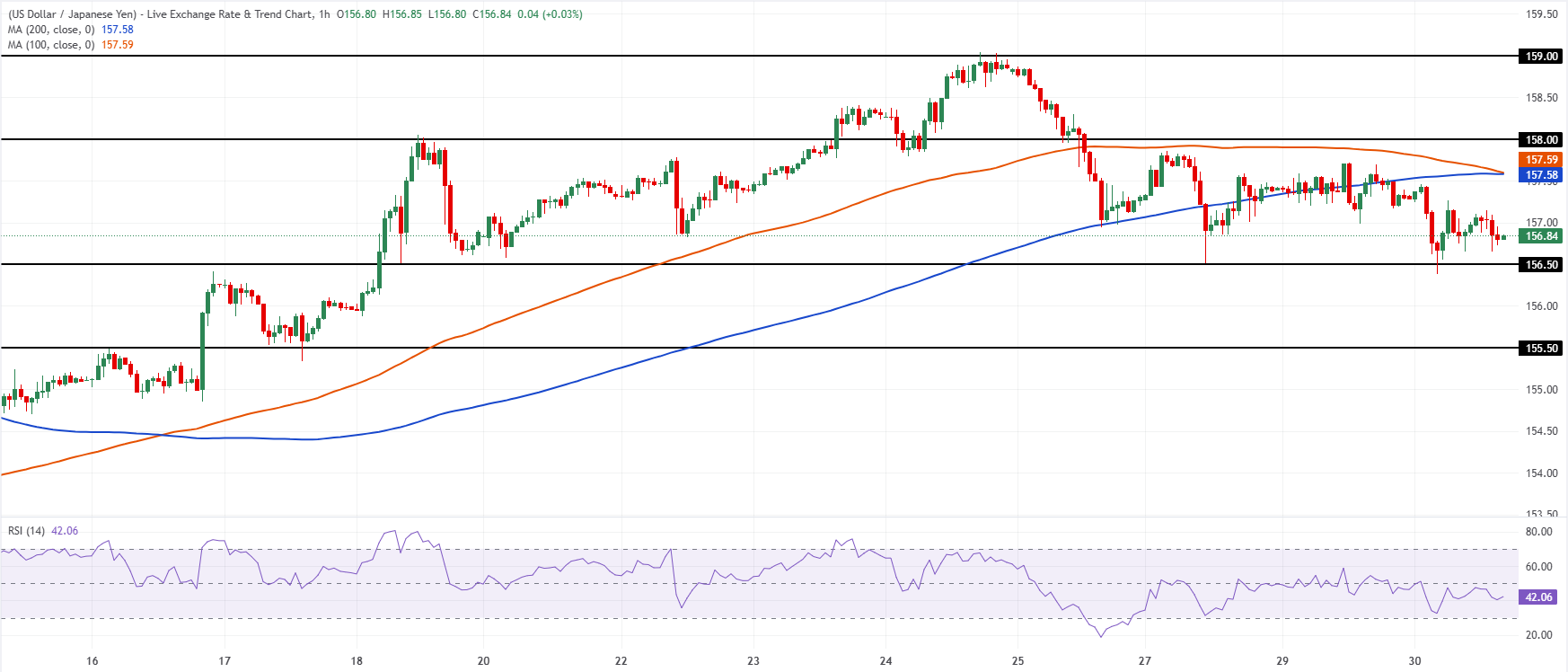
In the one-hour chart, USD/JPY trades at 156.84, retaining a bearish near-term bias as it holds below both the 100-period simple moving average (SMA) at 157.59 and the 200-period SMA at 157.58. The pair is retreating from recent highs, and the Relative Strength Index (14) around 42 suggests fading bullish momentum but not outright oversold conditions, hinting that sellers still have the upper hand while any rebounds would likely be capped by the clustered moving-average resistance overhead.
On the topside, immediate resistance is located at the 200-period SMA at 157.58, followed closely by the 100-period SMA at 157.59, creating a dense supply zone before the horizontal barrier at 158.00 and a stronger cap near 159.00. On the downside, initial support emerges at 156.50, with a deeper floor at 155.50, and a clear break under these levels would open the door to a more pronounced downside extension in the coming hours.


Comments
Log in or sign up to join the conversation.