

Managed futures strategies have been among the most disappointing investment categories since the bottom of the financial crisis. These strategies were designed to have negative correlation to both stocks and bonds—and in what has been a consistently strong equity market, the negative correlation has come through, with flat to negative returns for many managed futures strategies.
At the start of the year, this recency bias led some investors to continue being over-weight in the U.S. equity market and to avoid traditional portfolio “diversifiers.” With volatility picking back up at the end of January and the first 10% pullback in more than 500 days, it was a good test to see if portfolios were properly diversified.
In early February, we wrote about the importance of diversification and reminded people why the WisdomTree Managed Futures Strategy Fund (WTMF) does not include equity futures as part of its allowable universe. We thought that including equities could potentially increase correlations to equity markets at a time when investors least want that. This can be most evident during a sharp equity reversal, as we experienced recently, in which a trend-following strategy can’t adjust quickly enough and is caught on the wrong side of the trade.
In that research note, we looked at the average performance of the 10 largest competitors in the Morningstar U.S. Managed Futures Category during the pullback, and many of the largest funds failed to provide adequate downside protection compared to the S&P 500 Index.1 The largest managed futures funds had average declines over those two weeks that mirrored the S&P 500 returns, showing a high beta to equities. On the other hand, the WisdomTree strategy provided substantial downside protection and diversification by falling by only about one-quarter of the decline.
Below, we updated the performance chart to a more recent time frame. What is remarkable is that while equities have rebounded, many of the largest managed futures mutual funds have struggled to regain a positive performance trend, and more recently it seems these strategies moved in the opposite direction of the equity market. Although the WisdomTree strategy‘s performance is not positive year-to-date, we are pleased with its path and believe it has performed as expected, offering a return stream uncorrelated to equities.
For those looking to add to managed futures strategies, now could be a good entry point, especially if you are expecting another pullback in the S&P 500 Index. For those investors who already own managed futures strategies, now could be a good time to consider tax loss harvest and to reinvest in a strategy with less sensitivity to the S&P 500 Index.
Managed Futures Performance
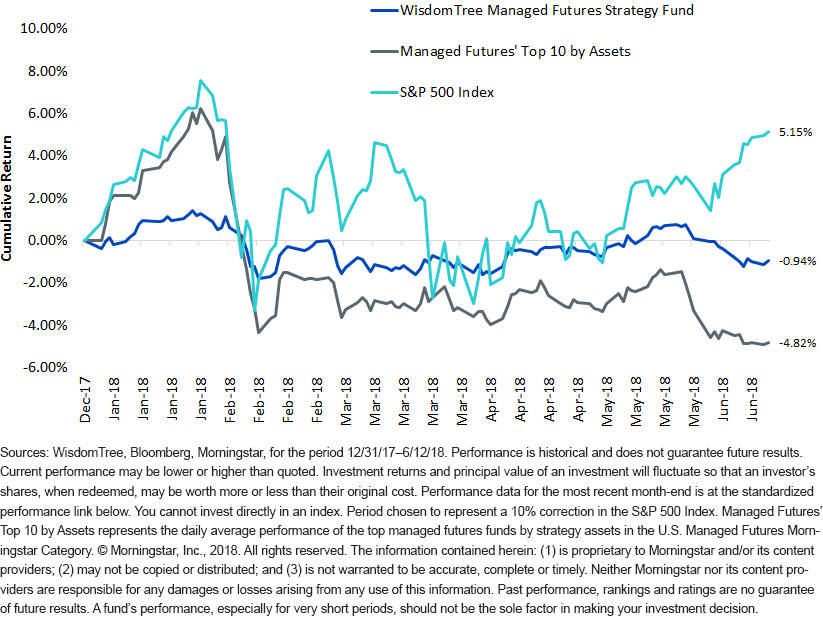
For standardized performance of WTMF, click here.
Factors Supporting Managed Futures
One of the factors that impinged on managed futures strategy returns was low returns on the collateral that was backing futures positions, given the zero bound on interest rates. Now that the Federal Reserve (Fed) is on a path to normalize rates, the collateral underpinning futures positions is earning more interest income with short-term interest rates rising.
With concerns about the overall levels of the market and the search for alternative strategies to help reduce portfolio volatility, this could be a good time to consider one of the few out-of-favor asset classes—managed futures—that is starting to see a stronger investment case shine through.
1Sources: WisdomTree, Bloomberg, Morningstar, for the period 1/26/18–2/8/18. Period was chosen to represent a 10% correction in the S&P 500 Index.



Comments
Log in or sign up to join the conversation.