

Founded in 2004, Unison has more than 20 years of experience helping homeowners unlock the wealth tied to their homes. It offers Equity Sharing Agreements to support flexible access to home equity.
For many homeowners, equity sharing is a less familiar concept than home equity lines of credit (HELOCs), making it hard to determine whether Unison and its services are legitimate. Before committing to any financial transaction related to your home, it’s worth understanding more about what Unison is and how it works.
What Is Unison?
Unison is a San Francisco and Omaha-based company that’s been in the home equity space since its founding in 2004. Unison says it’s worked with more than 17,000 homeowners and unlocked over $1.02 billion in home equity, and as of July 29, 2026, it holds a “Great” rating on Trustpilot, coming in at 4.6 out of 5. Unison is A+ rated with the Better Business Bureau and has been featured in USA Today, Forbes, and other publications.
What Is Equity Sharing?
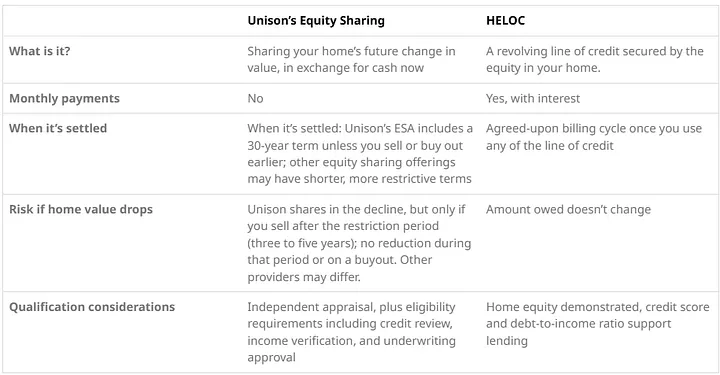
Equity sharing is a way to access the value in your home without having monthly payments, as it doesn’t involve taking out a loan. Instead of borrowing against your home and paying interest, you can unlock funds up front while Unison shares in the future change of your home’s value.
There’s no interest charged and no monthly payment required. Usually, the agreement is settled when you sell the home, refinance, or reach the end of the term. At that point, Unison receives the original amount it provided, plus or minus its agreed share of how your home’s value has changed since the agreement began.
The closest comparison to Unison’s Equity Sharing Agreement is a Home Equity Investment (HEI), which is offered by competitors like Point or Hometap. However, because most homeowners are better acquainted with traditional lending options like HELOCs, it may help to consider how equity sharing compares.
How Does Unison’s Equity Sharing Agreement Work?
Unison’s Equity Sharing Agreement follows a specific structure.
Amount you can access. Unison can help homeowners convert up to 15% of their home’s value into cash, with a maximum investment of $500,000 per home.1
Home value determination. Unison uses an independent appraisal of your home and applies a 5% Risk Adjustment to determine the Original Agreed Value, which is the starting value for the agreement. That 5% reduction is smaller than some competitors apply; Point, for example, uses 27.5%.1
Amount of your home’s future change in value that Unison shares in. Unison’s share may vary, but it’s typically defined as four times the percentage of home value it invests. For example, if you unlock 10% of your home’s value, Unison would typically share in 40% of your home’s future change in value.
Terms of the agreement. Terms can be as long as 30 years, with the option to end the agreement anytime before, either by selling or buying out the agreement. Keep in mind that some restrictions can apply, and some features of the Equity Sharing Agreement only become available after an initial restriction period.
To understand how Unison’s Equity Sharing Agreement might work, consider the following simplified hypothetical:
A home is appraised at $800,000.
Unison applies a 5% Risk Adjustment, setting the Original Agreed Value at $760,000. Every future change in value is measured from this $760,000 starting point.
The homeowner wants 10% of the value in the house, which is $76,000. In return, Unison shares in 40% of the home’s future change in value (four times the percentage it invests).
If the homeowner sells 10 years later for $1,000,000 (a $240,000 increase over the $760,000 starting value), they settle the agreement by returning the original $76,000 plus Unison’s 40% share of that change, $96,000, for a total of $172,000.
If the home’s value falls instead, Unison shares in the decline. Say it sells for $700,000 (a $60,000 decrease from the $760,000 starting value). Unison’s 40% share of that loss is $24,000, so the homeowner settles for $76,000 − $24,000 = $52,000, which is less than they initially received.
Two conditions apply to the downside: Unison shares in a decline only after the restriction period (three or five years, depending on your agreement), and only if you sell the home, not if you buy Unison out. During the restriction period, or on a buyout, the amount you settle for isn’t reduced by a decline.
For illustration purposes only. Not based on a real Equity Sharing Agreement; terms and conditions apply. Speak with your Unison Home Equity Consultant for details.
A Built-In Cap in the Early Years: The Equity Appreciation Limit
Because Unison doesn’t share in a decline during the restriction period, it also limits how much it can earn during that same window. This is a feature called the Equity Appreciation Limit. It caps the total amount you’d owe Unison if you exit early. For the first 12 months, that cap is 20% above the amount you received; after 12 months, it compounds monthly, rising gradually until the restriction period ends, when the limit no longer applies. So if your home appreciates quickly in the early years, this keeps what you’d owe from climbing as fast as Unison’s share otherwise would.
Considerations for Homeowners
Unison designs its Equity Sharing Agreement for longer-term use, and some of the benefits don’t apply right away. Loss-sharing only begins once the restriction period ends (three or five years into the agreement, depending on your terms).* During that period, if you sell or exit, the amount needed to settle won’t be reduced even if your home’s value fell. Unison also shares in a decline only if you sell; if you buy Unison out, it doesn’t share the loss.
* Whether it’s three or five years depends on a few factors specific to your agreement. Most agreements have a three-year restriction period. Agreements regarding third/fourth properties or non-owner-occupied properties see the restriction period rise to five years, as well as in cases where the amount accessed exceeds homeowner equity.
If you make improvements to your home during the agreement period, Unison’s Capital Improvement Adjustment (also called a Remodeling Adjustment) lets you keep 100% of the value those improvements add, so you don’t have to factor in Unison’s cut if you’re investing in upgrades. However, this adjustment only becomes available after your agreement’s three-year anniversary. You also have to provide Unison advance notice, use licensed contractors, and document the project to qualify. Many Home Equity Investment companies that offer similar products do not include a Remodeling Adjustment, meaning that when you improve your home (and boost its value), they’ll always share in the growth.
An Equity Sharing Agreement isn’t compatible with every type of financing. Reverse mortgages, interest-only loans, shared appreciation loans, and negative amortization loans can’t be paired with a Unison agreement. The agreement also involves a type of lien on your property, as you’d experience with a HELOC, so future refinancing options may be limited until the agreement is settled.
If you reach the end of your 30-year term without selling or refinancing, buying out Unison’s investment requires you to have that much cash on hand or be able to refinance your home. And, as with most home equity products, an Equity Sharing Agreement isn’t available in every state, so eligibility depends on where you live.
Confirmed: Unison Provides a Legitimate Equity-Sharing Option
Unison operates as an established company with over two decades in the equity-sharing space. Its Equity Sharing Agreement lets homeowners get cash today in exchange for a share of their home’s future change in value. Unison is upfront with details and disclosures, so homeowners interested in the product can ensure they understand their options fully before signing any agreement.
1 — Terms subject to change. The figures provided are based on publicly available information as of August 4, 2026 and are for informational purposes only. Verify current terms directly with each provider.
Disclaimer: This content is sponsored by Unison Agreement Corp. and is provided for informational and educational purposes only. It does not constitute financial, legal, tax, investment, or lending advice, nor is it a solicitation or offer. The Unison Equity Sharing Agreement is not a traditional loan. It involves no monthly payments to Unison and no interest charges. In exchange, you share a percentage of your home’s future change in value when the agreement ends (upon sale, refinance, buyout, 30-year term, or death/default). If your home depreciates below the Original Agreed Value, Unison typically shares in a portion of the loss, subject to program restrictions — you may still owe the full advance amount. A Memorandum of Agreement and lien interest is recorded against your property, which may affect future refinancing or transactions. An origination fee and standard third-party closing costs apply. Availability is limited to participating states only and is subject to eligibility requirements, credit review, income verification, and underwriting approval. Terms, fees, and conditions are subject to change. Home values can rise or fall, and there is no guarantee of any specific financial outcome. Tax consequences may apply. Unison Agreement Corp. does not provide financial, tax, or legal advice. You should carefully review the full Equity Sharing Agreement documents and consult with your own qualified financial advisor, attorney, and tax professional to determine whether this product is appropriate for your individual situation. For complete terms, current state availability, fees, risks, and eligibility, please visit https://www.unison.com or contact a Unison representative directly.
Published Originally on — https://ritzherald.com/is-unison-legit-what-homeowners-should-know-before-they-apply/
Comments
Log in or sign up to join the conversation.