

Trump’s economic policies - protectionism accompanied by fiscal spending and tax cuts - has bumped up the risk assets across the globe… especially US stocks, which are enjoying a record breaking run.
Though the markets have cheered Trump’s agenda, economists are questioning how Trump intends to finance his spending plans. Furthermore, economists and politicians across the globe and even in the US stand unanimous when it comes to criticizing Trump’s protectionist agenda.
The Federal Reserve has stayed apolitical, but could be a silent cheerleader of Trump’s program!
Protectionist policies boost inflation
History shows protectionist trade policies can stoke inflation. In 1994, the World Trade Organization had said: “Virtually all protection means higher prices.” Global trade and free movement of goods and services helps match demand and supply and thus keep price pressures under control.
Protectionist policies like high tariffs do the opposite. US President George Bush noted in his 1992 economic report to Congress: “Trade barriers not only raise the price of imported goods to consumers, but also the price of domestically produced goods that compete with these imports.”
Fiscal spending to boost growth
Commodity prices are already enjoying a positive rub from the talk of fiscal spending in the US. During the speech to congress on Wednesday, Trump talked about $1 trillion spending program. This marks a major shift from austerity to fiscal boost. This would not only boost inflation, but also push up growth rate in the US.
Now think what Fed wants to have - a combination of higher inflation and higher growth.
This is a blessing in disguise for Fed because -
Fed needs to raise rates and remain ready for next recession! - Fed kept interest rates at record low of 0.25% till December 2015. Over the 6-7 year period, the Fed did three rounds of QE, operation twist. However, the economic recovery has been anything but encouraging.
On the other hand, Fed’s liquidity pumping exercise boosted stock markets to record highs. Imagine for a second that if US economy suffers a serious shock and financial markets tank, the Fed would not be able to respond as it has done historically. In the past, Fed has cut rates by at least 200 basis points in order to counter the slowdown. However, this time there is no room for a 200 bps cut in rates if recession hits the US economy. The interest rates currently stand at 0.5%. From here, a 200 basis point drop would mean interest rate at -1.5%! This is clearly not desirable.
Hence, Trumpflation - high inflation, high growth - provides an opportunity for the Fed to hike rates at a faster rate. The new normal for the interest rates is likely to be well below what was seen before the great financial crisis. Nevertheless, Fed would want to quickly move rates to a level from where it would have enough room to react to the next recession. Trumpflation would allow Fed to do just that.
No wonder, it has stayed apolitical and it is advisable that we take future (possible) anti-Trump comments with a pinch of salt!
Let us look at the 2-year treasury yield
The yield closely follows the short-term rate hike bets and has jumped to 1.328%; the highest level since 2009 earlier today.
Daily chart- Bullish continuation pattern
(Click on image to enlarge)
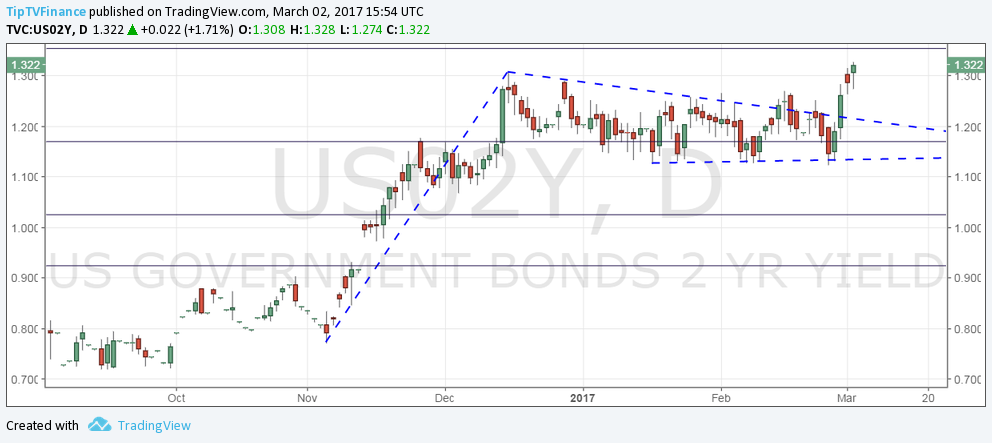
- We see a bullish flag breakout. Flag pattern is a continuation pattern, which means the rally from the low of 0.248% (Oct 2014 low) continues.
- On the higher side, the yield may face resistance at 1.353% (100% Fib expansion).
_636324431350288293.png)
Comments
Log in or sign up to join the conversation.