

News for shareholders in Wirecard (WCAGY) got worse over the course of last week: Wirecard AG filed for insolvency last Thursday after revealing a 1.9 billion Euro accounting black hole.
As we pointed out in our article last Thursday, the auditor Ernst & Young couldn't confirm the existence of 1.9 billion euros in cash on its balance sheet, representing roughly a quarter of its balance sheet.
After it became clear that the trustee accounts, e.g. with Philippines' BDO Unibank Inc., didn't exist, Wirecard's management decided to open proceedings "due to impending insolvency and over-indebtedness."
As a result, Wirecard shares collapsed further, dropping below 2 Euro per share and reducing the market capitalization to less than 300 million Euro.
An interesting question arises: what does this mean for big investors in Wirecard like Softbank?
SoftBank plans to sue auditor Ernst & Young over Wirecard scandal
Last Friday German news magazine "Der Spiegel" reported that SoftBank plans to sue accounting firm Ernst & Young over its role in the scandal involving Wirecard.
When reading carefully, above we wrote: "investor", not "shareholder" when it comes to the role of Softbank in Wirecard.
The reason for that is that in 2019 a Softbank subsidiary invested 900 million euros in Wirecard, but not by buying shares, instead of through a convertible note deal. That means, that these convertible notes can be repaid in stock rather than cash, is worth a 6% stake in Wirecard once converted.
After in September's concerns about Wirecard's accounting practices made rounds, it is said that Softbank did another deal with the target to hedge against its original bet, repackaging the convertible bonds from above into exchangeable, which are also repaid in stock.
To make long things short: not only will the sell out in Wirecard shares certainly negatively affect the original bond issuance.
But it also raises questions around Softbank's and its subsidiaries investment philosophy and strategy and over its due diligence.
In this context, it's certainly worth remembering the multi-billion dollar investment in WeWork which valuation was slashed from $47 billion to just $2.9 billion in a year, but also in Oyo.
While all investments have different issues, they have issues which could rather sooner than later negatively weigh on the share price of Softbank.
How to trade SoftBank Group Corp. CFD/#9984.JP in this environment?
When looking at a daily chart we can clearly see that SoftBank is technically clearly bullish and the sequence of higher highs and lows stays intact as long as we trade 4920 ¥.
Still, bulls should become a little careful with a potential bearish divergence forming in the RSI(14). We consider first signs of a top if the share drops below 5320 ¥.
A break below 4920 ¥ breaks the bullish sequence and favors further losses with a first target around 4300 ¥.
A stop should be placed at 5900 ¥, giving our idea a risk-reward ratio of a minimum of 580 ¥ to 1020 ¥ or 1 to 1.75:
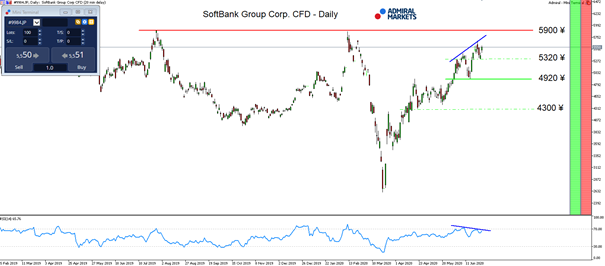
Source: Admiral Markets MT5 with MT5-SE Add-on #9984.JP chart (between February 5, 2019, to June 26, 2020). Accessed: June 26, 2020, at 10:00pm GMT - Please note: Past performance is not a reliable indicator of future results, or future performance.
In 2015 the value of #9984.JP dropped by 15.4%, in 2016 it increased by 33.1%, in 2017 it increased by 20.5%, in 2018, it dropped by 18.7%, in 2019 it increased by 33.5%, meaning that after five years, it was up by 30.9%.



Comments
Log in or sign up to join the conversation.