

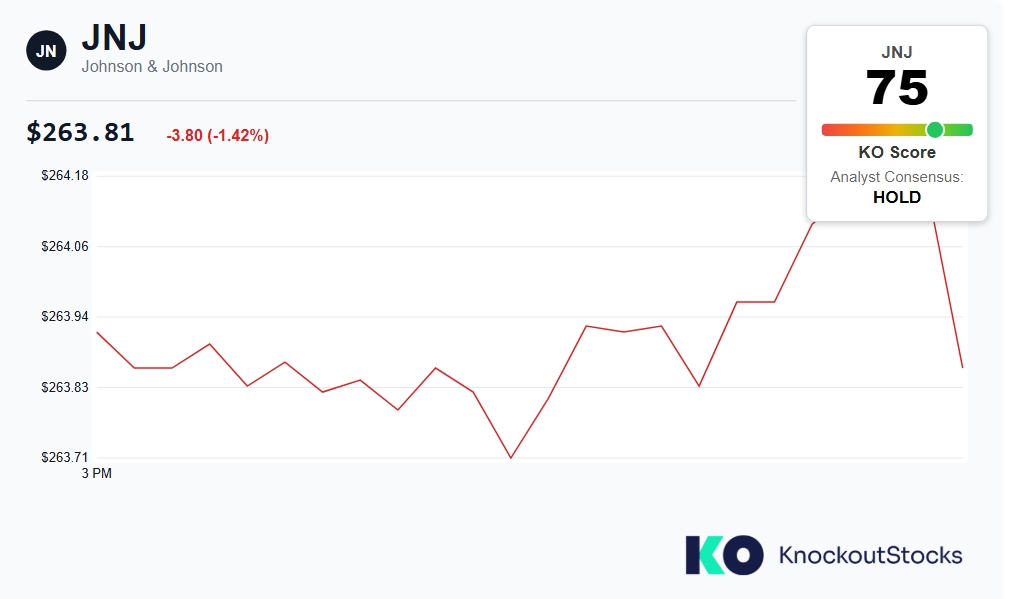
Johnson & Johnson (JNJ) stock closed Friday at $263.81, down 1.42%. The move came before the company released new cancer data on Sunday.
J&J reported Phase 1 results for JNJ-6143, an experimental once-daily prostate cancer pill. The data were presented at the ESMO Congress 2026.
Among patients with measurable disease at the 50 mg dose, 75% had a complete or partial tumor response. That works out to 12 out of 16 patients.
One news report put the response rate at 69%. The company’s own release says 75%, so that is the figure used here.
How the PSA Numbers Looked
At the 50 mg dose, 77% of patients had a confirmed PSA reduction of at least 50%. Another 48% saw their PSA fall by at least 90%.
The company said 38 patients received the 50 mg dose. One news report counted 31 evaluable patients, so the totals differ by source.
Patients in the study had a median of four prior therapies. These included chemotherapy and PSMA-targeted radioligand therapy, which is a tough group to move the needle on.
The most common treatment-related side effects were elevated cholesterol at 18%, nausea at 16% and elevated triglycerides at 16%. The company said most events were mild to moderate.
Four patients, or 11%, interrupted their dose. One patient reduced the dose, and one stopped treatment because of side effects.
At the time of the analysis, 71% of patients on the 50 mg dose were still on treatment. Median follow-up was 5.6 months.
The Drug and the Deal
JNJ-6143, formerly HLD-0915, came from J&J’s $3.05 billion acquisition of Halda Therapeutics in 2025. It is the first molecule from the company’s RIPTAC platform to reach clinical studies.
The drug uses a dual-protein lock between BRD4 and the androgen receptor. J&J says this triggers cancer cell death.
Yusri Elsayed, J&J’s global head of oncology, called the results “an encouraging foundation” for continued development. Professor Johann de Bono of the ICR in London said the anti-tumor activity in heavily treated patients was meaningful.
The trial was small, and the response rates do not show how long patients benefit. They also do not show whether the drug improves survival.
The 50 mg once-daily dose will move into a Phase 2 study in metastatic prostate cancer. The dose-escalation portion of the Phase 1 trial tested doses from 12.5 mg to 150 mg.
On Wall Street, 18 analysts have rated JNJ over the past three months, with a Moderate Buy consensus. The average price target is $288.71, about 9% above the current price.



Comments
Log in or sign up to join the conversation.