

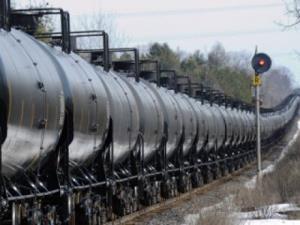
In early October I surmised that Greenbrier's (GBX) best days were long gone. Market chatter suggested that oil services giants like Halliburton (HAL) and Schlumberger (SLB) had attempted to cancel railcar orders amid a slow down in North American land drilling. On Greenbrier's recent quarterly earnings call, management went to pains to explain that Greenbrier was not heavily dependent upon the energy space. Management also indicated the industrial sector was not as gloomy as others appear to be:
Wells Fargo Analyst: The order this quarter for the industry was somewhat disappointing, but not surprising, just given the general industrial environment that we're hearing about these days.
Greenbrier: Well, we know that many people think it's - I hope they take their medication and survive it all ... We just do not share the view that the industrial sector is going to continue to be gloomy. There will be rent adjustments in rail, but we think that this is just a period of - where we will be going through like we have many times before.
Based on current GDP growth Greenbrier would be correct. The economy appears to be doing just fine.
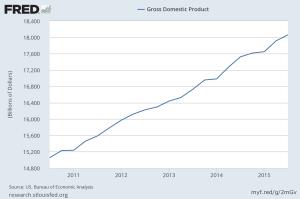
GDP has grown steadily from 2010 to Q3 2015. However, that growth was wind-aided. Since the financial crisis of 2008/2009, the government has spent over $400 billion in TARP, $8 trillion in zero interest loans to Wall Street and another $5 trillion in quantitative easing. It all begs the question, "What happens when the faux-stimulus ends?"
In my opinion, the benefits have largely gone to Wall Street and big business who will hoard their cash when the stimulus ends or the economy slows. By the time another recession hits, GBX will decline before longs can react in time.
Falling Commodities Are A Harbinger
The signs of a global slow down are beginning to materialize. The automobile sector has been a bright spot for Greenbrier and the railroad companies that make up the lion's share of railcar demand. However, falling oil prices and commodity prices are a harbinger of bad news. Oil prices are 50% off their Q2 2014 peak, while the Bloomberg Commodity Index is down nearly 30% over the past year.
Copper fell to its lowest level since 2009 and the threat of rising rates in the U.S. has caused capital flight from emerging markets. The subsequent decline in emerging markets currencies has caused the prices of metals in those countries to become more expensive; this in turn has hurt metals prices. The decline in markets for commodities, oil and metals will ultimately hurt rail traffic for these items and create less of a need for railroads to order railcars.
Railcar Orders Have Plummeted
Management constantly talked up its prodigious backlog of 41,300 units valued at about $4.7 billion. The company expects to deliver from 20,000 to 22,500 units in FY16. At the midpoint of expected deliveries, Greenbrier has 90% already in its backlog; FY16 revenue is practically in the bag.
However, new railcar orders for the industry have plummeted; third quarter orders plunged 83% to 7,374. This is much lower than the normalized rate of 60,000 envisioned by Greenbrier. Secondly, on its most recent analyst call, Management declined to give new orders for September. Now we know why. At this point, new orders is the one metric that will drive the stock. A bet on GBX is a bet that new orders will pick up to carry the company beyond FY2016.



Comments
Log in or sign up to join the conversation.