

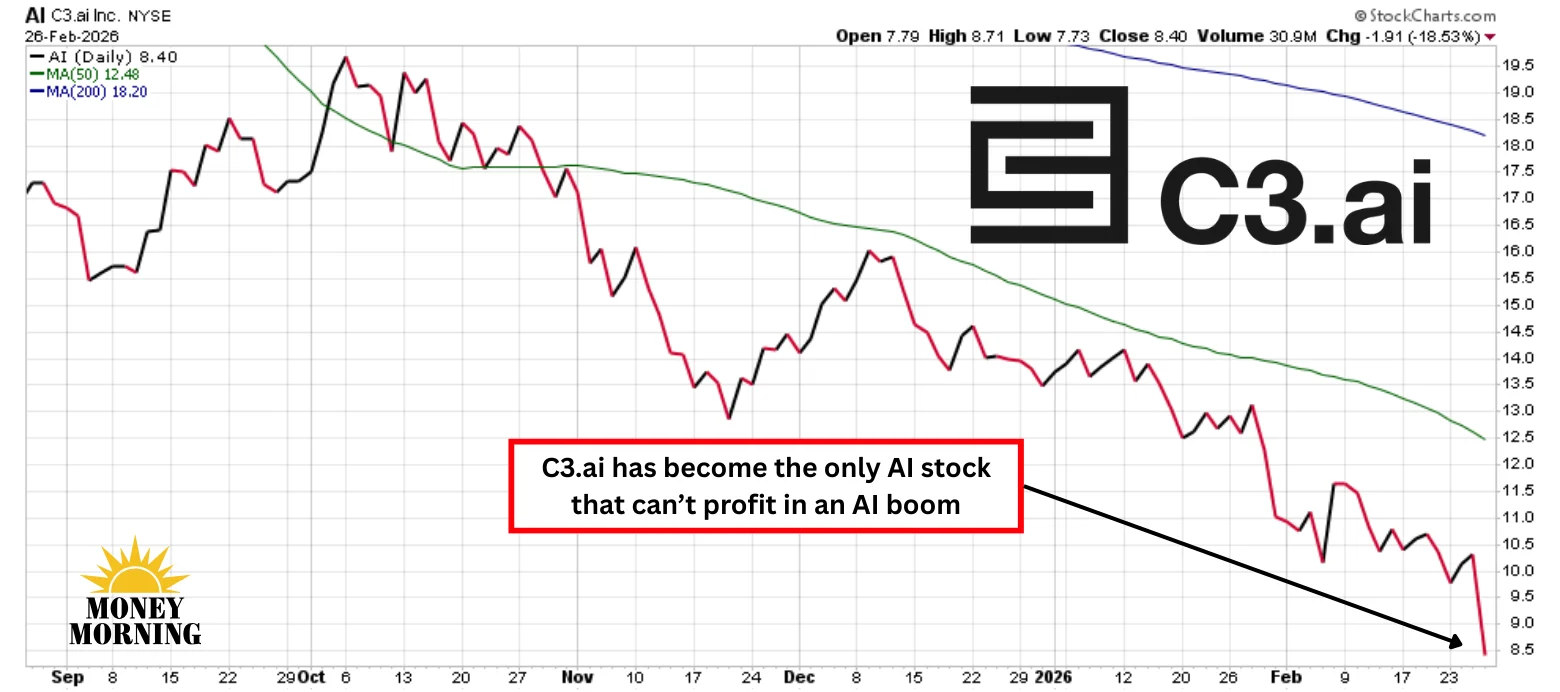
When C3.ai (AI) went public in December 2020, it struck gold by snagging the coveted ticker symbol "AI," which was surprisingly still available. This clever branding positioned the company as a frontrunner in the AI space, perfectly timed with the burgeoning AI boom. Yet, despite this fortunate start and the explosive growth in AI adoption across industries, C3.ai can't translate hype into profits.
The company just reported another disappointing quarterly result for its fiscal third quarter, with revenue falling far short of expectations. Its stock has plummeted nearly 40% year-to-date and almost 60% over the past year. Can C3.ai ever turn things around during an AI revolution that's enriching its peers?
Disappointing Earnings and Slashed Guidance
C3.ai's results were dismal, with total revenue of $53.3 million, a 46% drop year-over-year and missing analyst estimates of around $76 million. Subscription revenue – the core of its business – came in at $48.2 million, representing 90% of total revenue, but overall performance led to a non-GAAP net loss per share of $0.40, far wider than the $0.29 expected. GAAP net loss ballooned to $0.94 per share, underscoring operational inefficiencies.
The outlook is even bleaker. Full-year revenue guidance was slashed to $246.7 million to $250.7 million, down sharply from prior projections of $289.5 million to $309.5 million and a significant decline from 2025's $389.1 million. Fourth-quarter revenue is now expected at just $48 million to $52 million, well below consensus estimates of $78 million.
To stem the bleeding, C3.ai is laying off 26% of its workforce as part of a restructuring plan aimed at saving $135 million annually in operating expenses. As even CEO Stephen Ehikian acknowledged, "the reality is we were just burning too much money."
Struggles Despite Early-Mover Advantage
As an early entrant in enterprise AI, C3.ai should have capitalized on the market's enthusiasm, with businesses investing billions in AI. However, its core offerings – like the C3 AI Platform for building custom AI applications and industry-specific solutions – have failed to capture significant market share or investor confidence.
A major hurdle is the company's sales model, which offers potential customers free trials of its complex software. While this attracts interest, C3.ai struggles to convert these pilots into paying contracts. Ehikian described the commercial sector as mired in "pilot purgatory," where enterprises show curiosity, but balk at committing to large-scale, transformational deals. This conversion challenge highlights deeper issues: the software's complexity may not meet user expectations, leading to low adoption rates.
On a brighter note, the federal and defense segments showed promise, with bookings surging 134% year-over-year, accounting for 55% of total bookings. Ehikian called this a "playbook that's working," though even this growth isn't scaling fast enough to offset its commercial weaknesses.
The lack of consistent, high-value contracts underscores C3.ai's difficulty in turning AI interest into sustainable revenue streams.
Bottom Line
C3.ai has endured numerous reorganizations over the years, and is implementing yet another one now with cost cuts, sales restructuring, and a focus on agentic AI for internal efficiency. Despite these efforts, there's no clear path to profitability, with ongoing losses and a leadership team that appears uncertain on how to achieve it.
With cash reserves at $622 million providing some runway, the company's prospects remain shaky nonetheless, and investors should avoid this stock completely.



Comments
Log in or sign up to join the conversation.