

AMD had a strong start to 2026. Revenue hit a record $10.25 billion in Q1, up 38% from a year ago. Non-GAAP earnings per share rose 43% to $1.37, and GAAP net income nearly doubled to $1.38 billion.
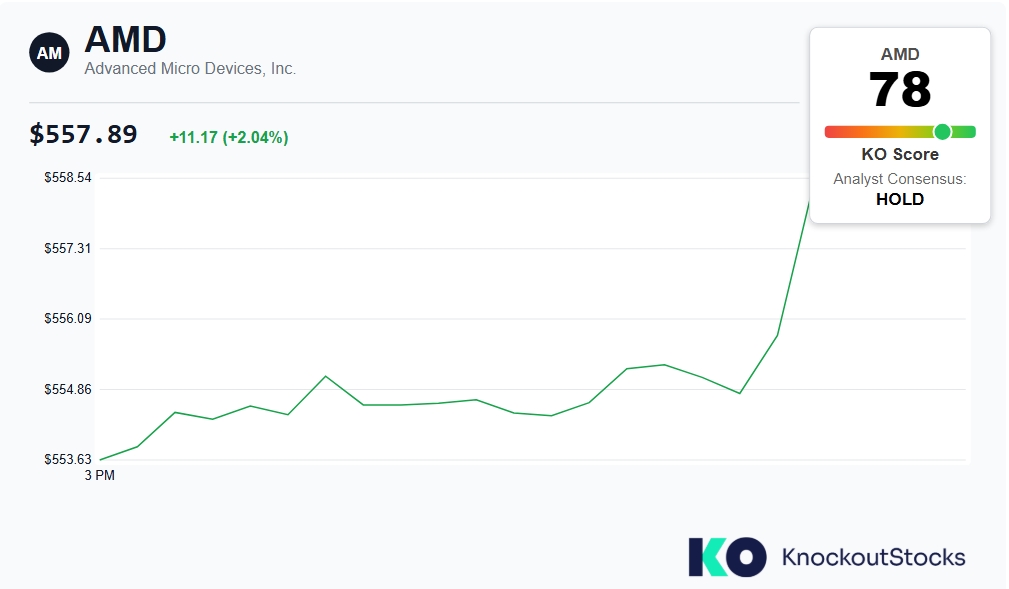
Advanced Micro Devices, Inc., AMD
The Data Center segment did the heavy lifting. Revenue there climbed 57% to $5.78 billion, driven by demand for EPYC server processors and MI350 AI accelerators. Segment operating income grew from $932 million to nearly $1.6 billion.
Client revenue was up 26%, Gaming gained 11%, and Embedded improved 6%. All four business units moved in the right direction.
MI450 and Helios Are the Next Big Test
AMD is preparing to launch the MI450 accelerator alongside a new rack-scale system called Helios. The platform bundles AI accelerators, EPYC CPUs, networking, and AMD software into one complete system.
Management says customer demand forecasts for MI450 and Helios have already exceeded internal expectations. Large cloud providers and AI developers are actively looking for alternatives to Nvidia (NVDA) to keep costs down and reduce single-supplier risk.
AMD does not need to overtake Nvidia to build a large business here. The overall AI infrastructure market is growing fast enough that AMD can carve out a real position even if Nvidia stays on top.
The software gap remains the main hurdle. Nvidia’s CUDA ecosystem is deeply embedded, and AMD’s ROCm platform still needs to prove it can match that reliability at scale.
EPYC Is a Quiet AI Play
AMD’s server CPU business is often overlooked in the AI conversation, but it matters.
AI systems rely on CPUs to handle data management, storage, and general workloads that run alongside accelerators. As inference and agentic AI workloads grow, demand for high-performance server CPUs grows with them.
AMD now expects the server CPU market to grow more than 35% annually through 2030. EPYC has already been winning business from Intel (INTC) on performance, efficiency, and core count. That means AMD captures AI infrastructure spending even when a customer’s accelerators come from someone else.
Valuation Is the Real Question
AMD’s stock jumped to a record high after its latest earnings outlook. At roughly 42 times forward earnings, it trades well above its five-year average and nearly double Nvidia’s forward multiple at that time — even though Nvidia controls a much larger slice of the AI accelerator market.
That premium requires AMD to execute cleanly on MI450, Helios, and EPYC. Any product delay, demand softness, or slower cloud deployments could pressure the stock.
Based on 44 analysts tracked by MarketBeat, AMD holds a Moderate Buy consensus.
The breakdown is two Strong Buys, 28 Buys, 13 Holds, and one Sell. Price targets range from $235 to $700, with an average of $458.92 — which was below AMD’s market price at the time, suggesting the stock moved faster than analyst models kept up with.



Comments
Log in or sign up to join the conversation.