

Intellia Therapeutics (NTLA) - Buy Recommendation - $30.25
On May 31, 2016, the quiet period for the Intellia Therapeutics, Inc. IPO will expire. At that time, the underwriters for the IPO will be allowed to issue reports and to make recommendations on June 1, 2016.
Intellia Therapeutics is a gene-editing company that uses the CRISPR/Cas9 system in order to develop potential cures for a variety of disorders through gene therapy. It is likely that the shares of NTLA will experience at least a temporary increase following the release of the underwriter reports. We previously previewed the Intellia Therapeutics IPO on May 3, 2016.
Impressive Early Market Performance
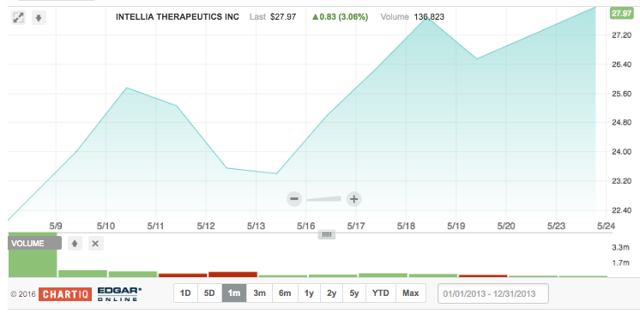
The expected price range for NTLA was set at $16 to $18 for its May 6 IPO. The company hoped to raise $88.3 million. On its first day of trading, NTLA outperformed that expectation and instead was priced at $22 per share, well above its expected range. With that pricing, the offering of 5 million shares and an overallotment option of an additional 750,000 shares made the value of the IPO instead be up to $126.5 million. The stock has grown since then in its early market performance.
Business Overview: Gene-editing Company Using Cutting-Edge Biotech to Develop New Potential Curative Therapies
Intellia Therapeutics, Inc. describes itself as a gene-editing company. It uses a new biotechnology called the CRISPR/Cas9 system in order to edit genes. The company's goal is to discover and develop new therapies to cure a variety of conditions by treating genes that are diseased. The company is based in Cambridge, Massachusetts.
Gene editing modifies the information contained in genes. The CRISPR/Cas9 system does so by making repairs to damaged portions, knocking out diseased portions and inserting new material. As the company disclosed in its SEC filings, this new technology has not yet been validated through clinical trials for human use. Since it is in an early stage of development, it is also uncertain whether products will be developed that can provide the therapeutic developments for which the company is striving. The company also notes that regulatory issues exist. Gene-editing therapies have not been approved in the U.S. to date, and only one gene-editing therapy has been approved in the European Union.
Overview of Executive Management
The founder, CEO and president of Intellia Therapeutics, Inc., is Nessan Bermingham, Ph.D. Mr. Bermingham has more than 15 years of experience in investments in Life Sciences. He was a founding partner of Bio Equity Capital and a partner at Omega Funds and Atlas Venture and has managed several investments across Europe and the U.S. He obtained his Ph.D. from Imperial College London in molecular biology.
Sapna Srivastava, the company's chief finance and strategy officer, holds a Ph.D. in neuroscience from New York University. She has served as an analyst on Wall Street and as an advisor to the biotech industry. Ms. Srivastava has previously worked for Morgan Stanley as a senior biotechnology analyst.
Competitors: Editas Medicine, CRISPR Therapeutics, Inc., Tracr Hematology Limited and Others
There are several other biotechnology companies that are also using the CRISPR/Cas9 system that could be competitors for NTLA. These include Editas Medicine, CRISPR Therapeutics, Inc., and Tracr Hematology Limited. The company may also face competition from gene-editing companies using other biotech tools for similar purposes.
Conclusion: Buy in Advance of Quiet Period Expiration
While we recommended that people hold off on purchasing shares of NTLA in advance of the company's IPO, we are currently suggesting that investors take advantage of the expiration of the quiet period on May 31, 2016. The company's early market performance has been strong and has outperformed its expectations.
NTLA's underwriters, including leads Credit Suisse, Jeffries, and Leerink Partners, along with Wedbush PacGrow, will likely publish a slew of positive recommendations at the expiration. We have found above-market returns of nearly 3% in a window of time surrounding many quiet period expirations, usually five days prior and two days following analyst reports.


Comments
Log in or sign up to join the conversation.