

In its final step in the process of splitting into two, Ashland, Inc. announced the spin-off of Valvoline, Inc. (Pending:VVV) into its own publicly traded company. The company filed its S-1/A with the Securities and Exchange Commission on Sept. 12, 2016, setting the terms for the IPO that is scheduled for Sept. 23, 2016. Valvoline will offer 30 million shares with an additional over-allotment option of 4.5 million shares. Valvoline estimates net proceeds of approximately $605 million (or approximately $697.0 million if the underwriters' over-allotment option is exercised in full). The price range is $20 to $23 per share.
Immediately prior to the closing of the offering, Valvoline plans to borrow approximately $980M and transfer the proceeds to Ashland. Valvoline will then use the net proceeds from the offering to reduce its loans and estimate that there will be no more than approximately $375.0 million in loans after using its net proceeds.
Upon completion of this offering, Valvoline will have 200,000,000 shares outstanding, (204,500,000 shares if the underwriters exercise their over-allotment option in full). Of those 200,000,00 shares, Ashland will own 170,000,000 shares, representing 85% of common stock outstanding. After the completion of the offering, Ashland Inc. will continue to control a majority of the voting power of Valvoline's common stock. After the 180-day lockup period, Ashland plans to effect a tax-free spin-off of its remaining stake in Valvoline.
Underwriters for the offer include: Bank of America Merrill Lynch, Citigroup (NYSE:C), Morgan Stanley (NYSE:MS), Deutsche Bank Securities, Goldman Sachs (NYSE:GS) and JPMorgan (NYSE:JPM).
Business summary
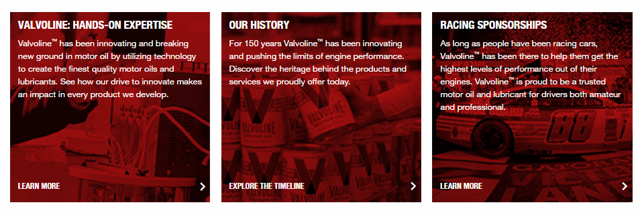
Founded in 1866 and headquartered in Lexington, Kentucky, Valvoline has 1,050 franchises and company-owned lubricant shops. It also sells its products through more than 30,000 retail stores in the U.S. and Canada, to installer customers with more than 12,000 locations, and to people in 140 countries around the world. It is the second-largest lube-store operator in the United States.
Executive management
Samuel J. Mitchell, Jr. has served as Senior Vice President of Ashland since 2011 and President of Valvoline since 2002. He was appointed as a director and Chief Executive Officer in May 2016 and September 2016, respectively. Mr. Mitchell joined Ashland in 1997. He holds a Bachelor's degree in Business Administration from Miami University of Oxford, Ohio, and a Master's degree in Business Administration from the University of Chicago.
Mary E. Meixelsperger has served as Chief Financial Officer of Valvoline since June 2016. Prior to joining Valvoline, Ms. Meixelsperger was: Senior Vice President and Chief Financial Officer of DSW Inc. (NYSE:DSW) from April 2014 to June 2016 and held numerous roles at Shopko Stores from 2006 to 2014. Meixelsperger started her career in public accounting at Arthur Young and Company. She received her Bachelor's Degree in Business Administration from the University of Wisconsin.
Financial highlights and risks
In the year 2015, Valvoline generated approximately $1.96 billion in sales, a 3.6% decrease from the previous year and $196 million in net income, a 13.1% increase from the previous year. For the nine months ended June 30, 2016, Valvoline generated approximately $1.4 billion in sales and $208 million in net income.
Among its many strengths, Valvoline points to its strong brand recognition, which is built on 150 years of history. The company reports that for fiscal year 2015, its Adjusted EBITDA was $422 million. The company plans to grow its quick-lube business through opening new stores and selling additional franchises. The company also envisions further growth through the acquisition of other quick-lube chains while also emphasizing revenue growth in existing stores.
The company identifies risks to its business as including any damage that might occur to its reputation, downward economic market conditions, the loss of any of its biggest customers, falling prices and an unsuccessful separation from Ashland.
Industry peers
Valvoline faces competition in each of its product categories and subcategories. The company identifies Jiffy Lube as its biggest competitor among quick-lube service stations as well as Grease Monkey, Express Oil Change. Jiffy Lube is owned by Shell Oil Company and is the largest lube station operator in the U.S. with 1,900 stores. Valvoline identified Shell (NYSE:RDS-A) as a major competitor in its lubricant business. Shell is the maker of Pennzoil and Quaker State.
Assuming Valvoline prices at $21.50, the mid-point of its price range, it will have a market capitalization of 4.3 billion. Using sales in 2015, Valvoline will trade at approximately 2.19x sales. This is just slightly above the S&P 500 average price to sales multiple (1.9).
Conclusion
Valvoline's lengthy history and strong brand recognition makes us believe that the company will continue its successful path as a separate entity.
As of Monday (9.19) the deal was oversubscribed and building.
The company has enjoyed substantial profits and has the infrastructure that is necessary for continued growth and earnings. We recommend that investors consider purchasing shares of Valvoline during its IPO.

Comments
Log in or sign up to join the conversation.