

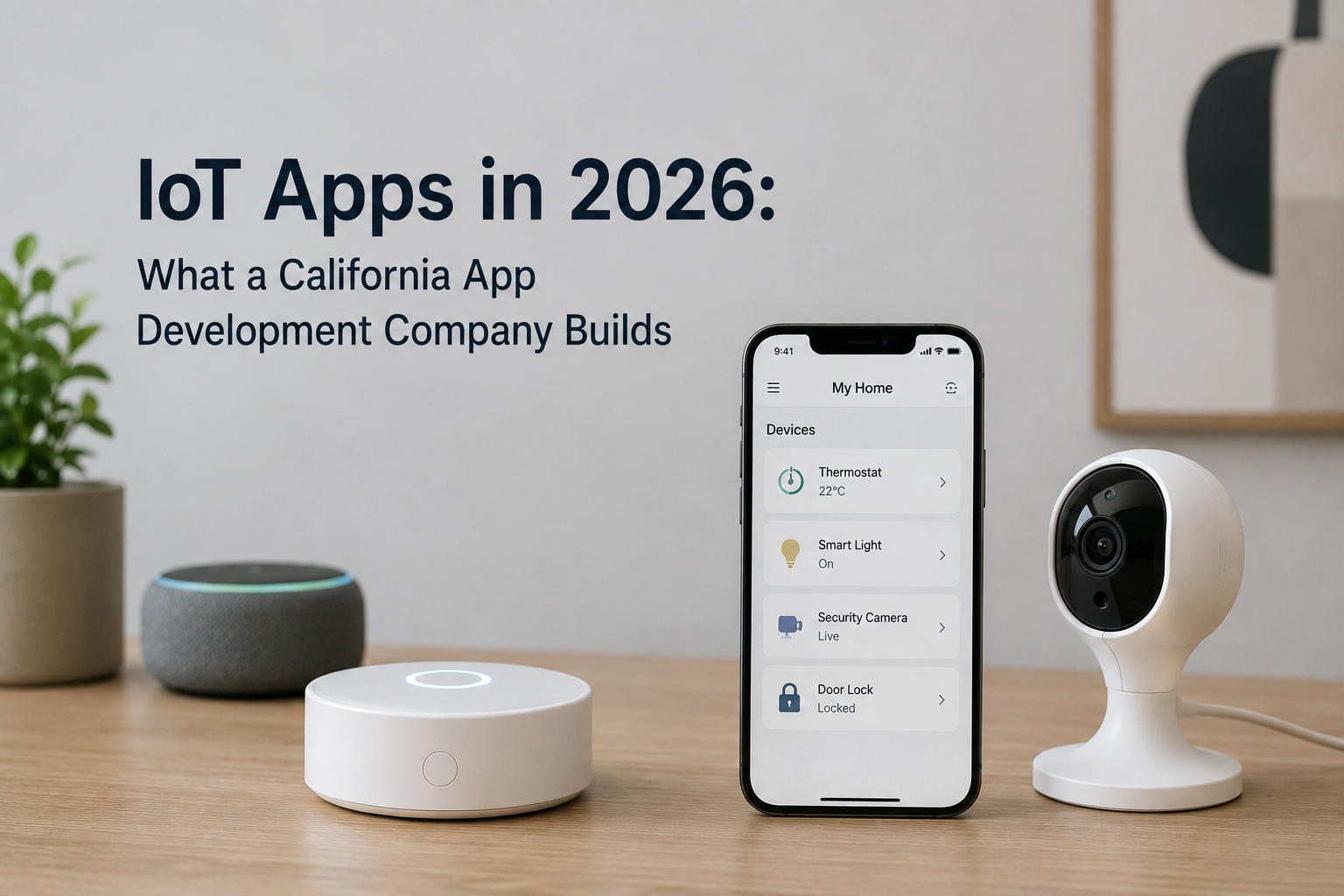
Ask five different vendors what "IoT app development" means and you'll get five different answers. Some will show you a device dashboard from three years ago and call it innovation. Others will talk your ear off about protocols you didn't ask about. What actually separates a good IoT-connected mobile app in 2026 from a mediocre one isn't the buzzwords it's whether the app can talk to any device a user owns, react in real time, and hold up once it's live in a hospital or a warehouse instead of a demo room.
As a mobile app development company in California, that's the bar we hold ourselves to, and it's worth walking through what it actually takes to clear it.
Matter Compatibility Isn't a Nice-to-Have Anymore
For a long time, building an IoT app meant picking a side you built for Apple HomeKit, or Google Home, or Amazon Alexa, and hoped your users didn't own a device from the "wrong" ecosystem. That's changing fast. Matter, the open connectivity standard now backed by Apple, Google, Amazon, and Samsung, has hit real adoption numbers certified devices have grown roughly tenfold since 2024. Thread, the mesh network running underneath it, is what keeps a lock or a sensor responsive even if one node in the network drops.
Any mobile app development team still treating Matter as an afterthought is going to be retrofitting their architecture within the year. We build it in from the start, so one codebase can talk to a thermostat, a wearable, and a security camera without caring which hub sits in the user's living room. That's largely why we lean on Flutter for cross-platform builds on IoT projects one codebase, multiple device ecosystems, without duplicating work.
Real-Time Data Means Edge Processing, Not Cloud Round-Trips
The second piece is speed. A fall-detection wearable or a fleet sensor flagging an engine problem can't afford to wait for a cloud server to process the data and send a response back. That kind of latency is fine for a to-do list app. It's not fine when someone's safety depends on it.
Edge AI running inference on the device itself, or on a nearby gateway has become the standard approach for anything time-sensitive: healthcare monitoring, industrial sensors, security systems. What this actually requires on the engineering side:
A backend that handles spotty connectivity gracefully instead of assuming a constant connection
Selective data sync instead of streaming everything to the cloud
A recovery path for when a device drops offline and comes back an hour later
It's a genuinely different problem than a typical app build, and it's where a general app development company starts to look different from one that actually knows IoT.
Building for One Industry Beats Building for Everyone
We've also noticed that the apps getting real traction aren't the ones trying to be a universal IoT platform. They're built for a specific industry's actual workflow:
Healthcare - wearables streaming vitals to clinician dashboards, with HIPAA compliance baked into the data architecture from the first sprint, not bolted on after a security audit
Logistics and fleet management - sensors reporting engine health and location in real time, so a maintenance issue gets caught before it turns into a breakdown
Manufacturing - edge processed sensor data catching anomalies on the line without waiting on a round-trip to the cloud
A track record matters more than a features list here. Having already shipped a real-time fleet management platform, for example, means we walk into a healthcare IoT project already understanding the reliability and compliance bar — not learning it mid-build.
Why This Looks Different Coming Out of California
Being an app development company in California isn't just a line on a homepage. A few things about the location actually shape how the work gets done:
Privacy comes first, by default. CCPA and its ongoing expansions mean device data location, health signals, usage patterns needs consent and deletion built into the architecture from day one, not added after a compliance review.
The ecosystem is next door. Apple and Google, among the companies driving Matter adoption and IoT chipsets, are California-based. Being close to that world shortens the gap between a new SDK dropping and it actually showing up in a client's app.
The demand is different. California's mix of healthtech, climate tech, and logistics startups sends a disproportionate share of IoT work to local mobile app development services, which pushes firms toward real depth instead of staying generalists.
What to Ask Before You Hire
If you're evaluating an app development service for an IoT project, a few questions will tell you fast whether they've actually done this before:
Do they have a real Matter/Thread strategy, or are they still wiring up single-ecosystem integrations one at a time?
Where does the inference actually run cloud only, or do they have hands-on edge AI experience?
Can they point to a real case study with device data at scale, not just a proof-of-concept?
How do they handle sync failures and dropped connections?
Is privacy architecture part of the initial spec, or a conversation that happens after something goes wrong?
Timeline is worth asking about too. IoT projects have more moving parts than a standard build, and scope creeps fast when there's no clear process for managing it.
The Bottom Line
IoT-connected apps in 2026 get judged on whether they actually work across devices, respond in real time, and fit the industry they're built for not on whether a sensor is technically "connected." Matter compatibility, edge AI, and real vertical experience are what separate an app that impresses in a demo from one that holds up in a hospital or a warehouse. Working inside that ecosystem and inside California's privacy rules every day gives us a head start on getting all three right.
If you're planning an IoT-connected app and want a team that's already shipped real-time device data at scale for healthcare and logistics clients, we'd like to hear what you're building. Get in touch for a free consultation and we'll walk through the Matter, edge AI, and compliance questions specific to your project no generic pitch, just a straight answer on what it'll actually take.
FAQs
Do I need a separate app for Matter and for older smart home ecosystems?
No. A well-architected IoT app can support Matter and still fall back to a device's proprietary SDK where a manufacturer hasn't adopted the standard yet. The goal is one app, not one app per protocol Matter just makes that a lot easier to pull off than it was three years ago.
How long does it typically take to build an IoT-connected mobile app?
It depends heavily on how many device types and protocols the app needs to support, but a reasonably scoped project usually runs 4 to 9 months from discovery to launch. Healthcare and industrial builds tend to run longer because of compliance testing and hardware integration work that a consumer app wouldn't need.
Is edge AI necessary for every IoT app, or only certain use cases?
Only where latency actually matters safety alerts, fall detection, equipment fault warnings, anything where a delay changes the outcome. A smart-home convenience app checking a thermostat setting can run on the cloud just fine. It's not a default; it's a decision based on what happens if the response is a few seconds late.
What makes IoT app development different from a standard mobile app build?
Mainly the assumptions you can't make. A standard app assumes a logged-in user tapping a screen. An IoT app has to account for devices going offline, sensors sending malformed data, multiple hardware vendors behaving differently, and data that has to sync correctly even after a connection drops. It's the same core development skills, applied to a much less predictable environment.
Why does it matter that a development team is based in California for an IoT project?
Mostly for two reasons: proximity to the companies setting the standards (Apple and Google both being California-based helps when a new SDK or certification requirement lands), and default familiarity with CCPA-level privacy requirements, which tend to be stricter than what a team used to lighter-touch state regulations might build in from day one.
Comments
Log in or sign up to join the conversation.