

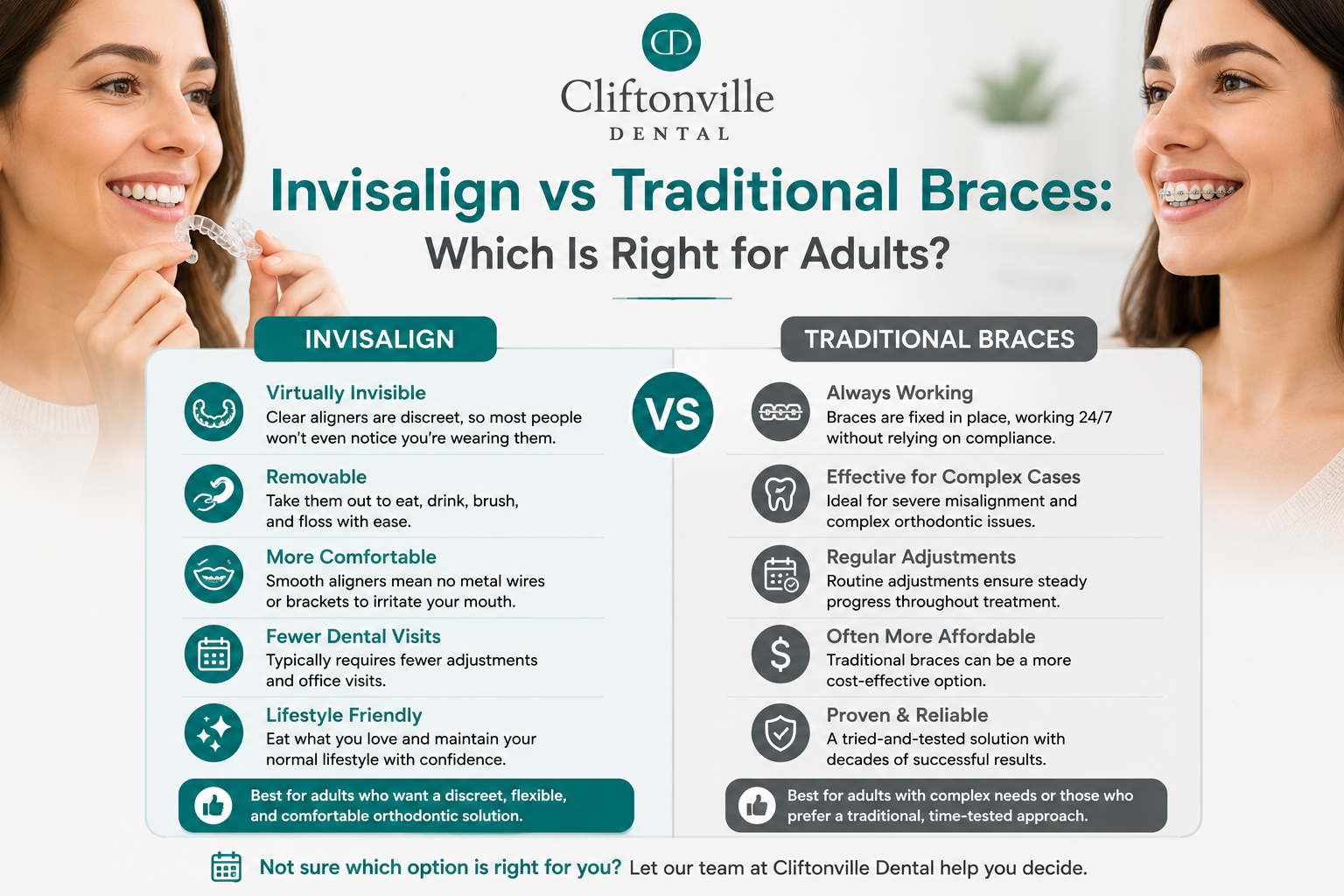
Quick answer: Fixed braces move teeth more predictably in complex cases and do not depend on you remembering anything. Invisalign is removable, near-invisible and easier to clean around, but only works if worn 20 to 22 hours a day. For most straightforward adult crowding and spacing, either will work and the choice is lifestyle. For significant bite correction, rotations and extraction cases, fixed braces are often still the stronger option.
Adult orthodontics has stopped being unusual. A large share of people now having treatment are in their thirties, forties and beyond, often correcting relapse from teenage braces they stopped wearing retainers for.
The question is almost never "can this be fixed", because usually it can. It is which appliance suits your case and your life. Here is the comparison without the marketing.
How each one actually works
Fixed braces bond brackets to each tooth, connected by a wire that applies continuous, controlled force. The orthodontist adjusts the wire at intervals. Modern adult options include ceramic brackets that are tooth-coloured and considerably less visible than the metal most people picture, and in some cases lingual braces fitted behind the teeth.
Invisalign uses a series of custom clear aligners, each worn for roughly one to two weeks before moving to the next. Each aligner moves teeth a fraction of a millimetre. Treatment is planned digitally from a scan, and small tooth-coloured attachments are usually bonded to certain teeth to give the aligners something to grip.
The key mechanical difference is control. A wire applies force in three dimensions continuously. Aligners apply force in planned increments and only while you are wearing them.
Where fixed braces win
Complex movements. Significant rotations, moving roots rather than just crowns, closing extraction spaces and correcting substantial bite discrepancies are generally more predictable with fixed appliances.
No compliance required. They are glued on. There is no version of this treatment where you forget to wear them, which for many people is decisive.
Often lower cost for equivalent complexity, though this varies considerably by practice and case.
Where Invisalign wins
Appearance. From conversational distance, most people will not notice them. For patient-facing jobs and presentations, this matters more than people admit.
Removable for eating. No food restrictions. Fixed braces come with a genuinely irritating list: no hard crusty bread, no toffee, no biting into apples, careful with popcorn.
Easier hygiene. You take them out and brush and floss normally. Cleaning around fixed brackets and wires properly takes real effort, and decalcification marks around brackets are a known risk when it is not done well.
Fewer emergency appointments. No bracket coming loose the night before a wedding.
Comfort. Aligners are smooth. Brackets and wires rub, particularly in the first fortnight.
The compliance problem, stated honestly
Invisalign requires 20 to 22 hours of wear a day. That means it comes out for meals and for brushing, and goes straight back in.
The maths is unforgiving. If you take aligners out for a two-hour dinner, an hour at the gym and forget them through a morning meeting, you are down to 18 hours and your teeth stop tracking the plan. Treatment stalls, aligners stop fitting, and you end up needing a refinement scan and additional aligners, adding weeks or months.
If you know yourself to be forgetful, or your job makes it awkward to remove and replace aligners discreetly, be honest about that at the consultation. It is a better conversation to have before you pay than three months in.
Cost and length of treatment
Both are private treatments for the overwhelming majority of adults. NHS orthodontics is generally reserved for under-18s meeting clinical need criteria, so adult treatment is almost always self-funded.
Treatment length depends on the case rather than the appliance, typically ranging from around six months for mild crowding to two years or more for complex work. Simple cosmetic alignment of front teeth sits at the shorter end.
Costs vary widely by practice and case complexity, so get an itemised quote that specifies whether it includes the initial scan and records, all aligners or adjustments, any refinements needed, retainers at the end, and review appointments. Retainers being excluded from a quoted price is a common surprise.
The part nobody mentions: retainers are forever
Teeth move for life. This is the single most important thing to understand before starting any orthodontic treatment.
Whatever appliance you choose, the result is held by retainers, either a fixed wire bonded behind the teeth, a removable retainer worn nightly, or both. Stop wearing them and teeth drift back, which is precisely why so many adults having treatment now are on their second round after teenage braces.
Budget for retainers, replacement retainers over the years, and the nightly habit. If that sounds unappealing, it is worth knowing now rather than after paying for two years of treatment.
Choosing between them
Ask at consultation:
Is my case suitable for both, or does one clearly suit it better clinically?
What is the projected treatment time for each?
Are refinements included if teeth do not track as planned?
Are retainers included, and what type do you recommend for me?
Will I need attachments, and where will they be visible?
Do I need any extractions or interproximal reduction?
If a practice presents only one option without explaining why the other was ruled out, ask directly. Sometimes the honest answer is that the case genuinely needs fixed appliances, and that is worth hearing plainly.
Before any orthodontic work starts, decay and gum disease need to be stable, which is why a full examination comes first. What that involves is set out in an earlier post on teeth whitening and why examination comes before cosmetic treatment.
About the practice behind this article
Cliftonville Dental is a private practice at 65 The Avenue, Cliftonville, Northampton NN1 5BT, on 01604 604545. It is owned and run by Dr Anesh Patel and Dr Arti Shah, both of whom still treat patients. Dr Patel qualified from King's College London in 1999 and returned to his hometown of Northampton, where he has worked ever since, with postgraduate training focused on cosmetic and implant dentistry. Dentists across Northamptonshire refer patients to the practice for that work.
The practice offers adult orthodontics including Invisalign and fixed braces, alongside preventative and general dentistry, hygienist care, white fillings, root canal treatment, crowns, bridges, veneers, teeth whitening, CEREC same-day crowns, children's dentistry, dental implants and facial aesthetics. It opens six days a week including evenings, publishes its fees and takes online bookings, and offers sedation for anxious patients. Families comparing options for a Family Dental Clinic in Northampton can arrange a consultation to discuss which appliance suits a particular case.
Frequently asked questions
Is Invisalign as effective as traditional braces? For mild to moderate crowding, spacing and relapse, outcomes are comparable when aligners are worn as prescribed. For complex rotations, extraction cases and significant bite correction, fixed braces generally remain more predictable.
Am I too old for braces? No. Teeth can be moved at any age provided the gums and supporting bone are healthy. Gum disease must be stable first, which is why the assessment matters more for adults than teenagers.
Does Invisalign hurt? Expect pressure and tenderness for a day or two after each new aligner, which settles. Most people find it milder than the discomfort after a fixed brace adjustment, though the first few days of any treatment are the least comfortable.
Can I get adult orthodontics on the NHS? Rarely. NHS orthodontic treatment is generally limited to under-18s who meet clinical need criteria. Adult treatment is nearly always private.
Will I have to wear a retainer forever? Effectively, yes. Teeth continue to move throughout life, and retention is what preserves the result. Most people settle into nightly wear of a removable retainer, sometimes alongside a bonded wire.
Can I switch from Invisalign to fixed braces partway through? It is possible and sometimes recommended if teeth are not tracking as planned. Ask upfront what happens, and what it costs, if the case does not progress as expected.
The bottom line
Choose fixed braces if your case is complex or you doubt your own consistency. Choose Invisalign if your case is suitable and appearance, hygiene and food freedom matter to you enough to build a 22-hour habit.
Either way, get a clear written quote, confirm whether retainers are included, and accept that retention is a lifelong commitment rather than an optional extra.
About the author
Dr Anesh Patel BDS, MFGDP (UK), GDC No. 76250, is Principal Dentist and co-owner of Cliftonville Dental in Northampton. He qualified from King's College London in 1999 and has practised in Northampton ever since, with postgraduate training focused on cosmetic and implant dentistry. He treats patients at the practice alongside Dr Arti Shah.
This article is general information and does not replace a personal orthodontic assessment.
Comments
Log in or sign up to join the conversation.