

Founded in 2007 by Brian Chesky and Joe Gebbia, Airbnb is an app and website that connects people seeking lodging with renters who have listed their personal houses, apartments, guest rooms, etc on either platform. Currently, the company boasts over 1.5 million listings in 34,000 cities and more than 190 countries, as well as over 40 million total guests. It also has an international presence in cities like Paris, London, Sao Paolo, Sydney, and many others.
Airbnb is reportedly worth an estimated $25.5 billion, making it worth more than well-known hotel chains Wyndham (WYN - Analyst Report), Holiday Inn owner InterContinental Hotels (IHG - Snapshot Report), and Hyatt (H - Snapshot Report)
IPO Buzz
Since 2014, rumors have been swirling of Airbnb’s inevitable initial public offering, even though CEO and co-founder Chesky said no to an IPO in 2014. In an interview with the Wall Street Journal, Chesky said that “we will do it at a time when it benefits the company, when we have a good reason.”
Their alleged valuation, however, as well as being a recognized name in the increasingly popular “sharing economy,” is helping raise buzz. Their popularity among venture capitalists is helping increase hype, too.
Airbnb is a company for the digital age, and investors and venture capitalists have taken notice. The company has already received a total of $2.3 billion in eight rounds of funding from firms like Andressen Horowitz, Fidelity Investments, and T. Rowe Price, among many others.
Composition of Airbnb Inc.'s Investors (Cumulative) | FindTheCompany
According to Neil Sequeira, managing director of VC firm General Catalyst Partners in Palo Alto, California, these types of companies are well-liked among investors. Specifically, Airbnb is popular because it is inexpensive to run; it doesn’t have to build and maintain hotels, or a hotel staff. The company is also easy to grow quickly, as there is no need for a physical office in every country—just consumers with a smartphone (even though Airbnb has international offices).
“The reason they make better investments is they are very high-margin at scale…you’re basically just closing a transaction. You don’t get that dirty,” said Sequeira.
We-commerce
What makes companies like Airbnb, Uber, Lyft, and other digital technology companies successful is their status as frontrunners in the new sharing economy, an economy that is slowly starting to affect the way money, investments, and business are handled (See also: Will Uber be the Hottest IPO of 2016?).
Because this economy is still in its beginning stages, it is seen as more of a movement. Thus, it is an economy that values more inclusivity and is less distrusting; more democracy and is less traditional; appreciates wasting less and helping each other make better decisions regarding resources; and harnesses the best aspects of technology to do all of the above.
The idea of trust lies at its core, and the sharing economy is selfless in nature—if people can trust more, they can save money and gain flexibility.
However, a we-commerce economy has its share of problems. It might be altruistic, but this kind of financial system also features billion dollar Silicon Valley investments that cause companies to ascend at exceedingly fast rates, burying the original mission of the movement (just think back to the billions of dollars invested into Airbnb, Uber, etc by venture capitalists last year).
Airbnb as a Lifestyle
Last July, Airbnb announced a huge rebranding, coupled with a desire to transition from a hotel service to a lifestyle brand.
In a blog post, the company stated they want to possess a logo that will be seen on a variety of products, houses, and businesses, to make sure people understand that whoever owns it is a supporter of their ideal—but, more importantly, a supporter of their brand.
Since this announcement, Airbnb has redesigned its website and apps, which are now far cleaner than previous versions, and feature subtle animations and flashier imagery. The company's branding has also undergone a makeover, thanks in large part to a new company symbol which looks like a paperclip stretched out in the style of an A-shaped birdhouse.
This desire of a company to be more than its services is reminiscent of Shake Shack, Inc (SHAK - Snapshot Report), the popular New York City burger joint who recently went public. Shake Shack is finding great success by promoting themselves as a lifestyle brand, as well as putting themselves into the “fine casual” dining category.
So, what can Airbnb learn from Shake Shack? Like the burger restaurant did, would Airbnb benefit by staying private longer? Could extra time help the company reinforce reserves, address weaknesses, and plan for the future?
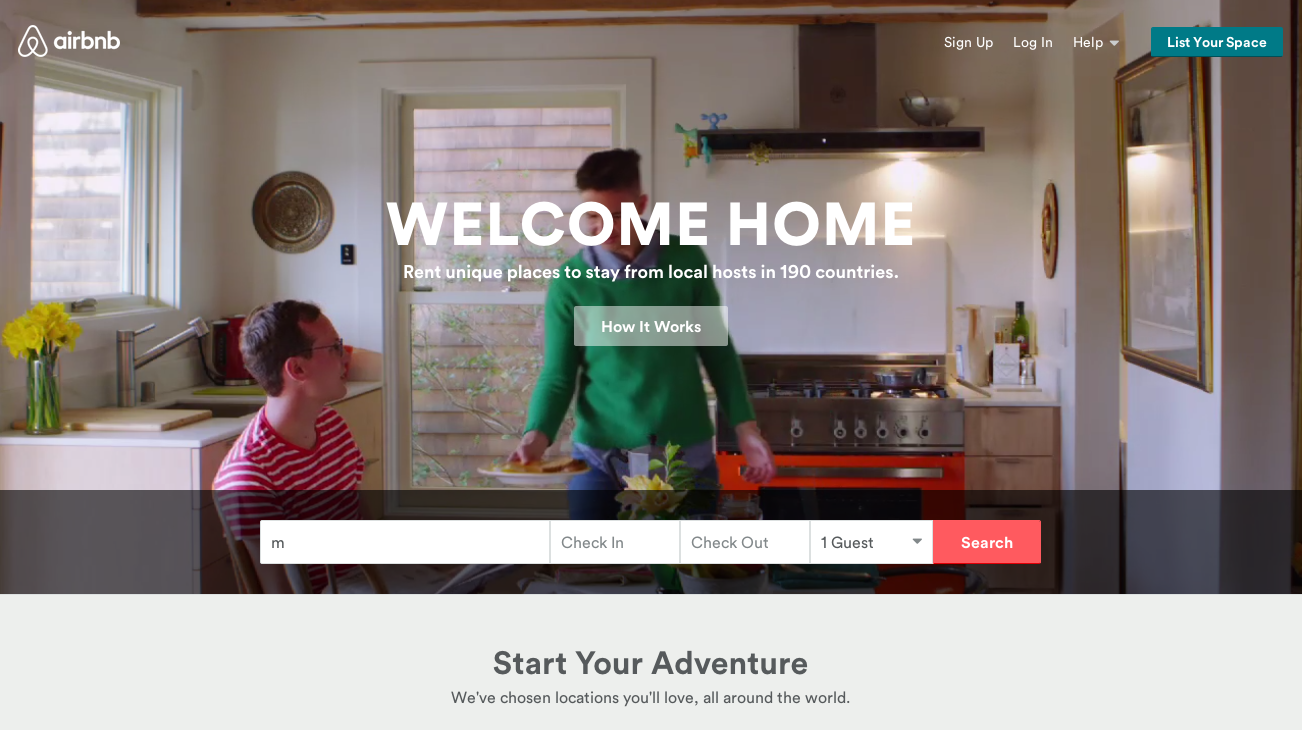
Image: Airbnb
Controversies to Consider
Airbnb may present a legitimate challenge to the hotel industry, but the company is enveloped by controversy and regulatory issues in cities that are none too pleased with residents turning their homes into hotels, reflecting similar problems that plague companies like Uber and Lyft.
In San Francisco, critics are blaming Airbnb for the more than 3% vacancy rate and a nearly $3,800 average rent. Average home prices just hit the $1 million median mark, and the city’s population has reached an all time high (according to Paragon Real Estate Group).
Despite the absence of a permit, which, according to law, one must have in order to rent for under 30 days, city residents are still illegally listing personal homes and apartments for less than the required number of days on Airbnb.
The company is also embroiled in a long-standing battle with New York City, where they face similar issues as in San Francisco. In 2010, the city passed an “illegal hotel law” that prevents people from subletting apartments for less than 29 days, which, not surprisingly, thwarts Airbnb in their goal to expand its market. In turn, the company responded with a massive promotional campaign that included subway advertisements with accompanying feel-good videos, a NYC marathon takeover, and its recently announced rebrand.
According to Credit Suisse analysts, Airbnb seems to be a contributing factor to cost decreases of some hotels in the city, along with other boutique hotels, bad weather, and a weaker Euro.
How Might Airbnb Perform?
Airbnb’s IPO could go either way. Their current $25.5 billion valuation is impressive in and of itself, and will most likely be the driving factor for investors come time for a public entrance into the market.
Airbnb needs to keep an eye on their increasing competition, however. Companies like Roomorama, HouseTrip, and the Expedia (EXPE - Analyst Report)-owned HomeAway all have a following of their own, and are all starting to eat into the market share.
Despite competing companies and regulatory issues, Airbnb has the potential to be one of the hottest upcoming IPOs. With millions of dollars in investments already, a thriving rebranding, and its rising popularity among travelers, Airbnb’s IPO is one to watch out for.

Comments
Log in or sign up to join the conversation.