


Fintech is increasingly offering investors a simple and cost-effective way to invest their money. However, when looking at reviews of some of these providers it is apparent that many of their customers do not have a good grasp of investment basics.
In rising markets, client reviews are broadly positive. We are now in bear market territory and the reviews have become more negative, one customer was complaining about a loss of less than 1%!
This is not hugely surprising, loss aversion - the tendency to prefer avoiding losses to acquiring equivalent gains - is an area that has been well-researched. It also leads to investors making poor decisions, such as buying high (for example, when markets have already risen) and selling low (when markets have already fallen).
It is inevitable that markets will fluctuate; they will always rise and fall. Investors should normally be looking at an investment horizon of 5+ years.
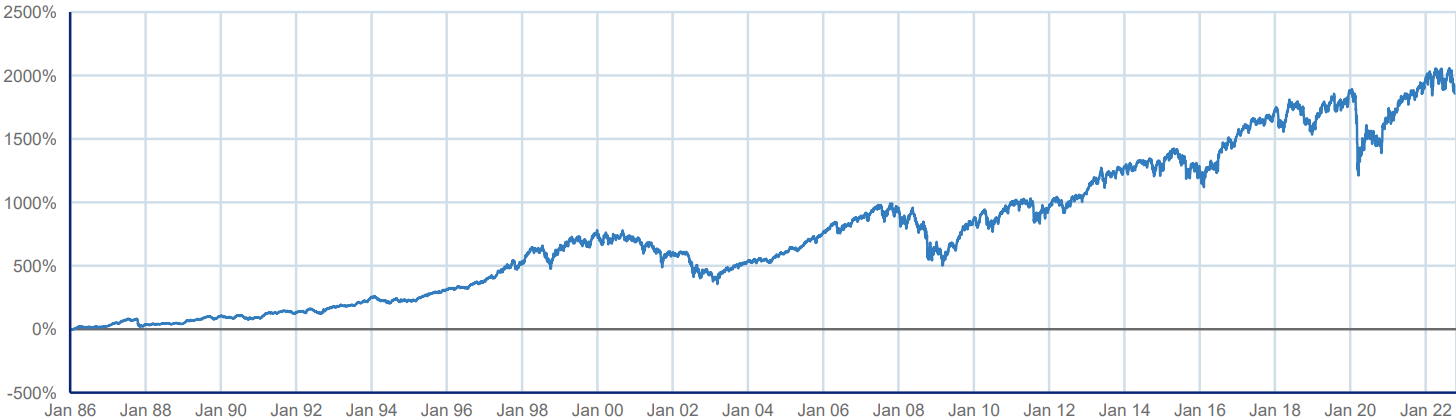
Putting short-term market volatility into a historical perspective can be helpful to investors. The chart below shows the performance of the FTSE 100 since January 1986.
There has been a range of momentous events in the subsequent 36 years such as: Black Monday (1987), Gulf War (1990-1991), Barings Collapse (1995), Asian Financial Crash (1997-1999), Dotcom Bust (2000-2003), Global Financial Crash (2007-2008), Oil Price Crash (2015-2016), Brexit Referendum (2016) and Covid-19 (2020).
Despite this, the index has delivered long-term growth for investors willing to ride out the ups and downs.

Chart: FTSE 100 January 1986 to 26th October 2022 (with income reinvestment), source www.selectwealth.co.uk
Our emotions intensify as investments increase in value and we become excited about the prospect of even greater returns. Nonetheless, most of the big gains have already been made by the time investors become optimistic.
However, if an investor waits until they feel most confident about markets, they will miss out on long-term gains because they will be buying at high prices.
2022 has been a tough year for investors with both equity and bond markets falling as we have soaring inflation, rising interest rates, and Russia’s invasion of Ukraine.
The erosion of returns will eventually lead many investors to capitulate, leaving the market for good. Even those who persevere could become despondent, wondering whether markets will ever recover.
Arguably, the point of maximum financial opportunity comes when you feel most discouraged about your investments. When the market is down, you might be tempted to throw in the towel, but you should generally avoid selling when your portfolio is worth the least. With no immediate end to the bear market in sight, providers may want to do more to educate their customers about investment fundamentals.
More By This Author:
Do UK-Based Investors Have Too Much Exposure To The FTSE 100?
Investing In Times Of Uncertainty
Comments
Log in or sign up to join the conversation.