
Two decades ago during the “dot-com” bubble, traders craved the volatility of high flying speculative technology startups like Amazon, boo.com, and pets.com. Unlike many pre-Y2K internet-enabled companies, Amazon survived and became a global behemoth of e-commerce, cloud computing and entertainment that traders still flock towards.
As the technology sector has matured, so have traders. They want a combination of growth and stability, not just speculative fervor about the future. Unlike tech companies of the past, modern technology titans offer stability in their current business segments while simultaneously innovating and disrupting new markets to stoke future growth.
Facebook (FB), Amazon (AMZN), Netflix (NFLX), and Google (GOOG) (now Alphabet) make up the infamous “FANG” acronym which serves as a representation for today’s biggest innovators and leaders in the market. Many add a second ‘A’ in FANG to make it “FAANG” in order to include fellow technology titan, Apple. These five companies dominate industries like cloud computing, e-commerce, online search, mobile phones, advertising, streaming, social media and have entered spaces like autonomous driving and artificial intelligence. These companies are the biggest and best at what they do. The NYSE FANG+ Index includes these “FAANG” companies alongside other innovative leaders like Alibaba (BABA), Baidu (BIDU), Nvidia (NVDA), Tesla (TSLA), and Twitter (TWTR).
While we believe technology traders have matured post-dot com bubble, we don’t believe technology equity index investing world has matured, especially given that two of the largest technology-related indices have top 10 holdings that include firms like Visa & Pepsi.
Technology Sector Index Landscape: Know Before You Trade
The Nasdaq-100 Index and the Tech Select Sector Index are popular technology indices that many consider to be benchmarks of tech. However, if you do a deep dive on both indices, we argue that neither fully represents the technology landscape.
Companies like Pepsi (P), Comcast (CMCSA), Starbucks (SBUX), Costco (COST), and Charter (CHTR) are all top 25 holdings of the Nasdaq-100 Index. When you think of technology innovation, things like coffee, potato chips, and cable boxes don’t really come to mind. Over the years, bigger and more established companies have left other exchanges or have listed directly on the Nasdaq, which in the early 2000’s was predominately home for technology companies. As a result, the Nasdaq-100 Index now looks quite different than in years past. In the chart below you’ll see the Nasdaq-100 Index includes sectors such as Consumer Staples, Financials, Health Care, and Industrials.
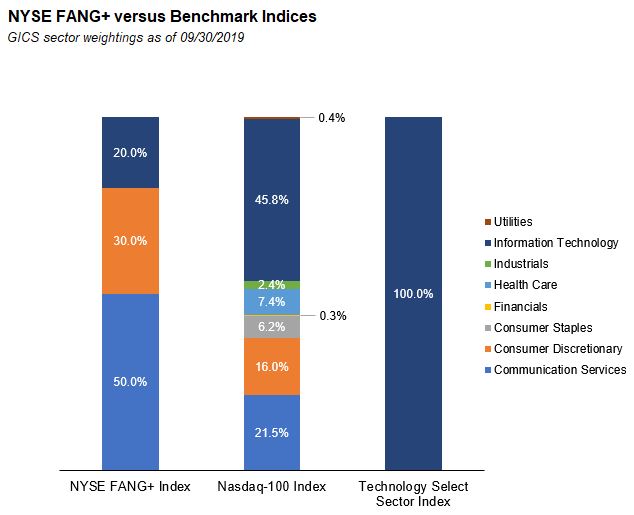
Source: Bloomberg, from 09/30/2019
Based on the above Global Industry Classification Standard (GICS) weighting, the Tech Select Sector Index may seem like a great alternative to the Nasdaq-100. However, that may not necessarily be the case. Facebook and Alphabet, two of the largest technology companies in the world, aren’t in the Tech Select Sector Index, but Visa and Mastercard are top 4 holdings.
To understand, you have to go back to the creation of the GICS. GICS is a structure launched by MSCI and S&P Global which impacted technology classifications. On September 28th, 2018, after reviewing the landscape of the market, GICS extended the telecommunications services sector to include media and entertainment firms from the consumer discretionary sector and internet companies from the information technology sector. This new telecommunications sector was renamed to the communication services sector. As a result, Facebook, and Alphabet all exist within the communication services sector instead of the information technology sector which includes Visa (V) and Mastercard (MA).
(Click on image to enlarge)
.jpg)
Source: Bloomberg, index data as of 09/30/2019. Top 10 names of the Technology Select Sector Index and the Communications Services Select Sector Index on 09/30/2019. The highlighted companies are members of the NYSE FANG+ Index on that date.
Further, it is worth noting that Amazon and Alibaba, global leaders in e-commerce and cloud computing, also don’t exist in either the Tech Select Sector Index or Communications Services Select Sector index.
To quickly summarize, the Technology Select Sector index, which some would consider a benchmark for technology, is missing the world’s largest companies involved in social media, online search engines, advertising and streaming services. The Technology Select Sector index does not include Facebook, Alphabet, Amazon, or Alibaba but it does have top 4 allocations to Visa and Mastercard due to those firms being classified as Information Technology.
The NYSE FANG+ index has the most innovative firms from the Nasdaq 100 and from both ‘Select’ indices mentioned above.
NYSE FANG+ Index versus Competitor Indices since September 2014
(Click on image to enlarge)
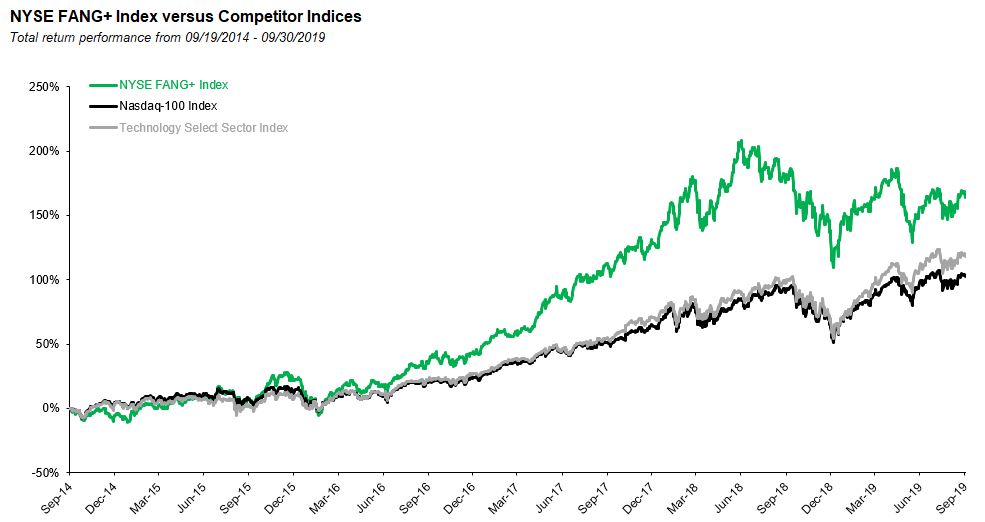
Source: Bloomberg, index data as of 09/30/2019. The NYSE FANG+ Index outperforms its competitor benchmarks since inception.
NYSE FANG+ Index Description & Holdings:
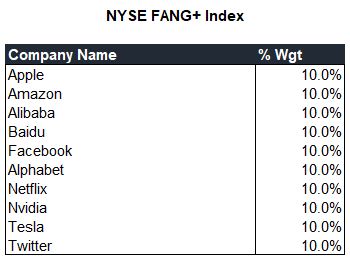
Source: Bloomberg, index holdings, & weighting data as of the close of 09/20/2019 (last rebalance date). Index rebalances quarterly to equal weight.
The NYSE® FANG+™ Index includes 10 highly liquid stocks that represent the top innovators across today’s technology and internet/media companies. The index’s underlying composition is equally weighted across all stocks, providing a unique performance benchmark that allows for a value-driven approach to investing. While the performance of indices weighted by market capitalization can be dominated by a few of the largest stocks, an equal-weighting allows for a more diversified portfolio.
A new Benchmark Index for Technology?
The NYSE® FANG+™ Index represents the most innovative names in the present day that many know and use, as well as the names that are trying to drive the new economy of the future. It features the names that many know and follow in the technology the sector. They are some of the most traded, and followed names in U.S. equity markets.
If you have strong bullish or bearish views on technology, and you want to trade the companies that represent innovation (not coffee shops, soda companies, or credit card companies, etc.), we believe this index should be considered as your new benchmark.



Comments
Log in or sign up to join the conversation.