

Summary
- The current large losses in Intel, AMD, Nvidia, and Micron shares are excessive since Intel crushed the Q1 earnings, which were originally expected to miss.
- The only justification for the scale of the loss is that Intel’s Q1 ER challenges the bull thesis of “a better 2H 2019”.
- AMD, Nvidia, and Micron shares’ reactions also seem excessive based on historical standards.
- History shows that Intel and the other 3 semi stocks would have reacted positively to a downside guidance with both revenue and EPS beats - the same case as in the current quarter.
- In terms of the actual fundamental content, it is clear that all four stocks are currently overreacting to Intel’s Q1 ER.
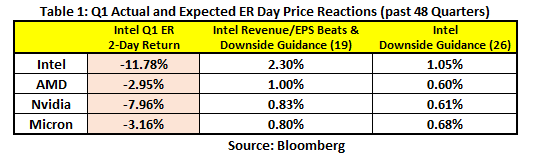
Intel (INTC) reported Q1 revenue (ER) and EPS beats but cut both Q2 and FY19 revenue and EPS guidance. At the time of this writing, Intel stock plunged -11.78% since Wednesday close, while other semiconductor stocks, Advanced Micro Devices (AMD), Nvidia (NVDA), and Micron Technology (MU) also dropped by -2.35%, -7.96%, and -3.16%, respectively (Table 1).
A Test Of A Better 2H 2019?
Other semi stocks' simultaneous plunge is more than just "sympathy". Intel's Q1 ER, other than being the first major semi call, has been heavily anticipated to provide a bellwether test on the current market hypothesis of "a better 2H 2019." Bears may argue that Intel might beat an already lowered Q1 estimate, but missed all important Data Center revenue both sequentially and year to year. In addition, the market appears to be bothered more by the continued rising ASP along with across the board declining unit shipments, a lethal combination for a continued weakening 2019, though Intel said it's taking a more cautious view of the year but expects H2 improvement. In his morning note, Stifel's Kevin Cassidy said that the weaker data center outlook will negatively affect Nvidia, but sees less risk to his AMD estimates, given the company's market share growth and limited data center exposure in China. Also, Intel's guidance for Q2 PC revenue to decline to high single digits could suggest AMD's market share gains and/or Intel's customers reducing inventory following many quarters of CPU shortages, said Cassidy. He views the likely shift away from HDDs indicated by Intel as negative for Seagate (STX) and Western Digital (WDC). In terms of NAND, Intel described an "incrementally more challenging" pricing environment. Although, in the earnings call, Intel CEO Robert Swan warned about the difficulty in NAND prices for the rest of 2019, Micron's bull contends that the impact of industry-wide supply cuts should begin to ease the supply/demand imbalance later this year.
The Response Is Excessive
That being said, the large stock losses appear overdone since Intel crushed the Q1 earnings which were originally expected to miss. Other stocks' reactions also seem excessive based on historical standards. Using last 12 years' ER records, Intel and the other 3 semi stocks would have reacted "positively" to downside guidance with both revenue and EPS beats - the same case as in the current quarter. On average, for the 26 cases that Intel had a downside guidance, INTC on average gained 1.05% on the ER day, and 2.30% if downside guidance is accompanied with revenue and EPS beats (19 cases) (Table 1).
In terms of to the actual fundamental content, it is clear that all four stocks are currently overreacting to Intel's Q1 ER.
Comments
Log in or sign up to join the conversation.