

Inflation is rising again, but this is not 2022. Weak demand and fading pricing power are forcing German companies to absorb more of the cost pressure themselves, turning profits into a buffer against a broader inflationary spiral.
The war in the Middle East and surging energy prices have pushed up headline inflation across the eurozone. In Germany, the impact was only temporary, as the government's two-month fuel tax rebate helped curb the rise in prices. At 2.9% in August, inflation was roughly one percentage point higher than in February, but still nowhere near the double-digit rates reached during the 2022 energy crisis.
And while inflation looks set to rise further over the coming months, potentially moving above 3% and remaining elevated until year-end, a return to 2022-style inflation still looks unlikely. Some knock-on effects from energy costs to other goods – though not visible yet – can be expected. However, the conditions that allowed inflation to become a broad-based problem four years ago are not currently present.
The labour market has softened, making strong wage increases less of a priority than job security. Pandemic savings are also gone. In short, the financial ability and willingness to pay higher prices are much lower than after the pandemic. As a result, companies appear to face limits to their pricing power that simply did not exist in 2022.
Pricing power stops before the consumer
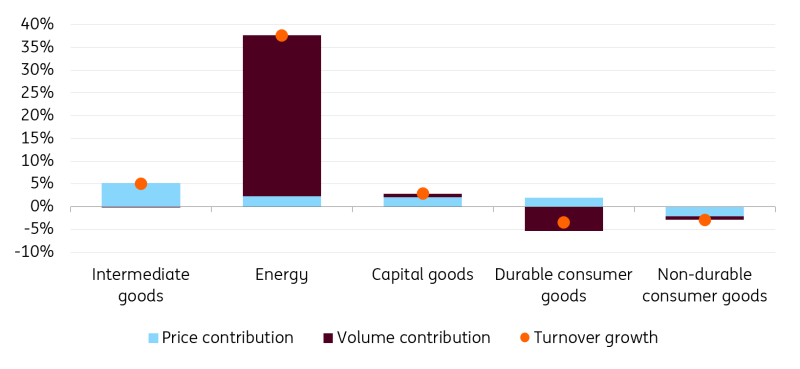
To assess industrial companies’ current pricing power, we have split domestic manufacturing turnover into a price contribution and an implied sales-volume contribution. The logic is straightforward. If prices rise while volumes remain stable, companies are successfully passing on higher costs. If higher prices coincide with falling volumes, sales are being sacrificed in the process.
In 2022, almost all turnover growth came from higher prices. Once that contribution faded, weak sales volumes pulled turnover into contraction. More recently, prices have started to contribute positively to turnover growth again. However, the aggregate picture masks substantial differences between sectors.
Producer-price and implied sales-volume contributions to domestic turnover growth
(Latest three-month average, May – July)
Source: Eurostat; ING Economic & Financial Analysis
Setting aside energy producers, whose markets are currently influenced by unusual factors and relatively inelastic demand, intermediate goods producers stand out. Here, prices are rising, while implied sales volumes remain broadly stable, pointing to relatively favourable pricing conditions. Capital-goods producers also retain some pricing room.
The picture changes significantly further downstream.
Among consumer goods manufacturers, weak purchasing power and subdued spending appetite are clearly visible, particularly in durable goods. Cars, furniture, clothing and household appliances are purchases that consumers can postpone when prices rise. And that seems to be exactly what’s happening. Recent price increases were accompanied by falling volumes and lower turnover.
While pricing power may still exist upstream in the production chain, it increasingly disappears before reaching the consumer. This yields two important conclusions: (i) the pass-through of higher energy prices to final consumption, and hence inflation, continues to look unlikely; and (ii) if the consumer is not paying the bill, someone else will have to.
Profits are becoming the buffer
This someone is companies at the end of the supply chain. If companies cannot pass higher costs on without losing sales, the adjustment must occur elsewhere. Firms can improve productivity, reduce other expenses or accept lower profits.
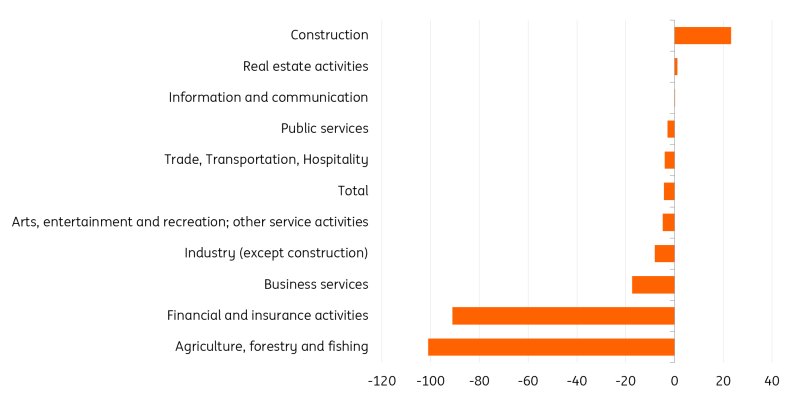
Indeed, recent data suggests that companies are finding it increasingly difficult to pass higher costs on to consumers and are instead absorbing more of the pressure themselves. Between the second quarter of 2025 and the second quarter of 2026, profits made a negative contribution to changes in price margins across large parts of the German economy.
Contribution of profits to the change in price margins between Q2 2025 and Q2 2026
(in percentage points)
Source: German Statistical Office, ING Economic & Financial Analysis
As demand weakens and consumers become more price-sensitive, companies are finding it harder to raise prices, resulting in greater pressure on profit margins.
This is most visible in agriculture, financial and insurance activities, business services and industry, where profits appear to have helped offset cost pressures most strongly.
Not 'greedflation' but 'the big squeeze'
Even if the inflation backdrop becomes more challenging in the months ahead, the dynamics look fundamentally different from those seen during the last energy crisis. Back in 2022, profits were widely viewed as part of the inflation problem, giving rise to terms such as "greedflation" and "shrinkflation". This time, it seems as if profits or better profit-squeezing, will dampen, not enhance, inflationary pressures.
Comments
Log in or sign up to join the conversation.