

Yes, I know that that is CPI inflation, and the PCE inflation rate (1.74%) has undershot the Fed’s 2.0% over the past 4 years. That’s not my point.
Rather, I’d like to revisit some criticism I got in the comment section over the past 4 years, when I began to argue that TIPS spreads seemed slightly biased by a liquidity premium. Because conventional Treasuries are slightly more liquid than TIPS, it seems that investors are willing to accept a slightly lower rate of return on Treasuries. Thus the TIPS spread slightly underestimates the market’s expected rate of CPI inflation.
Over the past few years, 5-year TIPS spreads have averaged about 1.7%. Because TIPS use the CPI to adjust for inflation, it is appropriate to look at the CPI when judging the accuracy of TIPS forecasts. (If you are not paying attention, this is my “I told you so” paragraph.)
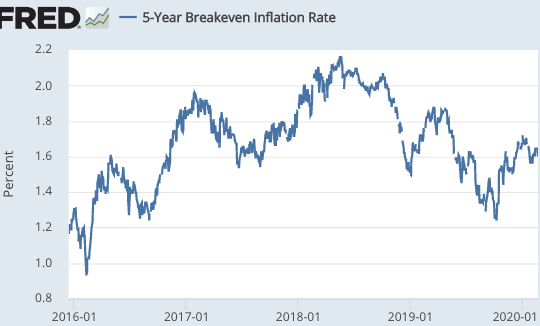
On the other hand, the Fed targets PCE inflation, which tends to run below CPI inflation. Because the TIPS tend to underestimate CPI inflation, but CPI inflation runs higher than PCE inflation, these two biases partially offset.
In my view, the TIPS spread is actually a pretty good predictor of future PCE inflation, although if anything I think it probably slightly underestimates future PCE inflation. In other words, the TIPS spread may underestimate CPI inflation by a bit more than the CPI overestimates PCE inflation.
If I had to guess, I’d say PCE inflation is likely to average about 1.7% over the next 5 years, even though the TIPS spread suggests only 1.6% for CPI inflation. The consensus of private sector forecasters is for 2.0% PCE inflation during 2020-24, but they’ve pretty consistently overestimated inflation for a decade. If you assume that the TIPS spread implies roughly 1.3% PCE inflation, then my prediction is roughly halfway between the market and the survey forecast.

Comments
Log in or sign up to join the conversation.